Potrzebie
Thursday, December 23, 2010
Wood Chips 24: Sunset on Mars
.
 Click "Wood Chips 24" heading at top to hear Ray Bradbury's "Mars Is Heaven" on X Minus One (1955). EC's adaptation was in Weird Science 18 (March-April, 1953). Following the Wood panels while listening offers a textbook example of specific differences in adapting a short story for radio and comics. Wood's research into period architecture is seen throughout amid lush vegetation, and he also drew what he knew; between 1937 and 1940, he lived in four different small towns in Wisconsin.
Drawing Green Lake, Wisconsin (a real place), he filled the interiors with such Victoriana as a roll-top desk and a shelf for displaying dishes. Surely Bradbury must have been delighted the first time he saw Wood's interpretation of his story. But note the curious window on page five which has four panes on the bottom sash and six on the top sash (which fills two-thirds of the window frame). This is similar to Wood's "There Will Come Soft Rains" error of the automobile preventing the automatic garage door from opening and closing.


H.B Vestal was the first illustrator of "Mars Is Heaven" in Planet Stories (Fall 1948).
 1890s Queen Anne style Victorian homes in Wisconsin. (Top two images are the same building from different angles.)


To read the entire Wally Wood "Spawn of Mars" story, go to Cloud 109. It was published in EC's Weird Fantasy 9 (September-October, 1951).
 To read the entire 3D "Spawn of Venus" story. go to Golden Age Comic Book Stories. It was created for an unpublished EC 3-D title (1954), but it was never published by EC.
In 1968, to get the original art for the Nostalgia Press EC reprint book, I went with Bill Gaines and Jerry DeFuccio to the real vault of horror, a midtown storage facility where Gaines kept the art for each of his comic books in large individual manila envelopes. I remember this as a large, dimly lit room with a concrete floor and locked storage rooms somewhat like small trailers. These had to be pulled out and unlocked. It was necessary to set up a work light on a stand inside the storage trailer so Jerry DeFuccio could locate each envelope. Gaines pulled a story from each envelope and handed the envelope back to Jerry. Then I stacked each story on a nearby table.
Earlier, when I told Wood I was going to Gaines' vault, he asked me to retrieve his 3-D sf story, "The Spawn of Venus", so he could use it in witzend. That was the first time Wood had seen the artwork in 15 years, and he then published it in witzend 6 (1969).

To see all of the "Spawn of Venus" pencil pages, go to stwallskull.

To read the entire Al Feldstein "Spawn of Venus", go to Entre Comics. It was originally in Weird Science 6 (March-April, 1951).


Drawing Green Lake, Wisconsin (a real place), he filled the interiors with such Victoriana as a roll-top desk and a shelf for displaying dishes. Surely Bradbury must have been delighted the first time he saw Wood's interpretation of his story. But note the curious window on page five which has four panes on the bottom sash and six on the top sash (which fills two-thirds of the window frame). This is similar to Wood's "There Will Come Soft Rains" error of the automobile preventing the automatic garage door from opening and closing.
©copyright 2010 by WMG estate and Ray Bradbury


H.B Vestal was the first illustrator of "Mars Is Heaven" in Planet Stories (Fall 1948).


To read the entire Wally Wood "Spawn of Mars" story, go to Cloud 109. It was published in EC's Weird Fantasy 9 (September-October, 1951).

In 1968, to get the original art for the Nostalgia Press EC reprint book, I went with Bill Gaines and Jerry DeFuccio to the real vault of horror, a midtown storage facility where Gaines kept the art for each of his comic books in large individual manila envelopes. I remember this as a large, dimly lit room with a concrete floor and locked storage rooms somewhat like small trailers. These had to be pulled out and unlocked. It was necessary to set up a work light on a stand inside the storage trailer so Jerry DeFuccio could locate each envelope. Gaines pulled a story from each envelope and handed the envelope back to Jerry. Then I stacked each story on a nearby table.
Earlier, when I told Wood I was going to Gaines' vault, he asked me to retrieve his 3-D sf story, "The Spawn of Venus", so he could use it in witzend. That was the first time Wood had seen the artwork in 15 years, and he then published it in witzend 6 (1969).
©copyright 2010 by WMG estate and Bill Pearson

To see all of the "Spawn of Venus" pencil pages, go to stwallskull.

To read the entire Al Feldstein "Spawn of Venus", go to Entre Comics. It was originally in Weird Science 6 (March-April, 1951).

Above images ©copyright 2010 by WMG estate.
Labels: bradbury, defuccio, feldstein, gaines, mars, pearson, stwallskull, witzend, wood chips
¶ 3:05 PM 2 comments
Friday, April 02, 2010
Galaxy Science Fiction wraparound


The first issue of H.L Gold's Galaxy Science Fiction was October 1950. During its first year, Galaxy offered Katherine MacLean's "Pictures Don't Lie" (revamped in EC Comics as "Chewed Out" by Al Feldstein and Joe Orlando), Ray Bradbury's "The Fireman" (published later as Fahrenheit 451), Damon Knight's "To Serve Man" (later a popular Twilight Zone episode), Fritz Leiber's much-anthologized "Coming Attraction" plus a serialization of Robert A. Heinlein's The Puppet Masters (filmed in 1994). The second year Galaxy presented Frederik Pohl and Cyril Kornbluth's "Gravy Planet" (later expanded as The Space Merchants) and serialized Alfred Bester's The Demolished Man.
So by October 1952, there was reason to celebrate, and Galaxy invited readers to meet its writers, artists and staff in a front cover wraparound illustration by Ed Emshwiller. It was quite a party, and inside was an map to identify the sf talents. Emsh placed Gold at the center of the party, and he added several humorous touches, including a hovercraft ashtray and a miniature of the first issue's cover on the back wall. W.I. van der Poel was the art director, Robert Guinn was the publisher, Willy Ley was the science editor, anthologist Groff Conklin was the book critic, Evelyn Paige (Gold's wife) was the assistant editor, Joan De Mario was the production manager and John Anderson was the advertising manager. Jerry Edelberg was a publicist who later did public relations for the 1964 World's Fair.
I've attempted a clean-up restoration from available materials. The best way to look at this is to use control-click to bring up the enlargement in a separate window that can be positioned alongside the identifications.
In "The World of 2052," Willy Ley wrote about time capsules. It's a good thing Steve Jobs didn't listen to Ley or there might have been no iPad:


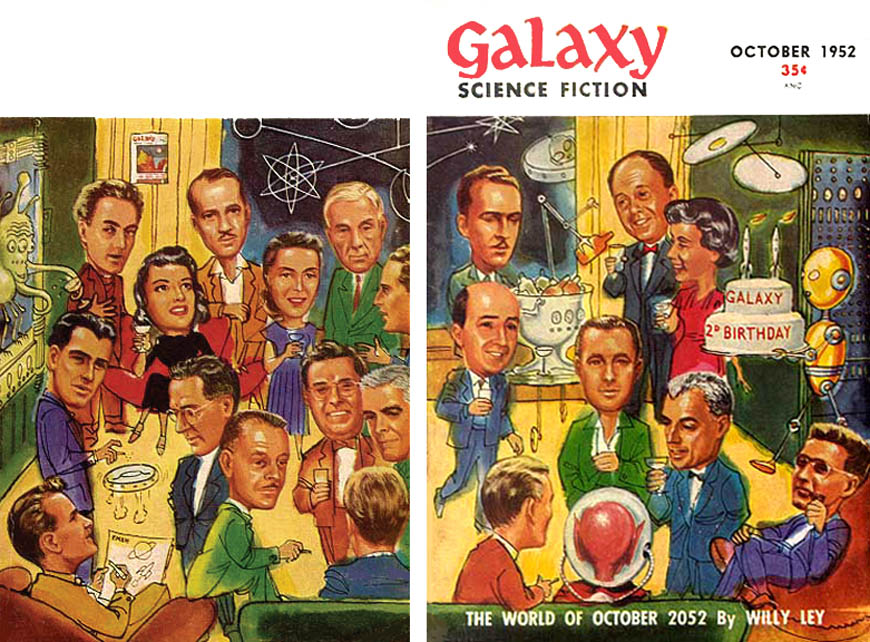
The first issue of H.L Gold's Galaxy Science Fiction was October 1950. During its first year, Galaxy offered Katherine MacLean's "Pictures Don't Lie" (revamped in EC Comics as "Chewed Out" by Al Feldstein and Joe Orlando), Ray Bradbury's "The Fireman" (published later as Fahrenheit 451), Damon Knight's "To Serve Man" (later a popular Twilight Zone episode), Fritz Leiber's much-anthologized "Coming Attraction" plus a serialization of Robert A. Heinlein's The Puppet Masters (filmed in 1994). The second year Galaxy presented Frederik Pohl and Cyril Kornbluth's "Gravy Planet" (later expanded as The Space Merchants) and serialized Alfred Bester's The Demolished Man.
So by October 1952, there was reason to celebrate, and Galaxy invited readers to meet its writers, artists and staff in a front cover wraparound illustration by Ed Emshwiller. It was quite a party, and inside was an map to identify the sf talents. Emsh placed Gold at the center of the party, and he added several humorous touches, including a hovercraft ashtray and a miniature of the first issue's cover on the back wall. W.I. van der Poel was the art director, Robert Guinn was the publisher, Willy Ley was the science editor, anthologist Groff Conklin was the book critic, Evelyn Paige (Gold's wife) was the assistant editor, Joan De Mario was the production manager and John Anderson was the advertising manager. Jerry Edelberg was a publicist who later did public relations for the 1964 World's Fair.
I've attempted a clean-up restoration from available materials. The best way to look at this is to use control-click to bring up the enlargement in a separate window that can be positioned alongside the identifications.
In "The World of 2052," Willy Ley wrote about time capsules. It's a good thing Steve Jobs didn't listen to Ley or there might have been no iPad:

The World of 2052
by Willy Ley
WABC has just written a letter to the future and I helped to write it—more precisely, I talked part of it. For it was (and is) half an hour a recording tape which, when finished, was broadcast and is now safely buried in a place where it will not deteriorate, to be taken out and rebroadcast a century from now.
Naturally, it is reminiscent of the Westinghouse Time Capsule which was buried on the World’s Fair Grounds a dozen years ago, to enlighten the inhabitants of this planet 5000 years from now about the doings of the year 1940. During the same year, a Time Vault was started in North Carolina, intended to preserve for posterity the books which we consider most important in our day.
This idea of writing letters to the future is not exactly new. For centuries, European master builders enclosed documents, contemporary coin of the realm and an occasional chronicle in the foundation stones of buildings, and American builders took over the tradition.
Trouble is that in those cases where the contents were recovered and examined, it turned out that the documents told things which we already knew from other sources, and that the coins were well known to numismatists and often not even rare, Still, one wishes that this habit had been established much earlier, say in Greek or at least Roman times.
But the only Roman example of such a Time Vault was not an intentional one. About half a century ago, the learned world was startled and excited by the announcement that a rich Roman’s private library had been found in Pompeii. It had been buried when Mt. Vesuvius let go in what is probably the most publicized and romanticized volcanic outbreak of all recorded history. The rolls of parchment were charred, of course. They had dried out in the interim and were so fragile that they could not be handled in any usual way. Still, methods of transporting them, unrolling them and finally reading them were worked out. And then it turned out that the original owner of that library had been a fanatic disciple of a small and completely unimportant philosophical school. After all that labor, it was a sad disappointment.
THE so-called Document Cave not far from the Dead Sea in Palestine, which was found recently, promises better results. At the very least, our knowledge of the history of the books of the Old Testament is going to be improved by that discovery; and that Document Cave might ever have been meant as a kind of Time Vault, for the documents seem to have been hidden there from contemporaries for the future, although the men who did it may have had only three or four generations in mind—not sixty or more, as it turned out to be.
IN a somewhat larger sense, every book written is a small time capsule. For while a book is primarily addressed to contemporaries, it is expected or hoped to last into the future. I can get first-hand information about the knowledge and beliefs of Gaius Plinius Secundus (Pliny the Elder) directly froth the shelves of my own library. It isn’t an original, but it is serviceable. Even originals last a long time, though. If I want to find out what the famous Municipal Physician of Zurich, Dr. Konrad Gesner, thought and knew about fossils in 1560, my library will serve, too. And this book was not preserved through the centuries in some Time Vault; it survived through the interest and care of generations of people.
The most interesting contents of any Time Capsule would be those portions in which its originators tell the future finders their guesses about the civilization, habits, etc., of the finders. But, again, it need not be a specific Time Capsule; it can be simply a book which has been preserved.
As has been pointed out in GALAXY by L. Sprague de Camp, we are just beginning to reap that kind of harvest from early examples of science fiction: If we are somewhat flabbergasted at the lack of vision of daring of those writers, and more than a little astounded by the nonsense which we were supposed to indulge in—not that we don’t indulge in different kinds of nonsense of our own designing—it should merely prove to us that we should be more daring in some respects and more careful in others.
Now let’s see if I can apply that advice myself.
As I told my audience of a hundred years hence, I think—lots of printed paper to the contrary notwithstanding—that cities will not be obsolete. Nor do I think that the wheeled vehicle will be obsolete, having been replaced by the helicopter, or by some other device yet to be invented. Nor do I believe that the day of the printed word has almost reached its end.
Having a little more space here in the magazine than I had time on the air, I would like to elaborate a bit on these statements. With and without reference to atomic bombs, we have been informed that “cities are abnormal.” Now, cities had originally the purpose of being trading centers. Later, they also became manufacturing centers. And you can’t say that those who settled in the cities did it because of necessity. Then, as now, the majority did it from choice.
It is obviously more convenient to be in the center of things than in the outskirts. And having lived in the country, I know from personal experience that it is not convenient. If you get there during a heat wave, it may look that way, and the little walk of 5500 feet for a newspaper or some smokes or even your mail, down a winding road, may be pleasant. But try it on a cold winter day, when the road is icy and has eight inches of loose snow on top. Try to take care of unexpected guests, unless your basement is a private grocery store. Try to enjoy (or even be attentive) in a movie if you know that the last bus home comes by just five minutes after the show; especially, if you also know that just the last bus is often early because the driver wants to go home, too.
In spite of what moralists and real estate agents tell us, the country home is convenient only if you also have a city home. And since people have the deplorable habit of looking after their own convenience, cities are neither abnormal nor obsolescent.
ANOTHER item I brought up in my broadcast was transportation. Will people ride in from sixty miles away in their own helicopters? Well, some may, of course, but that isn’t the proper answer.
The helicopter, once it gets to be easier to fly than the current production models, will have a great deal of advantages over the ground car. But it still needs parking space at the other end and the traffic problems of the modern city are not caused by the cars which, move, but by those which are parked.
The solution is obviously a type of transportation which does not park, but keeps moving. Just imagine how easy it would be to get around in New York if all the transportation available were public transportation—subways, elevateds, busses and taxicabs. The remedy for the future might not be up to the engineer only, but to the lawmakers as well.
This is not the place to go into the design of a city free of traffic problems. I just want to add that, while it has been proved that a large city can be supplied by air lift, it is neither a cheap nor a logical method of doing it.
Finally: I do think that the people a hundred years from now will still buy newspapers and read books. I also believe that these books and papers will be printed—presumably with a more lavish use of color than nowadays —on paper. I don’t believe in the “electronic device” which replaces the newspaper, nor in the newspaper printed photographically on a piece of plastic the size of a special delivery stamp. All you have to do is insert it in the projector and the letters will appear on the ceiling of your bedroom. You can read it while having breakfast in bed. Damned inconvenient is all I have to say.
I’ll go along with the tape recorder attached to the telephone which will take messages—”the deadline is really today, but since you were kept busy with two television shows and three conferences, it can be extended until Saturday”—while you are away. I go along with that because there you have an electrical device, your telephone, to begin with, and it can be adapted for playback.
But the printed word is superior to any recording device or projector in several respects, each important. You can read it in any position you happen to prefer at the moment. You need no special reconverting tool. No matter how simple, small, light and fool and tinkerproof that device is postulated to be, you can forget or mislay it. And, like anything else, it can run down or go out of order. Also, you can easily add a note or a reminder to the printed word. Furthermore, you can file a piece of newspaper. Of course you can file pieces of sound tape, too, or plastic micro-slides, but then you need your reconverting device to find out what’s on it.
Nor do I think that books will be printed on anything which we would not call paper, even though it may technically be something else. In quite a number of stories, the spaceship pilot looks up the characteristics of a planet in an almanac “printed on indestructible metal foil” and this practice, for all one can tell, was not restricted to the spaceman’s almanac in those stories.
Let’s see now. My own Rockets, Missiles and Space Travel has very nearly reached the bulk where it becomes a little hard to handle. I just measured and weighed it. The dimensions are 8 1/2 x 6 x 1 1/2 inches and its paper is about as thin as it can be and still be decent, In any event, I don’t think that metal foil could be any thinner than that paper and still take inscriptions of some kind on both sides. Hence the dimensions would be the same as those of the paper book.
But while the paper book, with binding, weighs two lbs., the metal book, if aluminum, would weigh nine pounds!
I’m all in favor of a non-yellowing, non-cracking permanent paper for books. But no metal foil, please, unless you can come up with a useful lithium alloy of a specific gravity of 0.5 or less.
Well, there you have a discourse on things that won’t happen. Go back to the stories now and see what might.
-- Willy Ley
Labels: bradbury, emshwiller, galaxy, gravy planet, h.l. gold, ident maps
¶ 6:28 AM 0 comments
Tuesday, March 31, 2009
Mars Is Heaven
Control click heading to hear the X Minus One adaptation of Ray Bradbury's Mars Is Heaven (May 8, 1955).


©WMG and Ray Bradbury

©WMG


Labels: BBC, bradbury, google, heaven, mars, martians, nasa, wood
¶ 2:27 PM 2 comments
Wednesday, March 25, 2009
There Will Come Soft Rains


Listen to the 1956 X Minus One adaptation of "There Will Come Soft Rains''.
Peter Cotter's animated adaptation...
Russian 1984 animated adaptation...
There will fall soft rains
Sara Teasdale's poem...
There will come soft rains and the smell of the ground,
And swallows circling with their shimmering sound;
And frogs in the pool singing at night,
And wild plum trees in tremulous white;
Robins will wear their feathery fire,
Whistling their whims on a low fence-wire;
And not one will know of the war, not one
Will care at last when it is done.
Not one would mind, neither bird nor tree,
If mankind perished utterly;
And Spring herself when she woke at dawn
Would scarcely know that we were gone.
--Sara Teasdale (1920)

Click heading above to hear the start of the 1977 BBC adaptation of "There Will Come Soft Rains''.
http://www.unz.org/Pub/Colliers-1950may06-00034?View=PDF&apages=0030
©WMG and Ray Bradbury
Wally Wood drew EC's adaptation of Ray Bradbury's "There Will Come Soft Rains" for Weird Fantasy 17 (January-February 1953). Note Wood's error on page two, panel four: The garage door cannot open or close with the "waiting car" parked midway into the doorframe. (The caption is the same as Bradbury's original paragraph.) In panel five, "After a long wait, the door swung down again"... which would smash the hood of the car. To read Ray Bradbury's original story (first published in the May 6, 1950 issue of Collier's), go here. In the Collier's original, the story takes place on April 28, 1985. Later, the date was changed.
Listen to the 1956 X Minus One adaptation of "There Will Come Soft Rains''.
Peter Cotter's animated adaptation...
Russian 1984 animated adaptation...
There will fall soft rains
Sara Teasdale's poem...
There will come soft rains and the smell of the ground,
And swallows circling with their shimmering sound;
And frogs in the pool singing at night,
And wild plum trees in tremulous white;
Robins will wear their feathery fire,
Whistling their whims on a low fence-wire;
And not one will know of the war, not one
Will care at last when it is done.
Not one would mind, neither bird nor tree,
If mankind perished utterly;
And Spring herself when she woke at dawn
Would scarcely know that we were gone.
--Sara Teasdale (1920)

Labels: BBC, bradbury, cotter, ec, soft rains, teasdale, ussr, wood, x minus one
¶ 9:13 AM 6 comments
Monday, August 25, 2008
The Small House Halfway Up In the Next Block
 Paul Rhymer's Vic And Sade was broadcast on NBC from 1932 to 1944. It was an influence on Kurt Vonnegut, who called it "the Muzak of my life".
The town where Vic and Sade lived was based on Bloomington, Illinois, where Rhymer grew up. Click to enlarge this beautifully rendered aerial terrain map.
 Paul Rhymer's Vic And Sade was broadcast on NBC from 1932 to 1944. It was an influence on Kurt Vonnegut, who called it "the Muzak of my life".
The town where Vic and Sade lived was based on Bloomington, Illinois, where Rhymer grew up. Click to enlarge this beautifully rendered aerial terrain map.
Control click heading above to hear episode from November 19, 1940 which involves Yamilton's Department Store seen at far right middle in the aerial view. Go to the Internet Archive for many more episodes.

At left on wagon is Mr. Gumpox, mentioned by Ray Bradbury in his introduction to The Small House Half-Way Up In the Next Block: Paul Rhymer's Vic and Sade (McGraw-Hill, 1972), in which Bradbury reflected on the mood of middle-class midwest America with its Sunday papers, tire swings and dime stores:

Hugh Chenoweth illustrated Paul Rhymer's 1939 Ruth and Roxy comic strip. Chenoweth, who did the Polly Pippin comic strip in the early 1940s, died in 1946 at the age of 42. The Vic and Sade comic strip ad above was drawn by Creig Flessel and John Streibel.
©Ray Bradbury
If this introduction were done out of mere Nostalgia, forget it. I would like to believe I am writing it for better reasons than that; solid and incontrovertible reasons having to do with human beings, a certain time and place, and that elusive thing called Creativity.
Paul Rhymer, like his mysterious Mr. Gumpox and his horse, passed through the alleys of our lives a long time ago. Because he worked in a field that was mostly garbage we figured that he, like Mr. Gumpox, must be a garbageman. Often, no one bothered to look in his wagon to see what it was he was gathering from the backyards of our time and living in that strange year 1932 and on up into the Forties.
In truth, Paul Rhymer was a junk collector, which is a far step up from garbage. He collected bits and pieces of mediocrity from all our commonplace occupations, all our inane conversations, all our bored afternoons and long evenings when all we could think of to do was trot down to the YMCA to watch the Fat Men Play Handball.
In my time and my town, Waukegan, Illinois, not so very far away from where Paul Rhymer was born, it was going down to the train station to watch the newer and yet newer trains roar through without stopping. Or that miraculous day when the dirigibles Akron or Macon actually flew over our lake, signifying a future we could hardly comprehend.
I was born in that little house half-way up in the next block. I am Rush Gook. My Mom and Dad were first relatives to Vic and Sade. I called my father Gov'. Which is neither here nor there, for I am writing this Introduction not because of saccharine sentiment but because of positive identification. Paul Rhymer got us dead-on in his sights but, good man that he was, didn't shoot us dead. Instead, he celebrated our incredible simplicities, our dull, long days that were made bearable through love. The things that my Mom and Dad and brother Skip threw away, he saved. String, old clocks fixed to the point of ruin, tire-swings out of trees. But, most of all, conversations more brilliant in their pointlessness, circling around nothing, than anything written since by Pinter or Beckett.
In all this, of course, Paul Rhymer and his ouija-board were helped out by his wondrous alter-ego Uncle Fletcher. We all had an Uncle Fletcher or someone like him hidden away in the woodwork of our childhood, an aunt or grandpa, who spoke riddles and wisdom or sublime nonsense, sometimes all in one breath. And perhaps we love Uncle Fletcher above all the other live and kicking creatures in Vic and Sade, because he glided through life, only half-hearing, half-seeing what went on around him. Amazing man, one felt he could have gone through the San Francisco earthquake and emerged with a tale of someone in East Cairo, Ill., aged 97, married a woman 101, adopted a son aged 75, later died. How can you resist a man like that? Each of us envied his half-deafness, his ability to shape Reality to his dream. We all felt that when death finally tapped Uncle Fletcher, mortality would be confounded and put off, too.
If I'm not careful, this Introduction will run three times longer than it should be. For suddenly, in writing it, my favorite moments come back as clear as bells ringing across a valley on a bright spring morn. I have known Bill Idelson, who enacted the role of Rush Gook, as a good warm friend for some ten years now. I never cease to love hearing him talk, for while our ages are close, his voice is still the bright young voice of Rush.
One night not so long ago, Rush, or Bill as I call him, said that one of his favorite old Vic and Sade shows was one where Rush and Vic sang some crazy song about flowers. I stunned Bill by immediately reciting: "Would that these pale hands chrysanthemums might gather,/Would that o'er green fields these tender feet might glide." Which are, of course, the first lines from that sappy song sung more than thirty years ago by father and son on the radio show.
Now, before you accuse me of falling into the very sentiment and nostalgia I warned myself against at the start of this essay, let me make some strong points.
Middle-class America, as it existed in the 1930s was dramatized lovingly and forever by Paul Rhymer.
The reason for this book is twofold, as must be the reason for this Introduction. To say that middle-class America once was. But to say, just as strongly, middle-class America, with all its virtues, still is.
We have gone through a rough time of wars and depressions and technologies, but the world of Vic and Sade has not vanished from the world. It has changed somewhat, yes, because of the impact of television, films, radio, the computer and the jet-stream plane. But a helluva lot of America still lives in small towns, and even those who have moved into the city have brought with them, genetically or otherwise, the temperament of Vic and Sade.
The little people are still little and still making-do day by day in small ways anywhere and everywhere. You might not see them taking that fast four-hour-jet from L.A. to New York, but drive across the country, stop at any crossroads, idle through any town on a hot summer day, and there they are, in the breezeways, listening to baseball games, that lazy man's sport that takes forever to wind up and pitch, swatting away the flies, talking to the dogs, drinking the venerable Nehis or Orange Crushes, calling to one another across the eternal noons. Mr. Gumpox may be driving a truck these days, instead of philosophizing with his horse, but here he comes. The Thimble Club is still meeting. The Fat Men are still down at the Y swatting those handballs for the benefit of eight-year-old boys. The dime store is still a magical place for ten-year-olds to wander with free time. Alleys are still great places to find all the stuff that dumb older people are stupid enough to throw away; my own children teach me this.
In fact, of course, you don't have to go to small towns to rediscover Vic and Sade's world. It's all over Los Angeles or San Francisco or even dire and dread New York.
You want me to prove it? Easy as pie.
Think of the last weekend you spent with your family and the one before that and the one before that.
Let me describe my own, here in Los Angeles in the late spring of 1972. Big city stuff? Not on your nutmeg-scraper:
Sunday morning. Everyone slept late. Got up. Went out and brought in the Sunday papers. Read the comics first.


Just as we did in 1924 and 1929 and 1934 and 1940!
Laid around the house; just as we did in 1926 and 1933 and 1941.
Some of the kids went bicycling. Just as we did in 1922 and 1938 and 1947.
Talked to the neighbors over the back fence, just as we did in 1930 and...
Went to the beach for a swim, just as we used to do in 1934...
Came home and read some more of the big Sunday paper. Remember 1936?
Fried some hamburgers and hot dogs, 1923.
Ate them. 1924.
Took a nap. 1925.
Went to a movie. 1926.
Came home and listened to radio. 1927. Played some records. 1928. Went over to actually sit in neighbors' living room to talk and have one, just one, beer. 1929.
I think I have ground the point into the dust.
Everything has changed but nothing has changed.
Our lives are full of Big Things. But more full of small ones. Our lives peak only on occasion. The rest of the time we are buttoning and unbuttoning and buttoning again, as my artist friend Streeter Blair once said.
It is all the little things, the so-called junky things, that Paul Rhymer has an eye and an ear for. He traps them, keeps them like ants in a jar, and lets them out in the light later, glorified by his ability to pick just the right ants from the universal picnic. God A'Mercy, we all cry, never saw such ants before. But we have. We did see them. We were there. The picnic was ours. And it still is.
All of which adds up to this. There is no cause for nostalgia save the good and life-enhancing nostalgia for the present. That can only be good. Glancing through this book, we can take a long and loving glance not at our Past, to hell with that, but at what goes on this very splendid moment at the heart of our families Here and Now. Paul Rhymer says, in the aggregate, finally, we are Good. Not always right, no, not always happy, no, but essentially Good. Which is a nice new-fashioned message to receive in a time when we have begun to doubt our senses, sanity and any possible sane future.
Well, I've been loitering out here in the alley behind the Small House. I must finish and go to eat in that kitchen where peanut butter and plain bread and fresh cold milk are the food of the gods.
Let me make my point a final time:
Vic and Sade and Rush and Uncle Fletcher are not dead, nor gone, nor buried.
They are here. They are us.
We celebrate ourselves, as Walt Whitman almost said.
Thus the title of this essay: Proust had the gift of recall for the Past. Paul Rhymer's talent was: Remembrance of Things Present.
We travel way around the world, most of us, simply to find and see Green Peach, Wisconsin, clear. We travel in Time to imitate the words of the old Al Jolson song, arrive Back In Your Own Backyard.
We can imagine that Rush Gook, grown up, did not necessarily stay on in that small town and join the kitchenware company like his Gov'. We can see him commute to the Big City. But now, late in time, an interesting thing is happening. We have noted, in a 40-year period, the pell-mell rush to Metropolis. Now we shall watch as the tide rolls back the other way. Rush Gook, finally, will retreat from jam-packed apartment high-rise Manhattan and water his roots again in Orchard Grove. He will have two children. Their names: Vic and Sade. They will grow up in that small town way out beyond the city, to which, of course, they will occasionally make visit in 1999.
But on Sunday mornings they will sleep late. They will get sick on sour cherries picked too soon and too low from the ripening tree. They will jump hopscotch. Baseball radio will laze the peachfuzz in their corporate ears. And once a month or twice a week they may just actually walk-instead-of-ride down to the Butler House Hotel and sit in the view bay window and give grandiose, pontifical orders for simple foods.
And the world will not End after all.
So say I.
So say the inhabitants of that Small House Half-Way Up in the Next Block.
Believe us.
Turn the page.
Live in the Present.
Ray Bradbury
Six blocks away from Palms, California.
May 20th, 1972

Hugh Chenoweth illustrated Paul Rhymer's 1939 Ruth and Roxy comic strip. Chenoweth, who did the Polly Pippin comic strip in the early 1940s, died in 1946 at the age of 42. The Vic and Sade comic strip ad above was drawn by Creig Flessel and John Streibel.
Labels: bradbury, chenoweth, illinois, nbc, radio, rhymer, vic and sade
¶ 11:43 AM 3 comments