Potrzebie
Wednesday, July 27, 2011
Wood Chips 36: Galaxy Science Fiction
.
Two of Wood's Galaxy Science Fiction illustrations. Leonard Rubin's "Don't Look Now" (October 1958) and (bottom) Robert Sheckley's "Time Killer" (April 1960).


Two of Wood's Galaxy Science Fiction illustrations. Leonard Rubin's "Don't Look Now" (October 1958) and (bottom) Robert Sheckley's "Time Killer" (April 1960).

Labels: galaxy, sheckley, wood chips
¶ 9:24 AM 2 comments
Sunday, December 26, 2010
Through the 1950s, Ed Emshwiller did annual Christmas covers for Galaxy, all featuring his four-armed Santa character. Note the 1956 issue with coffee pot spaceship design. In the background of the 1957 cover, Carol Emshwiller holds daughter Eve Emshwiller.


Labels: emshwiller, galaxy
¶ 11:47 AM 2 comments
Friday, July 16, 2010


When I worked at DC Comics during the 1990s I used to walk down a hall where the framed cover of that comic book was displayed. I would stop and study the faces in the crowd scene. Some people, such as Flo Steinberg (#5), Archie Goodwin (#15), Vince Colletta (#113), Ralph Reese (#137) and Larry Hama (#138), I had met before I began at DC. Others, such as colorist Bob LeRose (#77), Julie Schwartz (#81), production head Bob Rozakis (#121) and Trevor Von Eeden (#139), I met while working at DC. One day I turned over my stapler and was surprised to see a typewritten name taped to the underside. The stapler had once belonged to DC editor Murray Boltinoff (#119).
The code with numbers was a fascinating device, and it gave me the idea of doing something similar when I edited the DC/Skybox Cosmic Teams trading cards (1993). To identify the individual characters in the various teams, I designed the card backs to show outline drawings with a match-up of identifying names and numbers. Further, these cards employed a triptych effect in which three cards could be butted together to frame one image. Of all the triptych cards, the best was the Justice Society of America. With remarkable atmospheric perspective, Joe Kubert drew the Justice Society winning World War II with what appears to be the entire Allied invasion of Normandy in the background.
The Potrzebie restoration of the Galaxy Science Fiction wraparound cover with the outline names/numbers map brought some favorable reactions, so I thought I would try this again. This time the problem is not only the huge size necessary to see all the names, numbers and faces but how to see faces/names/numbers simultaneously. It's awkward. One solution would be to open multiple windows. Another would be to print out the sheet with the names and numbers. At any rate, keep clicking. A series of three clicks will eventually expand these images so they are very large and legible.

.jpg)
.jpg)

Labels: cosmic teams, dc comics, galaxy, ident maps, kubert, larry hama, neal adams, ralph reese, skybox
¶ 3:08 PM 1 comments
Friday, April 02, 2010
Galaxy Science Fiction wraparound


The first issue of H.L Gold's Galaxy Science Fiction was October 1950. During its first year, Galaxy offered Katherine MacLean's "Pictures Don't Lie" (revamped in EC Comics as "Chewed Out" by Al Feldstein and Joe Orlando), Ray Bradbury's "The Fireman" (published later as Fahrenheit 451), Damon Knight's "To Serve Man" (later a popular Twilight Zone episode), Fritz Leiber's much-anthologized "Coming Attraction" plus a serialization of Robert A. Heinlein's The Puppet Masters (filmed in 1994). The second year Galaxy presented Frederik Pohl and Cyril Kornbluth's "Gravy Planet" (later expanded as The Space Merchants) and serialized Alfred Bester's The Demolished Man.
So by October 1952, there was reason to celebrate, and Galaxy invited readers to meet its writers, artists and staff in a front cover wraparound illustration by Ed Emshwiller. It was quite a party, and inside was an map to identify the sf talents. Emsh placed Gold at the center of the party, and he added several humorous touches, including a hovercraft ashtray and a miniature of the first issue's cover on the back wall. W.I. van der Poel was the art director, Robert Guinn was the publisher, Willy Ley was the science editor, anthologist Groff Conklin was the book critic, Evelyn Paige (Gold's wife) was the assistant editor, Joan De Mario was the production manager and John Anderson was the advertising manager. Jerry Edelberg was a publicist who later did public relations for the 1964 World's Fair.
I've attempted a clean-up restoration from available materials. The best way to look at this is to use control-click to bring up the enlargement in a separate window that can be positioned alongside the identifications.
In "The World of 2052," Willy Ley wrote about time capsules. It's a good thing Steve Jobs didn't listen to Ley or there might have been no iPad:


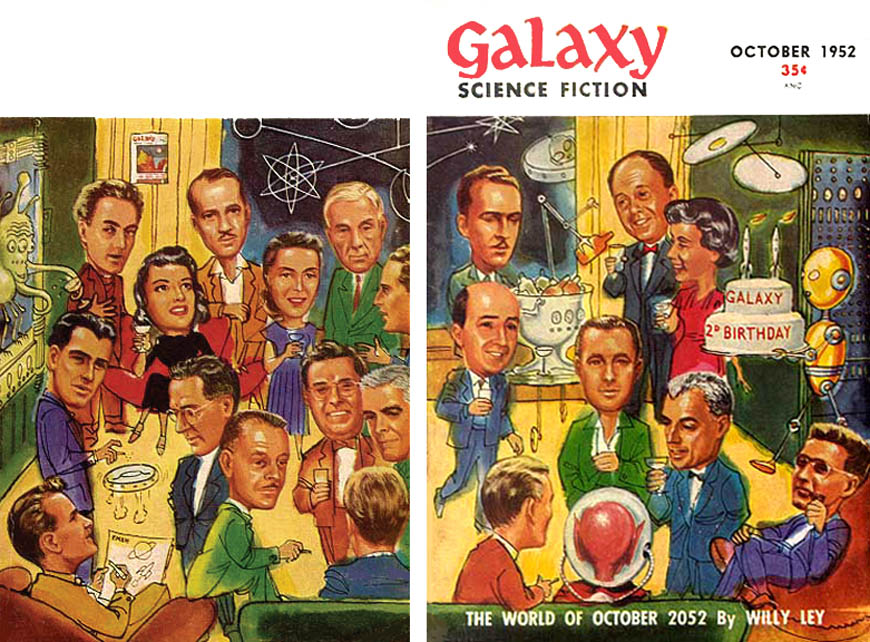
The first issue of H.L Gold's Galaxy Science Fiction was October 1950. During its first year, Galaxy offered Katherine MacLean's "Pictures Don't Lie" (revamped in EC Comics as "Chewed Out" by Al Feldstein and Joe Orlando), Ray Bradbury's "The Fireman" (published later as Fahrenheit 451), Damon Knight's "To Serve Man" (later a popular Twilight Zone episode), Fritz Leiber's much-anthologized "Coming Attraction" plus a serialization of Robert A. Heinlein's The Puppet Masters (filmed in 1994). The second year Galaxy presented Frederik Pohl and Cyril Kornbluth's "Gravy Planet" (later expanded as The Space Merchants) and serialized Alfred Bester's The Demolished Man.
So by October 1952, there was reason to celebrate, and Galaxy invited readers to meet its writers, artists and staff in a front cover wraparound illustration by Ed Emshwiller. It was quite a party, and inside was an map to identify the sf talents. Emsh placed Gold at the center of the party, and he added several humorous touches, including a hovercraft ashtray and a miniature of the first issue's cover on the back wall. W.I. van der Poel was the art director, Robert Guinn was the publisher, Willy Ley was the science editor, anthologist Groff Conklin was the book critic, Evelyn Paige (Gold's wife) was the assistant editor, Joan De Mario was the production manager and John Anderson was the advertising manager. Jerry Edelberg was a publicist who later did public relations for the 1964 World's Fair.
I've attempted a clean-up restoration from available materials. The best way to look at this is to use control-click to bring up the enlargement in a separate window that can be positioned alongside the identifications.
In "The World of 2052," Willy Ley wrote about time capsules. It's a good thing Steve Jobs didn't listen to Ley or there might have been no iPad:

The World of 2052
by Willy Ley
WABC has just written a letter to the future and I helped to write it—more precisely, I talked part of it. For it was (and is) half an hour a recording tape which, when finished, was broadcast and is now safely buried in a place where it will not deteriorate, to be taken out and rebroadcast a century from now.
Naturally, it is reminiscent of the Westinghouse Time Capsule which was buried on the World’s Fair Grounds a dozen years ago, to enlighten the inhabitants of this planet 5000 years from now about the doings of the year 1940. During the same year, a Time Vault was started in North Carolina, intended to preserve for posterity the books which we consider most important in our day.
This idea of writing letters to the future is not exactly new. For centuries, European master builders enclosed documents, contemporary coin of the realm and an occasional chronicle in the foundation stones of buildings, and American builders took over the tradition.
Trouble is that in those cases where the contents were recovered and examined, it turned out that the documents told things which we already knew from other sources, and that the coins were well known to numismatists and often not even rare, Still, one wishes that this habit had been established much earlier, say in Greek or at least Roman times.
But the only Roman example of such a Time Vault was not an intentional one. About half a century ago, the learned world was startled and excited by the announcement that a rich Roman’s private library had been found in Pompeii. It had been buried when Mt. Vesuvius let go in what is probably the most publicized and romanticized volcanic outbreak of all recorded history. The rolls of parchment were charred, of course. They had dried out in the interim and were so fragile that they could not be handled in any usual way. Still, methods of transporting them, unrolling them and finally reading them were worked out. And then it turned out that the original owner of that library had been a fanatic disciple of a small and completely unimportant philosophical school. After all that labor, it was a sad disappointment.
THE so-called Document Cave not far from the Dead Sea in Palestine, which was found recently, promises better results. At the very least, our knowledge of the history of the books of the Old Testament is going to be improved by that discovery; and that Document Cave might ever have been meant as a kind of Time Vault, for the documents seem to have been hidden there from contemporaries for the future, although the men who did it may have had only three or four generations in mind—not sixty or more, as it turned out to be.
IN a somewhat larger sense, every book written is a small time capsule. For while a book is primarily addressed to contemporaries, it is expected or hoped to last into the future. I can get first-hand information about the knowledge and beliefs of Gaius Plinius Secundus (Pliny the Elder) directly froth the shelves of my own library. It isn’t an original, but it is serviceable. Even originals last a long time, though. If I want to find out what the famous Municipal Physician of Zurich, Dr. Konrad Gesner, thought and knew about fossils in 1560, my library will serve, too. And this book was not preserved through the centuries in some Time Vault; it survived through the interest and care of generations of people.
The most interesting contents of any Time Capsule would be those portions in which its originators tell the future finders their guesses about the civilization, habits, etc., of the finders. But, again, it need not be a specific Time Capsule; it can be simply a book which has been preserved.
As has been pointed out in GALAXY by L. Sprague de Camp, we are just beginning to reap that kind of harvest from early examples of science fiction: If we are somewhat flabbergasted at the lack of vision of daring of those writers, and more than a little astounded by the nonsense which we were supposed to indulge in—not that we don’t indulge in different kinds of nonsense of our own designing—it should merely prove to us that we should be more daring in some respects and more careful in others.
Now let’s see if I can apply that advice myself.
As I told my audience of a hundred years hence, I think—lots of printed paper to the contrary notwithstanding—that cities will not be obsolete. Nor do I think that the wheeled vehicle will be obsolete, having been replaced by the helicopter, or by some other device yet to be invented. Nor do I believe that the day of the printed word has almost reached its end.
Having a little more space here in the magazine than I had time on the air, I would like to elaborate a bit on these statements. With and without reference to atomic bombs, we have been informed that “cities are abnormal.” Now, cities had originally the purpose of being trading centers. Later, they also became manufacturing centers. And you can’t say that those who settled in the cities did it because of necessity. Then, as now, the majority did it from choice.
It is obviously more convenient to be in the center of things than in the outskirts. And having lived in the country, I know from personal experience that it is not convenient. If you get there during a heat wave, it may look that way, and the little walk of 5500 feet for a newspaper or some smokes or even your mail, down a winding road, may be pleasant. But try it on a cold winter day, when the road is icy and has eight inches of loose snow on top. Try to take care of unexpected guests, unless your basement is a private grocery store. Try to enjoy (or even be attentive) in a movie if you know that the last bus home comes by just five minutes after the show; especially, if you also know that just the last bus is often early because the driver wants to go home, too.
In spite of what moralists and real estate agents tell us, the country home is convenient only if you also have a city home. And since people have the deplorable habit of looking after their own convenience, cities are neither abnormal nor obsolescent.
ANOTHER item I brought up in my broadcast was transportation. Will people ride in from sixty miles away in their own helicopters? Well, some may, of course, but that isn’t the proper answer.
The helicopter, once it gets to be easier to fly than the current production models, will have a great deal of advantages over the ground car. But it still needs parking space at the other end and the traffic problems of the modern city are not caused by the cars which, move, but by those which are parked.
The solution is obviously a type of transportation which does not park, but keeps moving. Just imagine how easy it would be to get around in New York if all the transportation available were public transportation—subways, elevateds, busses and taxicabs. The remedy for the future might not be up to the engineer only, but to the lawmakers as well.
This is not the place to go into the design of a city free of traffic problems. I just want to add that, while it has been proved that a large city can be supplied by air lift, it is neither a cheap nor a logical method of doing it.
Finally: I do think that the people a hundred years from now will still buy newspapers and read books. I also believe that these books and papers will be printed—presumably with a more lavish use of color than nowadays —on paper. I don’t believe in the “electronic device” which replaces the newspaper, nor in the newspaper printed photographically on a piece of plastic the size of a special delivery stamp. All you have to do is insert it in the projector and the letters will appear on the ceiling of your bedroom. You can read it while having breakfast in bed. Damned inconvenient is all I have to say.
I’ll go along with the tape recorder attached to the telephone which will take messages—”the deadline is really today, but since you were kept busy with two television shows and three conferences, it can be extended until Saturday”—while you are away. I go along with that because there you have an electrical device, your telephone, to begin with, and it can be adapted for playback.
But the printed word is superior to any recording device or projector in several respects, each important. You can read it in any position you happen to prefer at the moment. You need no special reconverting tool. No matter how simple, small, light and fool and tinkerproof that device is postulated to be, you can forget or mislay it. And, like anything else, it can run down or go out of order. Also, you can easily add a note or a reminder to the printed word. Furthermore, you can file a piece of newspaper. Of course you can file pieces of sound tape, too, or plastic micro-slides, but then you need your reconverting device to find out what’s on it.
Nor do I think that books will be printed on anything which we would not call paper, even though it may technically be something else. In quite a number of stories, the spaceship pilot looks up the characteristics of a planet in an almanac “printed on indestructible metal foil” and this practice, for all one can tell, was not restricted to the spaceman’s almanac in those stories.
Let’s see now. My own Rockets, Missiles and Space Travel has very nearly reached the bulk where it becomes a little hard to handle. I just measured and weighed it. The dimensions are 8 1/2 x 6 x 1 1/2 inches and its paper is about as thin as it can be and still be decent, In any event, I don’t think that metal foil could be any thinner than that paper and still take inscriptions of some kind on both sides. Hence the dimensions would be the same as those of the paper book.
But while the paper book, with binding, weighs two lbs., the metal book, if aluminum, would weigh nine pounds!
I’m all in favor of a non-yellowing, non-cracking permanent paper for books. But no metal foil, please, unless you can come up with a useful lithium alloy of a specific gravity of 0.5 or less.
Well, there you have a discourse on things that won’t happen. Go back to the stories now and see what might.
-- Willy Ley
Labels: bradbury, emshwiller, galaxy, gravy planet, h.l. gold, ident maps
¶ 6:28 AM 0 comments
Tuesday, July 07, 2009
Eric Frank Russell and Hubert Rogers
.
In the spring of 1950, I discovered Astounding Science Fiction, and during that summer I also began reading The Magazine of Fantasy and Science Fiction. The first issue of Galaxy Science Fiction appeared on the newsstand just as I began the eighth grade. Keeping up with these magazines, plus Other Worlds and Imagination, took up a good deal of my time in the jr. high study hall. Near the end of that school year, I was sitting in a car parked at the high school football field, holding the June 1951 issue of Astounding, completely absorbed in Eric Frank Russell's ...And Then There Were None, while occasionally glancing at the Hubert Rogers cover illustration. Russell later expanded the novella into his novel The Great Explosion (1962).

Chapter 1
 The midway airlock opened, the gangway went down. As before, exit was made in strict order of precedence starting with the Ambassador and finishing with Sergeant Major Bidworthy. Grouping near the bottom of the gangway they spent the first few moments absorbing sunshine and fresh air.
His Excellency scuffled the thick turf under his feet, plucked a blade of it grunting as he stooped. He was so constructed that the effort came close to an athletic feat and gave him a crick in the belly.
"Earth-type grass. See that, Captain? Is it just a coincidence or did they bring seed with them?"
"Could be either. Several grassy worlds are known. And almost all colonists went away loaded with seeds."
"It's another touch of home, anyway. I think I'm going to like this place." The Ambassador gazed into the distance, doing it with pride of ownership. "Looks like there's someone working over there. He's using a little motor-cultivator with a pair of fat wheels. They can't be very backward, it seems.
In the spring of 1950, I discovered Astounding Science Fiction, and during that summer I also began reading The Magazine of Fantasy and Science Fiction. The first issue of Galaxy Science Fiction appeared on the newsstand just as I began the eighth grade. Keeping up with these magazines, plus Other Worlds and Imagination, took up a good deal of my time in the jr. high study hall. Near the end of that school year, I was sitting in a car parked at the high school football field, holding the June 1951 issue of Astounding, completely absorbed in Eric Frank Russell's ...And Then There Were None, while occasionally glancing at the Hubert Rogers cover illustration. Russell later expanded the novella into his novel The Great Explosion (1962).

...And Then There Were None
by Eric Frank Russell
The ambassador went silent as the ship closed in and the planet's day-side face rapidly expanded. Then followed the usual circling and photographing. A lot of villages and small towns were to be seen, also cultivated areas of large extent. It was obvious that this planet -- while by no means fully exploited -- was in the hands of colonists who were energetic and numerically strong.
Relieved that life was full, abundant and apparently free from alien disease, Grayder brought the ship down onto the first hard-standing he saw. Its enormous mass landed feather-like on a long, low hump amid well-tended fields. Again all the ports became filled with faces as everyone had a look at the new world.
Relieved that life was full, abundant and apparently free from alien disease, Grayder brought the ship down onto the first hard-standing he saw. Its enormous mass landed feather-like on a long, low hump amid well-tended fields. Again all the ports became filled with faces as everyone had a look at the new world.
 The midway airlock opened, the gangway went down. As before, exit was made in strict order of precedence starting with the Ambassador and finishing with Sergeant Major Bidworthy. Grouping near the bottom of the gangway they spent the first few moments absorbing sunshine and fresh air.
His Excellency scuffled the thick turf under his feet, plucked a blade of it grunting as he stooped. He was so constructed that the effort came close to an athletic feat and gave him a crick in the belly.
"Earth-type grass. See that, Captain? Is it just a coincidence or did they bring seed with them?"
"Could be either. Several grassy worlds are known. And almost all colonists went away loaded with seeds."
"It's another touch of home, anyway. I think I'm going to like this place." The Ambassador gazed into the distance, doing it with pride of ownership. "Looks like there's someone working over there. He's using a little motor-cultivator with a pair of fat wheels. They can't be very backward, it seems.
Eric Frank Russell
 "H'm-m-m !" He rubbed a couple of chins. "Bring him here. We'll have a talk and find out where it's best to make a start."
"Very well." Captain Grayder turned to Colonel Shelton. "His Excellency wishes to speak to that farmer." He pointed to the faraway figure.
"That farmer," said Shelton to Major Hame. "His Excellency wants him at once."
"Bring that farmer here," Hame ordered Lieutenant Deacon. "Quickly."
"Go get that farmer," Deacon told Sergeant Major Bidworthy. "And hurry -- His Excellency is waiting."
Bidworthy sought around for a lesser rank, remembered that they were all inside, cleaning ship and not smoking, by his order. He, it seemed, was elected.
Tramping across four fields and coming within hailing distance of his objective, he performed a precise military halt, released a barracks square bellow of, "Hi, you!" and waved urgently.
.jpg)
The farmer stopped his steady trudging behind the tiny cultivator, wiped his forehead, glanced casually around. His indifferent manner suggested that the mountainous bulk of the ship was a mirage such as are five a penny around these parts. Bidworthy waved again, making it an authoritative summons. Now suddenly aware of the sergeant major's existence, the farmer calmly waved back, resumed his work.
Bidworthy employed a brief but pungent expletive which -- when its flames had died out -- meant, "Dear me!" and marched fifty paces nearer. He could now see that the other was bushy-browed, leather-faced, tall and lean.
"Hi!" he bawled.
Stopping the cultivator again, the farmer leaned on one of of its shafts and idly picked his teeth.
Smitten by the ingenious thought that perhaps during the last few centuries the old Terran language had been abandoned in favour of some other lingo, Bidworthy approached to within normal talking distance and asked, "Can you understand me?"
"Can any person understand another?" inquired the farmer with clear diction.
Bidworthy found himself afflicted with a moment of confusion. Recovering, he informed hurriedly, "His Excellency the Earth Ambassador wishes to speak with you at once."
"Is that so?" The other eyed him speculatively, had another pick at his teeth. "And what makes him excellent?"
"He is a person of considerable importance," said Bidworthy, unable to decide whether the other was trying to be funny at this expense or alternatively was what is known as a character. A lot of these long-isolated pioneering types liked to think of themselves as characters.
"Of considerable importance," echoed the farmer, narrowing his eyes at the horizon. He appeared to be trying to grasp a completely alien concept. After a while, he inquired, "What will happen to your home world when this person dies?"

"Nothing," Bidworthy admitted.
"It will roll on as before?"
"Yes."
"Round and round the sun?"
"Of course."
"Then," declared the farmer flatly, "if his existence or nonexistence makes no difference he cannot be important." with that, his little engine went chuff-chuff and the cultivator rolled forward.
 "H'm-m-m !" He rubbed a couple of chins. "Bring him here. We'll have a talk and find out where it's best to make a start."
"Very well." Captain Grayder turned to Colonel Shelton. "His Excellency wishes to speak to that farmer." He pointed to the faraway figure.
"That farmer," said Shelton to Major Hame. "His Excellency wants him at once."
"Bring that farmer here," Hame ordered Lieutenant Deacon. "Quickly."
"Go get that farmer," Deacon told Sergeant Major Bidworthy. "And hurry -- His Excellency is waiting."
Bidworthy sought around for a lesser rank, remembered that they were all inside, cleaning ship and not smoking, by his order. He, it seemed, was elected.
Tramping across four fields and coming within hailing distance of his objective, he performed a precise military halt, released a barracks square bellow of, "Hi, you!" and waved urgently.
.jpg)
The farmer stopped his steady trudging behind the tiny cultivator, wiped his forehead, glanced casually around. His indifferent manner suggested that the mountainous bulk of the ship was a mirage such as are five a penny around these parts. Bidworthy waved again, making it an authoritative summons. Now suddenly aware of the sergeant major's existence, the farmer calmly waved back, resumed his work.
Bidworthy employed a brief but pungent expletive which -- when its flames had died out -- meant, "Dear me!" and marched fifty paces nearer. He could now see that the other was bushy-browed, leather-faced, tall and lean.
"Hi!" he bawled.
Stopping the cultivator again, the farmer leaned on one of of its shafts and idly picked his teeth.
Smitten by the ingenious thought that perhaps during the last few centuries the old Terran language had been abandoned in favour of some other lingo, Bidworthy approached to within normal talking distance and asked, "Can you understand me?"
"Can any person understand another?" inquired the farmer with clear diction.
Bidworthy found himself afflicted with a moment of confusion. Recovering, he informed hurriedly, "His Excellency the Earth Ambassador wishes to speak with you at once."
"Is that so?" The other eyed him speculatively, had another pick at his teeth. "And what makes him excellent?"
"He is a person of considerable importance," said Bidworthy, unable to decide whether the other was trying to be funny at this expense or alternatively was what is known as a character. A lot of these long-isolated pioneering types liked to think of themselves as characters.
"Of considerable importance," echoed the farmer, narrowing his eyes at the horizon. He appeared to be trying to grasp a completely alien concept. After a while, he inquired, "What will happen to your home world when this person dies?"

"Nothing," Bidworthy admitted.
"It will roll on as before?"
"Yes."
"Round and round the sun?"
"Of course."
"Then," declared the farmer flatly, "if his existence or nonexistence makes no difference he cannot be important." with that, his little engine went chuff-chuff and the cultivator rolled forward.
To continue reading, go here.
Labels: astounding science fiction, eric frank russell, galaxy, hubert rogers, myob, obs, the magazine of fantasy and science fiction
¶ 10:30 AM 3 comments
Friday, February 15, 2008
Emsh and Coye

 Luis Ortiz has been doing an important series of biographical art books, beginning with Arts Unknown: The Life & Art of Lee Brown Coye (Nonstop Press, 2005). With 350+ illustrations, this is the first full survey of the phantasmagraphical eccentric Coye (1907-1981), a muralist and watercolor artist who exhibited at both the Whitney and the Metropolitan Museum of Art in addition to his outré illustrations for Weird Tales. For models Coye brought into his studio skeletons, dead animals, live rats, and human body parts from a medical college.

Ortiz writes, "Coye was an art machine and an American Original. As a child he was considered a 'holy terror'. As an adult, after a hard day of doing medical illustrations, he thought nothing of walking into a bar carrying a decapitated human head under his arm, placing it on the counter and buying his guillotined 'friend' a drink. On another occasion he 'borrowed' the finger-bone of a saint (a holy relic he was building a reliquary for) from the Catholic Church in his hometown of Syracuse, New York. The Syracuse diocese was beside itself and had to send clergy to perform a blessing on Coye's studio since the relic could only travel to holy places."
 When Coye was young he was in upstate New York and found an oddity while wandering in the backwoods near an isolated, abandoned farmhouse. Surrounding the house were strange arrangements of crossed sticks. Coye never forgot this and later drew arrangements of sticks into his illustrations, suggesting something sinister. The horror writer Karl Edward Wagner used the incident as the basis for his award-winning short story, "Sticks", with twigs grouped in lattice-like patterns. Adapted by Tom Lopez into a memorable, chilling ZBS audio production, aired in 1984 on The Cabinet of Dr. Fritz, Wagner's story was an apparent source for The Blair Witch Project (1999). As a promotional device for that film, Manhattan's Angelika and other movie theaters put sticks into lobby display cases.
Nonstop followed the Coye collection with a biography of author Carol Emshwiller and illustrator-filmmaker Ed Emshwiller, along with previously unpublished art, in Emshwiller: Infinity X Two: The Art & Life of Ed and Carol Emshwiller (2007), also from Nonstop. These are the first two volumes in the publisher's Library of American Artists.
During the 1950s and 1960s, Ed Emshwiller was both an abstract gallery painter and a Hugo Award-winning illustrator for science fiction magazines and paperbacks (using the signature Emsh and sometimes Emsler). In the early 1960s he moved into filmmaking, serving as a cameraman on several features (Hallelujah the Hills, Time of the Heathen) and documentaries (The Streets of Greenwood) while also creating his own experimental films/video and pioneering the new tools of computer animation. CalArts is the school founded by Walt Disney, and in 1979, Emshwiller became dean of the School of Film/Video at CalArts where he founded the school’s Computer Animation Lab in 1983.
 I first became aware of Emshwiller in the early 1950s with his illustrations for Galaxy Science Fiction, notably his clever June 1952 cover depicting a futuristic energy crisis as described in Frederik Pohl and C.M. Kornbluth's The Space Merchants (then called Gravy Planet). In addition to more than 700 sf covers, he also did a great number of black-and-white interior illustrations, including some which were masterful in their storytelling and dramatic tension. (The one above illustrates "The Dark Side of the Moon" by Sam Merwin, Jr. from the June 1953 issue of Space Stories. Click to enlarge and see details in the inking.) Oddly, no more than two or three of his superior b/w illustrations bob to the surface of the entire Internet.
I met Emshwiller in 1961 when I was booking short films into the Charles Theater on the Lower East Side. We screened his Dance Chromatic (1959) which combined abstract paintings with the movements of a dancer. He explained how this was all accomplished in the camera; he would rewind to get the double exposure. So there was an element of guesswork involved, yet the finished result appeared to have been carefully planned. At a New York Film Festival press screening a few years later, I was taken aback when he mentioned that my own film, The Year the Universe Lost the Pennant (1961), had been an influence on his stunning Relativity (1966), a film he noted as "something that deals with subjective reality, the emotional sense of what one's perception of the total environment is -- sexual, physical, social, time, space, life, death."
 On another occasion we were judges together at the American Film Festival (an annual event of the Educational Film Library Association), where we laughingly pointed out that the program had far too many films in which water was the main focus of interest. The librarians were not amused. Below is his award-winning trance-like Thanatopsis (1962), which he described as, "The confrontation of a man and his torment. Juxtaposed against his external composure are images of a woman and lights in distortion, with tension heightened by the sounds of power saws and a heartbeat." When I asked him how he had achieved the vibratory effect in Thanatopsis, he refused to reveal his trade secret, claiming that advertising agencies were stealing techniques he had invented. (Somewhere the technique is described as "multiple single-frame exposures.")
Forthcoming from Nonstop are the Sketchbook of Fantasy & Science Fiction Art (Fall 2008), Earl Kemp's Encyclopedia of Cult Magazines: A Compendium of Culturally Obsessive and Curiously Expressive Publications (2008) and Comic Brut (2009) which includes Otto Soglow (The Little King), Carl Anderson (Henry), Irving Phillips (The Strange World of Mr. Mum), Antonio Prohias (Spy vs. Spy), Jim Woodring (Frank), Frans Masereel and Lynd Ward, Marjorie Henderson Buell (Little Lulu), Harry Hanan (Louie), Mik (Ferd'nand) and Ernie Bushmiller (Nancy).
Above is Emshwiller's portrait of Robert Silverberg.
Ed Emshwiller's Thanatopsis (1962) (5:12)


 Luis Ortiz has been doing an important series of biographical art books, beginning with Arts Unknown: The Life & Art of Lee Brown Coye (Nonstop Press, 2005). With 350+ illustrations, this is the first full survey of the phantasmagraphical eccentric Coye (1907-1981), a muralist and watercolor artist who exhibited at both the Whitney and the Metropolitan Museum of Art in addition to his outré illustrations for Weird Tales. For models Coye brought into his studio skeletons, dead animals, live rats, and human body parts from a medical college.
Ortiz writes, "Coye was an art machine and an American Original. As a child he was considered a 'holy terror'. As an adult, after a hard day of doing medical illustrations, he thought nothing of walking into a bar carrying a decapitated human head under his arm, placing it on the counter and buying his guillotined 'friend' a drink. On another occasion he 'borrowed' the finger-bone of a saint (a holy relic he was building a reliquary for) from the Catholic Church in his hometown of Syracuse, New York. The Syracuse diocese was beside itself and had to send clergy to perform a blessing on Coye's studio since the relic could only travel to holy places."
 When Coye was young he was in upstate New York and found an oddity while wandering in the backwoods near an isolated, abandoned farmhouse. Surrounding the house were strange arrangements of crossed sticks. Coye never forgot this and later drew arrangements of sticks into his illustrations, suggesting something sinister. The horror writer Karl Edward Wagner used the incident as the basis for his award-winning short story, "Sticks", with twigs grouped in lattice-like patterns. Adapted by Tom Lopez into a memorable, chilling ZBS audio production, aired in 1984 on The Cabinet of Dr. Fritz, Wagner's story was an apparent source for The Blair Witch Project (1999). As a promotional device for that film, Manhattan's Angelika and other movie theaters put sticks into lobby display cases.
Nonstop followed the Coye collection with a biography of author Carol Emshwiller and illustrator-filmmaker Ed Emshwiller, along with previously unpublished art, in Emshwiller: Infinity X Two: The Art & Life of Ed and Carol Emshwiller (2007), also from Nonstop. These are the first two volumes in the publisher's Library of American Artists.
During the 1950s and 1960s, Ed Emshwiller was both an abstract gallery painter and a Hugo Award-winning illustrator for science fiction magazines and paperbacks (using the signature Emsh and sometimes Emsler). In the early 1960s he moved into filmmaking, serving as a cameraman on several features (Hallelujah the Hills, Time of the Heathen) and documentaries (The Streets of Greenwood) while also creating his own experimental films/video and pioneering the new tools of computer animation. CalArts is the school founded by Walt Disney, and in 1979, Emshwiller became dean of the School of Film/Video at CalArts where he founded the school’s Computer Animation Lab in 1983.
 I first became aware of Emshwiller in the early 1950s with his illustrations for Galaxy Science Fiction, notably his clever June 1952 cover depicting a futuristic energy crisis as described in Frederik Pohl and C.M. Kornbluth's The Space Merchants (then called Gravy Planet). In addition to more than 700 sf covers, he also did a great number of black-and-white interior illustrations, including some which were masterful in their storytelling and dramatic tension. (The one above illustrates "The Dark Side of the Moon" by Sam Merwin, Jr. from the June 1953 issue of Space Stories. Click to enlarge and see details in the inking.) Oddly, no more than two or three of his superior b/w illustrations bob to the surface of the entire Internet.
I met Emshwiller in 1961 when I was booking short films into the Charles Theater on the Lower East Side. We screened his Dance Chromatic (1959) which combined abstract paintings with the movements of a dancer. He explained how this was all accomplished in the camera; he would rewind to get the double exposure. So there was an element of guesswork involved, yet the finished result appeared to have been carefully planned. At a New York Film Festival press screening a few years later, I was taken aback when he mentioned that my own film, The Year the Universe Lost the Pennant (1961), had been an influence on his stunning Relativity (1966), a film he noted as "something that deals with subjective reality, the emotional sense of what one's perception of the total environment is -- sexual, physical, social, time, space, life, death."
 On another occasion we were judges together at the American Film Festival (an annual event of the Educational Film Library Association), where we laughingly pointed out that the program had far too many films in which water was the main focus of interest. The librarians were not amused. Below is his award-winning trance-like Thanatopsis (1962), which he described as, "The confrontation of a man and his torment. Juxtaposed against his external composure are images of a woman and lights in distortion, with tension heightened by the sounds of power saws and a heartbeat." When I asked him how he had achieved the vibratory effect in Thanatopsis, he refused to reveal his trade secret, claiming that advertising agencies were stealing techniques he had invented. (Somewhere the technique is described as "multiple single-frame exposures.")
Forthcoming from Nonstop are the Sketchbook of Fantasy & Science Fiction Art (Fall 2008), Earl Kemp's Encyclopedia of Cult Magazines: A Compendium of Culturally Obsessive and Curiously Expressive Publications (2008) and Comic Brut (2009) which includes Otto Soglow (The Little King), Carl Anderson (Henry), Irving Phillips (The Strange World of Mr. Mum), Antonio Prohias (Spy vs. Spy), Jim Woodring (Frank), Frans Masereel and Lynd Ward, Marjorie Henderson Buell (Little Lulu), Harry Hanan (Louie), Mik (Ferd'nand) and Ernie Bushmiller (Nancy).
Above is Emshwiller's portrait of Robert Silverberg.
Ed Emshwiller's Thanatopsis (1962) (5:12)

Labels: coye, emshwiller, galaxy, gravy planet, karl edward wagner, ortiz, silverberg, zbs
¶ 8:12 AM 2 comments