Potrzebie
Saturday, October 01, 2011

Mexican illustrator Miguel Covarrubias (1904-1957) did this panorama of 1930s network radio personalities for the May 1938 issue of Fortune. It's another in the Potrzebie series of images with key outline identification maps, joining our previous image maps of Galaxy Science Fiction authors, Superman vs. Ali and DC's Cosmic Teams trading cards. At bottom is Covarrubias' caricature of himself.


Labels: covarrubias, ident maps, radio
¶ 3:59 PM 0 comments
Saturday, March 20, 2010
Mickey at the microphone

 In 1938, Walt Disney had his own NBC musical variety radio series, The Mickey Mouse Theater of the Air. Sponsored by Pepsodent with a weekly budget of $10,000 to $12,000, it was broadcast from the Disney Little Theater on the RKO lot, airing on Sunday afternoons from January 2 to May 21, 1938. Disney was both the host and the voice of Mickey Mouse, along with Donald Duck (Clarence Nash), Goofy (Stuart Buchanan), Clarabelle Cow (Florence Gill) and Minnie Mouse (Thelma Boardman). Scripted by comedy writer Bill Demling and radio actor Eddie Holden, the series also featured Old King Cole (Billy Bletcher), Clara Cluck (Florence Gill) and other Disney characters. Others heard on the series were Mel Blanc and Walter Tetley (later famed as nephew Leroy on The Great Gildersleeve and grocery boy Julius on The Phil Harris-Alice Faye Show).
The opening theme was "Who's Afraid of the Big Bad Wolf?", and the Felix Mills Orchestra (with 33 musicians) supplied the music. Also heard was Donald Duck's Swing Band and Donald Duck's Webfoot Sextet (with cowbells, bottles, a car horn and a meat grinder creating Spike Jones-like effects), plus a 12-voice female choir (with four members who supplied the whistling for Minnie Mouse's Woodland Bird Choir) and an eight-voice male choir. John Hiestan was the announcer. Snow White and the Seven Dwarfs opened February 4, 1938, and this radio series was created to promote the film. So after the debut "Robin Hood" episode, "Snow White Day" was heard January 9. The 20 episodes included "Ancient China," "Sleeping Beauty," "Who Killed Cock Robin?" and "William Tell".
Click below to hear seven episodes, beginning with ''Snow White", followed by "Mother Goose Land," "Cinderella," "King Neptune" (with Bea Benaderet as Miriam the Mermaid), "The Pied Piper" (with Hans Conried), "The Old Woman in the Shoe" and "Old MacDonald" (with Cliff Arquette in the title role and Mel Blanc as the hiccuping farmer's daughter). From the fourth episode on, the voice of Mickey was not Disney but was supplied by comedian Joe Twerp. And when Walt was too busy to host, he was impersonated by announcer Hiestan!
http://archive.org/details/MickeyMouseTheateroftheAir
When I was a child, I regularly bought three magazines, Dell's 1000 Jokes (edited by Bill Yates), Radio Mirror (which later became Radio and Television Mirror and then TV Radio Mirror) and Radio Best (in a large bedsheet size, as I recall). In the 1920s, MacFadden published Radio Stories. During the 1930s, listeners could choose between Radioland, Radio Mirror, Radio Guide and Radio Stars. The Radio Mirror at top is the April 1938 issue. The Radio Best here is dated April 1948.
 The monthly radio magazines made it possible to see what the radio performers looked like. But their program listings were frustrating because the magazines went to the printer so far in advance, they could not list specific episodes. General listings in magazines just could not compare with the daily newspaper radio listings, and some newspapers ran entire pages about radio with photos, columns, features and extensive listings.
Because Walter Annenberg published newspapers, he was aware that daily radio logs brought many readers, so in the early 1940s he did publish a weekly, Movie-Radio Guide, with a 21-page program guide (just titles, but it did give playlists on some classical music programs). It even included a short wave page with "War News in English" (times and stations in Mexico City, Berlin and many other cities) and "Programs for Our Troops Overseas". ("Clip out this column and send it to a soldier friend abroad.") By early 1943, he gave it up and went to a monthly schedule, but a decade later, this weekly magazine became the forerunner of TV Guide, which Annenberg started in 1953.


The opening theme was "Who's Afraid of the Big Bad Wolf?", and the Felix Mills Orchestra (with 33 musicians) supplied the music. Also heard was Donald Duck's Swing Band and Donald Duck's Webfoot Sextet (with cowbells, bottles, a car horn and a meat grinder creating Spike Jones-like effects), plus a 12-voice female choir (with four members who supplied the whistling for Minnie Mouse's Woodland Bird Choir) and an eight-voice male choir. John Hiestan was the announcer. Snow White and the Seven Dwarfs opened February 4, 1938, and this radio series was created to promote the film. So after the debut "Robin Hood" episode, "Snow White Day" was heard January 9. The 20 episodes included "Ancient China," "Sleeping Beauty," "Who Killed Cock Robin?" and "William Tell".
Click below to hear seven episodes, beginning with ''Snow White", followed by "Mother Goose Land," "Cinderella," "King Neptune" (with Bea Benaderet as Miriam the Mermaid), "The Pied Piper" (with Hans Conried), "The Old Woman in the Shoe" and "Old MacDonald" (with Cliff Arquette in the title role and Mel Blanc as the hiccuping farmer's daughter). From the fourth episode on, the voice of Mickey was not Disney but was supplied by comedian Joe Twerp. And when Walt was too busy to host, he was impersonated by announcer Hiestan!
http://archive.org/details/MickeyMouseTheateroftheAir
When I was a child, I regularly bought three magazines, Dell's 1000 Jokes (edited by Bill Yates), Radio Mirror (which later became Radio and Television Mirror and then TV Radio Mirror) and Radio Best (in a large bedsheet size, as I recall). In the 1920s, MacFadden published Radio Stories. During the 1930s, listeners could choose between Radioland, Radio Mirror, Radio Guide and Radio Stars. The Radio Mirror at top is the April 1938 issue. The Radio Best here is dated April 1948.

Because Walter Annenberg published newspapers, he was aware that daily radio logs brought many readers, so in the early 1940s he did publish a weekly, Movie-Radio Guide, with a 21-page program guide (just titles, but it did give playlists on some classical music programs). It even included a short wave page with "War News in English" (times and stations in Mexico City, Berlin and many other cities) and "Programs for Our Troops Overseas". ("Clip out this column and send it to a soldier friend abroad.") By early 1943, he gave it up and went to a monthly schedule, but a decade later, this weekly magazine became the forerunner of TV Guide, which Annenberg started in 1953.
Labels: clarence nash, disney, radio, radio best, radio mirror
¶ 6:55 AM 0 comments
Saturday, March 07, 2009
Everything's coming up Rosa Rio!

Rosa Rio, who will be 107 years old in June, has been the organist at Florida's palatial Tampa Theatre since 1996. She began her career in 1911 as a pianist with silent movies. On radio, during the 1930s to the 1950s, she provided the music for Bob and Ray, Cavalcade of America, Ethel and Albert, The Shadow and other programs. In some cases, such as Bob and Ray and Lorenzo Jones, these programs would be in adjacent timeslots. In this 1942 photo, she is running to get from one NBC radio program to another.


Kurt Loft captured the magic of the Tampa Theatre in his 2007 article for the Tampa Tribune:

Click heading above to hear a 1971 interview with Rosa Rio, who is seen below at the gold and ivory organ in Brooklyn's Fox Theatre where she was the house organist in 1933-34. (The Fox was demolished in 1971.)

Rosa Rio, who will be 107 years old in June, has been the organist at Florida's palatial Tampa Theatre since 1996. She began her career in 1911 as a pianist with silent movies. On radio, during the 1930s to the 1950s, she provided the music for Bob and Ray, Cavalcade of America, Ethel and Albert, The Shadow and other programs. In some cases, such as Bob and Ray and Lorenzo Jones, these programs would be in adjacent timeslots. In this 1942 photo, she is running to get from one NBC radio program to another.


Tampa Theatre interior
Kurt Loft captured the magic of the Tampa Theatre in his 2007 article for the Tampa Tribune:
Tampa rightly takes pride in its prize in the heart of downtown, a 1,450-seat theater built more than 80 years ago and now on the National Register of Historic Places. Nothing like it exists here, a mixed-breed of Italian Renaissance, Byzantine, Mediterranean, Spanish, Greek Revival and English Tudor. Gleaming marble floors and palazzo tile add touches of regal weight. Defending the premises are mythological figures standing in alcoves around the proscenium, and exotic beasts, gargoyles and birds hide among darkened nooks and crannies. On any given night the Mighty Wurlitzer organ - a staple during the age of silent film - pops up through the center of the stage. Designed by architect John Eberson and built for $1.2 million, the theater was Tampa's first "air-cooled" building when it opened on Oct. 15, 1926, featuring the silent film "Ace of Cads" for 25 cents.
Continue reading Loft here.
Continue reading Loft here.

Labels: blogjam, bob and ray, brooklyn, fox, greg williams, lew williams, organ, radio, rosa rio, tampa theatre, the shadow
¶ 3:54 PM 3 comments
Monday, August 25, 2008
The Small House Halfway Up In the Next Block
 Paul Rhymer's Vic And Sade was broadcast on NBC from 1932 to 1944. It was an influence on Kurt Vonnegut, who called it "the Muzak of my life".
The town where Vic and Sade lived was based on Bloomington, Illinois, where Rhymer grew up. Click to enlarge this beautifully rendered aerial terrain map.
 Paul Rhymer's Vic And Sade was broadcast on NBC from 1932 to 1944. It was an influence on Kurt Vonnegut, who called it "the Muzak of my life".
The town where Vic and Sade lived was based on Bloomington, Illinois, where Rhymer grew up. Click to enlarge this beautifully rendered aerial terrain map.
Control click heading above to hear episode from November 19, 1940 which involves Yamilton's Department Store seen at far right middle in the aerial view. Go to the Internet Archive for many more episodes.

At left on wagon is Mr. Gumpox, mentioned by Ray Bradbury in his introduction to The Small House Half-Way Up In the Next Block: Paul Rhymer's Vic and Sade (McGraw-Hill, 1972), in which Bradbury reflected on the mood of middle-class midwest America with its Sunday papers, tire swings and dime stores:

Hugh Chenoweth illustrated Paul Rhymer's 1939 Ruth and Roxy comic strip. Chenoweth, who did the Polly Pippin comic strip in the early 1940s, died in 1946 at the age of 42. The Vic and Sade comic strip ad above was drawn by Creig Flessel and John Streibel.
©Ray Bradbury
If this introduction were done out of mere Nostalgia, forget it. I would like to believe I am writing it for better reasons than that; solid and incontrovertible reasons having to do with human beings, a certain time and place, and that elusive thing called Creativity.
Paul Rhymer, like his mysterious Mr. Gumpox and his horse, passed through the alleys of our lives a long time ago. Because he worked in a field that was mostly garbage we figured that he, like Mr. Gumpox, must be a garbageman. Often, no one bothered to look in his wagon to see what it was he was gathering from the backyards of our time and living in that strange year 1932 and on up into the Forties.
In truth, Paul Rhymer was a junk collector, which is a far step up from garbage. He collected bits and pieces of mediocrity from all our commonplace occupations, all our inane conversations, all our bored afternoons and long evenings when all we could think of to do was trot down to the YMCA to watch the Fat Men Play Handball.
In my time and my town, Waukegan, Illinois, not so very far away from where Paul Rhymer was born, it was going down to the train station to watch the newer and yet newer trains roar through without stopping. Or that miraculous day when the dirigibles Akron or Macon actually flew over our lake, signifying a future we could hardly comprehend.
I was born in that little house half-way up in the next block. I am Rush Gook. My Mom and Dad were first relatives to Vic and Sade. I called my father Gov'. Which is neither here nor there, for I am writing this Introduction not because of saccharine sentiment but because of positive identification. Paul Rhymer got us dead-on in his sights but, good man that he was, didn't shoot us dead. Instead, he celebrated our incredible simplicities, our dull, long days that were made bearable through love. The things that my Mom and Dad and brother Skip threw away, he saved. String, old clocks fixed to the point of ruin, tire-swings out of trees. But, most of all, conversations more brilliant in their pointlessness, circling around nothing, than anything written since by Pinter or Beckett.
In all this, of course, Paul Rhymer and his ouija-board were helped out by his wondrous alter-ego Uncle Fletcher. We all had an Uncle Fletcher or someone like him hidden away in the woodwork of our childhood, an aunt or grandpa, who spoke riddles and wisdom or sublime nonsense, sometimes all in one breath. And perhaps we love Uncle Fletcher above all the other live and kicking creatures in Vic and Sade, because he glided through life, only half-hearing, half-seeing what went on around him. Amazing man, one felt he could have gone through the San Francisco earthquake and emerged with a tale of someone in East Cairo, Ill., aged 97, married a woman 101, adopted a son aged 75, later died. How can you resist a man like that? Each of us envied his half-deafness, his ability to shape Reality to his dream. We all felt that when death finally tapped Uncle Fletcher, mortality would be confounded and put off, too.
If I'm not careful, this Introduction will run three times longer than it should be. For suddenly, in writing it, my favorite moments come back as clear as bells ringing across a valley on a bright spring morn. I have known Bill Idelson, who enacted the role of Rush Gook, as a good warm friend for some ten years now. I never cease to love hearing him talk, for while our ages are close, his voice is still the bright young voice of Rush.
One night not so long ago, Rush, or Bill as I call him, said that one of his favorite old Vic and Sade shows was one where Rush and Vic sang some crazy song about flowers. I stunned Bill by immediately reciting: "Would that these pale hands chrysanthemums might gather,/Would that o'er green fields these tender feet might glide." Which are, of course, the first lines from that sappy song sung more than thirty years ago by father and son on the radio show.
Now, before you accuse me of falling into the very sentiment and nostalgia I warned myself against at the start of this essay, let me make some strong points.
Middle-class America, as it existed in the 1930s was dramatized lovingly and forever by Paul Rhymer.
The reason for this book is twofold, as must be the reason for this Introduction. To say that middle-class America once was. But to say, just as strongly, middle-class America, with all its virtues, still is.
We have gone through a rough time of wars and depressions and technologies, but the world of Vic and Sade has not vanished from the world. It has changed somewhat, yes, because of the impact of television, films, radio, the computer and the jet-stream plane. But a helluva lot of America still lives in small towns, and even those who have moved into the city have brought with them, genetically or otherwise, the temperament of Vic and Sade.
The little people are still little and still making-do day by day in small ways anywhere and everywhere. You might not see them taking that fast four-hour-jet from L.A. to New York, but drive across the country, stop at any crossroads, idle through any town on a hot summer day, and there they are, in the breezeways, listening to baseball games, that lazy man's sport that takes forever to wind up and pitch, swatting away the flies, talking to the dogs, drinking the venerable Nehis or Orange Crushes, calling to one another across the eternal noons. Mr. Gumpox may be driving a truck these days, instead of philosophizing with his horse, but here he comes. The Thimble Club is still meeting. The Fat Men are still down at the Y swatting those handballs for the benefit of eight-year-old boys. The dime store is still a magical place for ten-year-olds to wander with free time. Alleys are still great places to find all the stuff that dumb older people are stupid enough to throw away; my own children teach me this.
In fact, of course, you don't have to go to small towns to rediscover Vic and Sade's world. It's all over Los Angeles or San Francisco or even dire and dread New York.
You want me to prove it? Easy as pie.
Think of the last weekend you spent with your family and the one before that and the one before that.
Let me describe my own, here in Los Angeles in the late spring of 1972. Big city stuff? Not on your nutmeg-scraper:
Sunday morning. Everyone slept late. Got up. Went out and brought in the Sunday papers. Read the comics first.


Just as we did in 1924 and 1929 and 1934 and 1940!
Laid around the house; just as we did in 1926 and 1933 and 1941.
Some of the kids went bicycling. Just as we did in 1922 and 1938 and 1947.
Talked to the neighbors over the back fence, just as we did in 1930 and...
Went to the beach for a swim, just as we used to do in 1934...
Came home and read some more of the big Sunday paper. Remember 1936?
Fried some hamburgers and hot dogs, 1923.
Ate them. 1924.
Took a nap. 1925.
Went to a movie. 1926.
Came home and listened to radio. 1927. Played some records. 1928. Went over to actually sit in neighbors' living room to talk and have one, just one, beer. 1929.
I think I have ground the point into the dust.
Everything has changed but nothing has changed.
Our lives are full of Big Things. But more full of small ones. Our lives peak only on occasion. The rest of the time we are buttoning and unbuttoning and buttoning again, as my artist friend Streeter Blair once said.
It is all the little things, the so-called junky things, that Paul Rhymer has an eye and an ear for. He traps them, keeps them like ants in a jar, and lets them out in the light later, glorified by his ability to pick just the right ants from the universal picnic. God A'Mercy, we all cry, never saw such ants before. But we have. We did see them. We were there. The picnic was ours. And it still is.
All of which adds up to this. There is no cause for nostalgia save the good and life-enhancing nostalgia for the present. That can only be good. Glancing through this book, we can take a long and loving glance not at our Past, to hell with that, but at what goes on this very splendid moment at the heart of our families Here and Now. Paul Rhymer says, in the aggregate, finally, we are Good. Not always right, no, not always happy, no, but essentially Good. Which is a nice new-fashioned message to receive in a time when we have begun to doubt our senses, sanity and any possible sane future.
Well, I've been loitering out here in the alley behind the Small House. I must finish and go to eat in that kitchen where peanut butter and plain bread and fresh cold milk are the food of the gods.
Let me make my point a final time:
Vic and Sade and Rush and Uncle Fletcher are not dead, nor gone, nor buried.
They are here. They are us.
We celebrate ourselves, as Walt Whitman almost said.
Thus the title of this essay: Proust had the gift of recall for the Past. Paul Rhymer's talent was: Remembrance of Things Present.
We travel way around the world, most of us, simply to find and see Green Peach, Wisconsin, clear. We travel in Time to imitate the words of the old Al Jolson song, arrive Back In Your Own Backyard.
We can imagine that Rush Gook, grown up, did not necessarily stay on in that small town and join the kitchenware company like his Gov'. We can see him commute to the Big City. But now, late in time, an interesting thing is happening. We have noted, in a 40-year period, the pell-mell rush to Metropolis. Now we shall watch as the tide rolls back the other way. Rush Gook, finally, will retreat from jam-packed apartment high-rise Manhattan and water his roots again in Orchard Grove. He will have two children. Their names: Vic and Sade. They will grow up in that small town way out beyond the city, to which, of course, they will occasionally make visit in 1999.
But on Sunday mornings they will sleep late. They will get sick on sour cherries picked too soon and too low from the ripening tree. They will jump hopscotch. Baseball radio will laze the peachfuzz in their corporate ears. And once a month or twice a week they may just actually walk-instead-of-ride down to the Butler House Hotel and sit in the view bay window and give grandiose, pontifical orders for simple foods.
And the world will not End after all.
So say I.
So say the inhabitants of that Small House Half-Way Up in the Next Block.
Believe us.
Turn the page.
Live in the Present.
Ray Bradbury
Six blocks away from Palms, California.
May 20th, 1972

Hugh Chenoweth illustrated Paul Rhymer's 1939 Ruth and Roxy comic strip. Chenoweth, who did the Polly Pippin comic strip in the early 1940s, died in 1946 at the age of 42. The Vic and Sade comic strip ad above was drawn by Creig Flessel and John Streibel.
Labels: bradbury, chenoweth, illinois, nbc, radio, rhymer, vic and sade
¶ 11:43 AM 3 comments
Sunday, June 01, 2008
Shirley Jackson's The Lottery
 Control click heading to hear "The Lottery" on NBC Short Story (March 14, 1951).
Here is Larry Yust's unforgettable short film The Lottery (1969), one title from an Encyclopedia Britannica educational film series. During the 1970s, I saw that Massachusetts Educational Television had made the series available, yet there was a curiosity. All the titles in the series were listed with the exception of The Lottery. This struck me as somewhat peculiar, so I made a phone call to find out why. I spoke to a woman who said that the MET "board members voted it out." So there you have it: This film was banned in Boston.
This is easily the best adaptation of the famed Shirley Jackson short story, first published in The New Yorker (June 28, 1948). Filmed in Fellows and Taft, California, the short is so naturalistic that it opens with a disclaimer ("The following is fiction"), even though it was part of a series called Short Story Showcase. Many people remember seeing this film in school and wanted to see it again years later, but it was hard to locate until it resurfaced six months ago.
Also see it here.
Joe Summers is played by Billy Benedict, a familiar face during the 1940s as a regular in the Bowery Boys. Benedict, who made almost 300 films and TV episodes before his death in 1999, was reunited with director Yust in the horror film Homebodies (1974), one of the few features ever directed by the talented Yust. Benedict spoke briefly about working with Yust in this interview.
The Academic Film Archive cited this "as one of the two bestselling educational films ever". When it was made, it had an accompanying ten-minute commentary film, Discussion of The Lottery by USC English professor Dr. James Durbin. To see the Durbin discussion, go here.
Shirley Jackson recalled reactions to the story in her 1960 lecture "Biography of a Story":
 Control click heading to hear "The Lottery" on NBC Short Story (March 14, 1951).
Here is Larry Yust's unforgettable short film The Lottery (1969), one title from an Encyclopedia Britannica educational film series. During the 1970s, I saw that Massachusetts Educational Television had made the series available, yet there was a curiosity. All the titles in the series were listed with the exception of The Lottery. This struck me as somewhat peculiar, so I made a phone call to find out why. I spoke to a woman who said that the MET "board members voted it out." So there you have it: This film was banned in Boston.
This is easily the best adaptation of the famed Shirley Jackson short story, first published in The New Yorker (June 28, 1948). Filmed in Fellows and Taft, California, the short is so naturalistic that it opens with a disclaimer ("The following is fiction"), even though it was part of a series called Short Story Showcase. Many people remember seeing this film in school and wanted to see it again years later, but it was hard to locate until it resurfaced six months ago.
Also see it here.
Joe Summers is played by Billy Benedict, a familiar face during the 1940s as a regular in the Bowery Boys. Benedict, who made almost 300 films and TV episodes before his death in 1999, was reunited with director Yust in the horror film Homebodies (1974), one of the few features ever directed by the talented Yust. Benedict spoke briefly about working with Yust in this interview.
The Academic Film Archive cited this "as one of the two bestselling educational films ever". When it was made, it had an accompanying ten-minute commentary film, Discussion of The Lottery by USC English professor Dr. James Durbin. To see the Durbin discussion, go here.
Shirley Jackson recalled reactions to the story in her 1960 lecture "Biography of a Story":
On the morning of June 28, 1948, I walked down to the post office in our little Vermont town to pick up the mail. I was quite casual about it, as I recall - I opened the box, took out a couple of bills and a letter or two, talked to the postmaster for a few minutes, and left, never supposing that it was the last time for months that I was to pick up the mail without an active feeling of panic. By the next week I had had to change my mailbox to the largest one in the post office, and casual conversation with the postmaster was out of the question, because he wasn't speaking to me. June 28, 1948 was the day The New Yorker came out with a story of mine in it. It was not my first published story, nor my last, but I have been assured over and over that if it had been the only story I ever wrote or published, there would be people who would not forget my name.
I had written the story three weeks before, on a bright June morning when summer seemed to have come at last, with blue skies and warm sun and no heavenly signs to warn me that my morning's work was anything but just another story. The idea had come to me while I was pushing my daughter up the hill in her stroller - it was, as I say, a warm morning, and the hill was steep, and beside my daughter the stroller held the day's groceries - and perhaps the effort of that last 50 yards up the hill put an edge to the story; at any rate, I had the idea fairly clearly in my mind when I put my daughter in her playpen and the frozen vegetables in the refrigerator, and, writing the story, I found that it went quickly and easily, moving from beginning to end without pause. As a matter of fact, when I read it over later I decided that except for one or two minor corrections, it needed no changes, and the story I finally typed up and sent off to my agent the next day was almost word for word the original draft. This, as any writer of stories can tell you, is not a usual thing...
One of the most terrifying aspects of publishing stories and books is the realization that they are going to be read, and read by strangers. I had never fully realized this before, although I had of course in my imagination dwelt lovingly upon the thought of the millions and millions of people who were going to be uplifted and enriched and delighted by the stories I wrote. It had simply never occurred to me that these millions and millions of people might be so far from being uplifted that they would sit down and write me letters I was downright scared to open; of the 300-odd letters that I received that summer I can count only 13 that spoke kindly to me, and they were mostly from friends. Even my mother scolded me: "Dad and I did not care at all for your story in The New Yorker," she wrote sternly; "it does seem, dear, that this gloomy kind of story is what all you young people think about these days. Why don't you write something to cheer people up?"
Curiously, there are three main themes which dominate the letters of that first summer—three themes which might be identified as bewilderment, speculation and plain old-fashioned abuse. In the years since then, during which the story has been anthologized, dramatized, televised, and even—in one completely mystifying transformation—made into a ballet, the tenor of letters I receive has changed. I am addressed more politely, as a rule, and the letters largely confine themselves to questions like what does this story mean? The general tone of the early letters, however, was a kind of wide-eyed, shocked innocence. People at first were not so much concerned with what the story meant; what they wanted to know was where these lotteries were held, and whether they could go there and watch.
Labels: lottery, nbc, radio, shirley jackson, short story, yust
¶ 10:26 AM 9 comments
Wednesday, March 19, 2008
"Write if you get work."
 Control click on above heading to hear Bob Elliott and Ray Goulding. Or click here for Bob and Ray's Encyclopedic Book of Wonder.
The other cast members on the Bob and Ray television series (1951-53) were Cloris Leachman and Audrey Meadows. Above: Meadows plays a game of Duplication with Bob and Ray. The game required Peppermint Patties, cards, checkers and cribbage boards. The series was also known as Club Embassy.

.
 Control click on above heading to hear Bob Elliott and Ray Goulding. Or click here for Bob and Ray's Encyclopedic Book of Wonder.
The NYC Paley Center has an upcoming (3/31) Bob and Ray panel discussion with Bob Elliott (now 85), Chris Elliott and MSNBC's Keith Olbermann. The connection is that Olbermann's "Worst Person in the World" segment is based on an old Bob and Ray routine.
The other cast members on the Bob and Ray television series (1951-53) were Cloris Leachman and Audrey Meadows. Above: Meadows plays a game of Duplication with Bob and Ray. The game required Peppermint Patties, cards, checkers and cribbage boards. The series was also known as Club Embassy.
NPR interview with Bob Elliott.
Thanks to collector Ira Gallen, here's a 1952 clip from the series involving a pitch for the Bob and Ray Burglar Kit.
 When you click to enlarge Bob and Ray Throw a Stereo Spectacular (RCA LSP 1773), you can see that on this 1958 Living Stereo record jacket Jack Davis managed to squeeze in almost every performer and group heard on the album. (The only one I don't see is the Percussion Ensemble.)
Thanks to collector Ira Gallen, here's a 1952 clip from the series involving a pitch for the Bob and Ray Burglar Kit.
 When you click to enlarge Bob and Ray Throw a Stereo Spectacular (RCA LSP 1773), you can see that on this 1958 Living Stereo record jacket Jack Davis managed to squeeze in almost every performer and group heard on the album. (The only one I don't see is the Percussion Ensemble.)
Listen above for episodes of Bob and Ray's Mary Backstayge, Noble Wife. When I was last at the Museum of Television & Radio (now the Paley Center), I saw they had a huge amount of uncataloged Bob and Ray shows. In 1954 I stayed up until 11pm to listen each night to their late night series, a bit more informal than their daytime shows, yet I never see that series mentioned in print and never run across any CDs or MP3s specifically noting the late night series. Odd. Does anyone know if this is around somewhere? Another item I recall: the Bob and Ray newsletter, available if one wrote in and requested to be placed on the mailing list. Has anyone ever seen this?
Labels: audrey meadows, bob and ray, krazy tv, olbermann, peppermint, radio
¶ 8:44 AM 4 comments
Friday, March 02, 2007
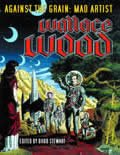
Wallace Wood: Against the Grain, part 35
The folk and country music played while he worked, but sometimes the Woods would kill the lights in the studio and attend concerts. “When the Weavers first made it,” said Tatjana, “we used to go to folk concerts — Kingston Trio, Odetta. But he was especially crazy about the Weavers. We went to several of their concerts. We saw Pete Seeger in the street once, and Wallace accosted him and talked to him about how much he enjoyed his singing. One of his favorites was Hank Williams. Shitkicker music was never my favorite. He would listen to this stuff for endless hours. Once in a while I’d say, ‘Couldn’t we put on some classical music?’ I’d put something on, but he didn’t grow up with it, and basically he never cared too much for it. So I always relented and let him put on what he wanted. I liked the folk music, but I didn’t like the hillbilly. I even made an effort to drag the poor guy to some operas in our early years, but he never cared for that too much.”
¶ 5:09 PM 0 comments