Potrzebie
Monday, February 20, 2012
Clark Dimond's interview with John Severin
.

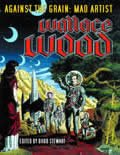
John Severin died in Denver February 12 at the age of 90, Here Clark Dimond and John Severin talk about EC and Wally Wood. Recorded over two decades ago, it was published in Against the Grain: Mad Artist Wallace Wood (2003). © 2012 Bhob Stewart and Clark Dimond.
Ω∆Ω
World War II was receding into memory. In a deserted reception room of a publishing firm, two men met for the first time. The war had sent them both to Eniwetok, Guam, and Japan. Both had served in airborne divisions. And both were artists. John Severin describes the encounter in this interview with Clark Dimond, taped September 26, 1985, in Denver, Colorado.
Clark Dimond: You say Wood came down from Massachusetts?
John Severin: That’s my memory. I would still say to this day that he came down from Massachusetts, but listen, he could have said Wisconsin or Minnesota.
This was the Charles William Harvey Studio?
No. All this talk with Woody was done in a publisher’s office around 44th St. between 5th and 7th.
Not a major publisher?
No, there were hundreds of these guys there for awhile. They’d put out a couple of books for maybe a year and they’d disappear. You’d never hear from them, or of them again. What happened... the only person in this small lobby, foyer, office waiting room with a sofa and a couple of chairs when I walked in was this guy in the overcoat with the short collar. It was like an apartment.

You were there showing your work?
I was going to. I never did. Never did. That I remember. It was wintertime, or leastways it was cold time. Nobody else seemed to be there. It was a very weird situation. I’d noticed this guy’s portfolio when I came in. The portfolio was black. It was easily six or eight inches thick. I saw a Paratrooper’s pin on his lapel. We got to talking because I had been in the Airborne. He told me he’d been in New York for a couple of weeks trying to get work in the comics, and he’d had no luck at all.
This was ’49 or so? It must have been pretty early on.
It had to be. ’49’s a good year. Yeah, I’m sure it was ’49. And he said he’d had no luck at all. He was going back the next day or the day after. He was going to return to Massachusetts, and I said, “Gee, let me see your work.” He showed me a couple of pages and... How the hell this guy didn’t get work, I don’t care who it was, I don’t understand. I mean, if he wasn’t lying to me, if he’d really come down here to get into comics, and he’d seen comics companies, and they hadn’t accepted him, I couldn’t understand it, because the guys in the business were not as good. The work wasn’t totally professional, but boy it was so good. About two days on the job, and he’d have had it made, see. And so I said, “Jeez, I can’t understand how you haven’t gotten a job. Boy, there must be something we can do. Why don’t you come over to the studio I share with a couple of guys?” I said, “Maybe we can work up some kind of a deal.” So I don’t remember if we saw anybody in this office. Maybe we did. There was nobody talking to us.
 You were just sitting there...
Just waiting for somebody to come out. Bringing us coffee or anything. So we left. He came over to the Charles William Harvey Studio. We never changed the name after I bought in. He [Charles Stern] went to Paris. We didn’t change the name because it had gotten known. Charlie Stern walked in,and we looked at Woody’s work with Harvey and Willie [Kurtzman and Elder] and everybody agreed with me. The guy’s work is fantastic.
Was it science-fiction?
It was all the stuff you ever... Lots of big trees, gnarled trees, and hero types, Flash Gordon standing around, and girls in their filmy Alex Raymond gowns, and weird monsters, lots of dinosaurs, lots of science-fiction. A lot of the work was done on illustration board and took up more space, naturally, but it was a thick portfolio. We decided what we should do was call Will Eisner. This guy would be perfect for him.
To work as an assistant?
Yeah. Because Will Eisner apparently was using lots of guys. They set up an appointment, and Woody went down there. And never returned. That was it. He learned I don’t know how much from Will Eisner.
This was before you or Kurtzman got together with EC.
Harvey was working for Timely/ Marvel. Willie and I were partners working for whoever the hell would hire us. I couldn’t ink, and Willie was not too good at drawing. So the combination worked out, and we both made money on the deal. It was later that Harvey made contact with EC.
 So Wood went down and became...
One with Will Eisner.
Is that where he ran into Harrison?
I don’t know. For a short while Woody disappeared. He would come in the studio once in awhile and say hello, just make some sort of contact, but I had no idea what he did. For about the period of a year all I heard from him was that he was working and busy. Since I was just breaking in my¬self, I really didn’t give a damn about anything except me getting going. I was glad that he was working, and he seemed to be doing very well.
When Wood broke into EC he was working with Harry Harrison. Then he hooked up with Joe Orlando.
I went up to the studio there one day. Of course, I had seen their work. I noticed it was different. It was fabulous how Joe had gone along with Woody, hand in glove. Orlando couldn’t do it alone; he had to have Woody standing right next to him. The same is true of [Angelo] Torres and [Al] Williamson. For awhile, they were sitting side by side.
Even when he tried to draw Wood you could see the Orlando: he has his own style.
It’s stiffer; it doesn’t flow as well. I don’t mean the drawing, I mean the ink line. It’s a more solid, staid line than Woody’s.
So Woody dropped out of sight for awhile...
The next time he and I made any real contact was when he started working at EC.
You came in with Kurtzman, right? Wood was already working for Feldstein then.
Yes, he was. I’m sure. Right. Harvey and I talked about this idea: Woody was one of the four guys that was going to be in this Mad Harvey was thinking up. Harvey knew who to give the jobs to. That’s what made EC so different. You didn’t just walk into an office, you were part of a group. You drank coffee with the publisher, you argued with the editor, you loaned cigarettes to the mail boy. And it showed! It showed! They shot the breeze one around the other and came up with ideas. Not in a formal manner. I mean, it wasn’t “Run it up the flagpole...” These guys didn’t have any flagpole. They didn’t even have a flag. They just sat around and shot the breeze. “Hey, that was a good idea...”
This was going on most of the time?
Yeah. You might go in there sometime and find two people in the office. The next time you might find eight. And it was the conversations back and forth over the editor’s desk, with him saying, “Bill has an idea. Why don’t you do this? Why don’t you do that?” And it went on and on and on all the time. Whether or not many good ideas came out of this is totally unimportant. The thing was the feeling was so totally different from any other comic company that, sort of, inside, you wanted to do your best for these guys. For the guys. Whereas you did your best for the other people because you wanted a paycheck—and wanted another script so you could get another paycheck. I wouldn’t say I did it for the love of it, personally, but you wanted to do your best for them for some reason. It was like your own neighborhood gang.
Well, everybody was roughly of an age.
Yeah. They were.

A cohesive group of young turks. This story in Frontline Combat #15, “Perimeter,” “kiddie drawing” raised to some higher level.
It’s on a higher level is what it is. You're right. But this is the appeal he had. If you analyze Woody’s drawing, you’ll find that it’s totally distorted, all out of proportion. But who the hell cares? Look. You know what that figure’s [in “Perimeter” splash foreground] doing but if you analyze that thing, those legs come from hips that are [expansive gesture] far apart. One leg is over there, and one leg is over here, he’ll do it any old time, and it doesn’t matter. It doesn’t matter. His storytelling ability, his black and white. He just makes a very entertaining picture. That is all that is required. That’s why you like Feldstein, his pictures are something else: they’re entertaining. Woody does a much better job, though. He’s got a looseness to his inking that’s very attractive. Wood doesn’t draw helmets that fit on the head. Okay, who cares? The thing is good. Look on the cheeks of this guy here [page two, panel seven above]. Unbelievable. The guy has obviously got a box lunch in his mouth. Never mattered to me with him. Never.
That’s because he’s got a way of making you feel like you’re there.
Ridiculous to say, but he’s good. Yes, he’s good. A lot of guys learned about highlights from him—lighting from both sides. The dark scene with the highlighting he probably got from Eisner, but it seems to me he had it before he got to Eisner.
Sometimes Wood gets so photographic that it almost outdoes that amazing piece of Russ Heath’s for Blazing Combat #4.
That’s one that will go down in history.
And “Atom Bomb,” in Two-Fisted Tales #33, I don’t understand how he got the time or energy to turn it out like that.
He was a workaholic. In between playing the guitar.
Oh, he played guitar?
Yeah. He played at parties.
I never heard him play that I remember. He’d give me advice on playing, though.
One time when I was living in Jersey, he wanted me to buy him a gun. Considering the way he went, I’m sure glad I didn’t get that thing for him. Because it might have been the one that did it. Not that it would matter, but it might have made me feel funny.
Yeah, but you can’t... I mean.... In going back over the early stories (and he wasn’t writing them, I agree) you see panel after panel of guys blowing their own heads off. The horror, the crime, the shock.
Oh, I wouldn’t have felt guilty, because that’s his decision in the final analysis. But that wouldn’t have given him the idea, though. That’s just a coincidence. For instance, maybe I’ve drawn a lot of guys... I haven’t, though.

But you don’t know how you’re gonna die.
Yeah. But I’m not gonna blow my brains out.
It’s a ghoulish approach to comics, but I get a pretty strange feeling when I see those Alex Raymond panels of car crashes. That’s coincidence in its way, but—
It makes sense, though. For instance, Raymond was in¬terested in cars, and he put cars in his stories. Cracking up cars and having car chases was a good thing to do for him. It happens that since he owned cars and liked cars, he got himself killed in one. Woody liked guns and so forth. That’s why he could draw the stuff that way. He was interested in those kind of stories, and that’s why they gave them to him. So it happens that at the end he decided to use a gun. I’m sure that if he collected Sherman tanks he might have crawled under the treads. But what’re you gonna do? A guy drowns because he’s around water. Or hangs because he plays with ropes. You can’t go into too much coincidence on these things. Woody avoided more than he coped. If he didn’t like a place he stayed away from it. And making a decision: he would be inclined to let the rest of them make a decision. And if it was okay, he’d go along, and if it wasn’t, he just wouldn’t do it. But he wouldn’t get too involved in making the positive decision. I guess all this stuff got to be a little too much for him. You know, it was not going to be worth it. To him.

Well, it was also the fact that he was very determinedly a comic artist.
That was his life.
He wouldn’t edit Witzend. It had some interesting pieces in it, but it never seemed to cohere into a whole.
It needed a force behind it and Woody wasn’t a force. His work was his force. As you say, that was Woody on the paper more than in real life. He put everything he had into that stuff. You wouldn’t have found out as much about Woody talking to him as you would looking at his work. I liked him. He had a great sense of humor. It was wry; but it was quiet, retiring, removed. “Keep me in the corner.” Even when he was quiet and restrained he got some kind of respect. It was due to the work and the fact that he didn’t do anything to cause anybody to get mad at him. He didn’t swear, he didn’t drink too much—I don’t know, he might have got to winging it later on. But he’s just a good guy. He had certain respect offered him. They’d ask for his opinions, since he never gave them. “What do you think, Woody?” You don’t do that to someone you have no respect for. What can I tell you? I liked Tatjana very much. She’s great. Very interesting gal.

He destroyed his own erotica.
I didn’t know he did much of it at all. I would suspect it from certain things, but I only know he did it for certain magazines. For a buck at that particular moment. He did go for a lot of nudies running around. But I accepted those for what they were, and of course I nearly flipped when somebody showed me... what was it in? Hustler?
The filthy stuff? It was in Puritan.
Yeah. But even when Woody did that, it didn’t have that dirty feeling. Isn’t that funny? It was just straight flat out pornography. It was about as dirty as those little eight-page books were, but he could do things like that and get away with it. Another guy could do the same damn thing and get shot down.

Wood did it all. Could do it all. He was serious about it.
But there are a lot of them out there, a lot of people in this business all through the years who have... It was their life. Nothing on the side like wives, girl¬friends, church. It was the focal point of anything that they did. But Wood was more so than any one person that I know. He was totally wrapped up in it. A quick contrast, not to bring me in: there are guys like me in the business who treat it like a business. It’s the way I earn a living. But not so with these guys. This is their whole life. It is central to what they are doing. What they do that isn’t directly involved with comics is on the fringe of the same kind of thinking, the same philosophy. The musicians you say he hung out with probably were involved in that kind of thinking and some of it would go comic and some of it would go another direction. Dope, I don’t know.

No, dope wasn’t one of Wood’s problems.
No, I don’t mean him. All this meshwork. It goes in different directions. I mean, I was trying to find out where this stuff in Heavy Metal and Lampoon came from, and I assumed—
You’re making the assumption that it came from drugs.
You have to smoke marijuana to understand Lampoon.
You have seen Flo Steinberg’s Big Apple, right? No parody more vicious than self parody.
But you see, no matter what you looked at, you always got the feeling it’s somehow amusing. You didn’t ever feel cruddy; he would draw cruddy people, and they looked cruddy. But the picture didn’t come off as a cruddy picture. [In Wood’s “My Word,” Big Apple] I think this is one of the funniest things in this splash [the kid with the erection, lower left]. What is that thing? It isn’t a real human being. But that’s Woody. My sister is so embarassed to have done work in here.

Oh, I think Big Apple is great. I always liked Flo Steinberg.
Yeah. I do too. She’s cra-azy.
She gets the credit for this. In some ways, it’s got more editorial direction than Witzend.
Flo has more to say than Woody would say. Not that he could say, but that he would say. Woody wouldn’t. Why wouldn’t Woody? I don’t know. Woody would. Would he? The only other thing is the personality side of Woody—what can you say? I enjoyed him. I think he liked me. The only contact I ever had with him business-wise was the one job we did together in which I managed to screw up his pencils. Totally.

Which job was that?
It wasn’t for EC. It was [“Creeps” in Creepy #78] for Warren. Wood did the pencils. They were looking for some bum to do the inks, and they gave it to me. I don’t mean that you’d look at it and throw up, but when you realize it was Woody, it was no longer Woody when I got through with it. Nor was it me. Which might have been a little help. I had done about three jobs with, I think it was Infantino, and the editor sent me a “Woody.” Would I like to do it? Sure. Be interesting. But Woody didn’t put it on the right kind of paper for me; he had a tooth on his paper. I like a slicker paper. The most tooth I want is what you get on Duo Shade. Strathmore with the chemicals in the paper gives it a tooth. That’s the only tooth I want, because I can’t loosen up, my pens scratch all over. Starting with the wrong kind of paper I managed to goof it. I would have liked to see a good Woody job come out of it. Be nice. But I didn’t even do a good Severin inking job, if there is such a thing. It didn’t come out Severin; it sure wasn’t Wood—but you can see the two of us are there. And maybe that’s the problem. Two people who are either too strong for one another. Or something. Maybe too much alike. He and I aren’t alike at all, as a matter of fact.

Certainly at EC you were never combined.
Oh, no. They didn’t do much combining at all at EC. I think it’s been a big mistake in the business. I don’t mean each individual instance has been a mistake. Sometimes it’s been good. But the idea of combining the artists, I mean the inker and the penciller, that’s a bad deal. You dilute both people.
You’re not doing a service to either artist.
Now and then you find an exception, but that proves the rule. But I have to draw it, and like Woody in a way, and why I can understand him—being that way, I put me in there. And if I draw it, if I ink it, it’s alive. Then I get on to the next one. But when somebody else draws it, it’s just a matter of making it ready for production. And I really cannot get into the stuff. A nose is a nose is a nose is a nose. It means nothing. But when I draw a nose, it’s a particular nose. On this particular guy. Who has a particular soul. That I created. [laughs] As a result, I’ll louse anybody up.


John Severin died in Denver February 12 at the age of 90, Here Clark Dimond and John Severin talk about EC and Wally Wood. Recorded over two decades ago, it was published in Against the Grain: Mad Artist Wallace Wood (2003). © 2012 Bhob Stewart and Clark Dimond.
Ω∆Ω
World War II was receding into memory. In a deserted reception room of a publishing firm, two men met for the first time. The war had sent them both to Eniwetok, Guam, and Japan. Both had served in airborne divisions. And both were artists. John Severin describes the encounter in this interview with Clark Dimond, taped September 26, 1985, in Denver, Colorado.
Clark Dimond: You say Wood came down from Massachusetts?
John Severin: That’s my memory. I would still say to this day that he came down from Massachusetts, but listen, he could have said Wisconsin or Minnesota.
This was the Charles William Harvey Studio?
No. All this talk with Woody was done in a publisher’s office around 44th St. between 5th and 7th.
Not a major publisher?
No, there were hundreds of these guys there for awhile. They’d put out a couple of books for maybe a year and they’d disappear. You’d never hear from them, or of them again. What happened... the only person in this small lobby, foyer, office waiting room with a sofa and a couple of chairs when I walked in was this guy in the overcoat with the short collar. It was like an apartment.

You were there showing your work?
I was going to. I never did. Never did. That I remember. It was wintertime, or leastways it was cold time. Nobody else seemed to be there. It was a very weird situation. I’d noticed this guy’s portfolio when I came in. The portfolio was black. It was easily six or eight inches thick. I saw a Paratrooper’s pin on his lapel. We got to talking because I had been in the Airborne. He told me he’d been in New York for a couple of weeks trying to get work in the comics, and he’d had no luck at all.
This was ’49 or so? It must have been pretty early on.
It had to be. ’49’s a good year. Yeah, I’m sure it was ’49. And he said he’d had no luck at all. He was going back the next day or the day after. He was going to return to Massachusetts, and I said, “Gee, let me see your work.” He showed me a couple of pages and... How the hell this guy didn’t get work, I don’t care who it was, I don’t understand. I mean, if he wasn’t lying to me, if he’d really come down here to get into comics, and he’d seen comics companies, and they hadn’t accepted him, I couldn’t understand it, because the guys in the business were not as good. The work wasn’t totally professional, but boy it was so good. About two days on the job, and he’d have had it made, see. And so I said, “Jeez, I can’t understand how you haven’t gotten a job. Boy, there must be something we can do. Why don’t you come over to the studio I share with a couple of guys?” I said, “Maybe we can work up some kind of a deal.” So I don’t remember if we saw anybody in this office. Maybe we did. There was nobody talking to us.

Just waiting for somebody to come out. Bringing us coffee or anything. So we left. He came over to the Charles William Harvey Studio. We never changed the name after I bought in. He [Charles Stern] went to Paris. We didn’t change the name because it had gotten known. Charlie Stern walked in,and we looked at Woody’s work with Harvey and Willie [Kurtzman and Elder] and everybody agreed with me. The guy’s work is fantastic.
Was it science-fiction?
It was all the stuff you ever... Lots of big trees, gnarled trees, and hero types, Flash Gordon standing around, and girls in their filmy Alex Raymond gowns, and weird monsters, lots of dinosaurs, lots of science-fiction. A lot of the work was done on illustration board and took up more space, naturally, but it was a thick portfolio. We decided what we should do was call Will Eisner. This guy would be perfect for him.
To work as an assistant?
Yeah. Because Will Eisner apparently was using lots of guys. They set up an appointment, and Woody went down there. And never returned. That was it. He learned I don’t know how much from Will Eisner.
This was before you or Kurtzman got together with EC.
Harvey was working for Timely/ Marvel. Willie and I were partners working for whoever the hell would hire us. I couldn’t ink, and Willie was not too good at drawing. So the combination worked out, and we both made money on the deal. It was later that Harvey made contact with EC.

One with Will Eisner.
Is that where he ran into Harrison?
I don’t know. For a short while Woody disappeared. He would come in the studio once in awhile and say hello, just make some sort of contact, but I had no idea what he did. For about the period of a year all I heard from him was that he was working and busy. Since I was just breaking in my¬self, I really didn’t give a damn about anything except me getting going. I was glad that he was working, and he seemed to be doing very well.
When Wood broke into EC he was working with Harry Harrison. Then he hooked up with Joe Orlando.
I went up to the studio there one day. Of course, I had seen their work. I noticed it was different. It was fabulous how Joe had gone along with Woody, hand in glove. Orlando couldn’t do it alone; he had to have Woody standing right next to him. The same is true of [Angelo] Torres and [Al] Williamson. For awhile, they were sitting side by side.
Even when he tried to draw Wood you could see the Orlando: he has his own style.
It’s stiffer; it doesn’t flow as well. I don’t mean the drawing, I mean the ink line. It’s a more solid, staid line than Woody’s.
So Woody dropped out of sight for awhile...
The next time he and I made any real contact was when he started working at EC.
You came in with Kurtzman, right? Wood was already working for Feldstein then.
Yes, he was. I’m sure. Right. Harvey and I talked about this idea: Woody was one of the four guys that was going to be in this Mad Harvey was thinking up. Harvey knew who to give the jobs to. That’s what made EC so different. You didn’t just walk into an office, you were part of a group. You drank coffee with the publisher, you argued with the editor, you loaned cigarettes to the mail boy. And it showed! It showed! They shot the breeze one around the other and came up with ideas. Not in a formal manner. I mean, it wasn’t “Run it up the flagpole...” These guys didn’t have any flagpole. They didn’t even have a flag. They just sat around and shot the breeze. “Hey, that was a good idea...”
This was going on most of the time?
Yeah. You might go in there sometime and find two people in the office. The next time you might find eight. And it was the conversations back and forth over the editor’s desk, with him saying, “Bill has an idea. Why don’t you do this? Why don’t you do that?” And it went on and on and on all the time. Whether or not many good ideas came out of this is totally unimportant. The thing was the feeling was so totally different from any other comic company that, sort of, inside, you wanted to do your best for these guys. For the guys. Whereas you did your best for the other people because you wanted a paycheck—and wanted another script so you could get another paycheck. I wouldn’t say I did it for the love of it, personally, but you wanted to do your best for them for some reason. It was like your own neighborhood gang.
Well, everybody was roughly of an age.
Yeah. They were.

A cohesive group of young turks. This story in Frontline Combat #15, “Perimeter,” “kiddie drawing” raised to some higher level.
It’s on a higher level is what it is. You're right. But this is the appeal he had. If you analyze Woody’s drawing, you’ll find that it’s totally distorted, all out of proportion. But who the hell cares? Look. You know what that figure’s [in “Perimeter” splash foreground] doing but if you analyze that thing, those legs come from hips that are [expansive gesture] far apart. One leg is over there, and one leg is over here, he’ll do it any old time, and it doesn’t matter. It doesn’t matter. His storytelling ability, his black and white. He just makes a very entertaining picture. That is all that is required. That’s why you like Feldstein, his pictures are something else: they’re entertaining. Woody does a much better job, though. He’s got a looseness to his inking that’s very attractive. Wood doesn’t draw helmets that fit on the head. Okay, who cares? The thing is good. Look on the cheeks of this guy here [page two, panel seven above]. Unbelievable. The guy has obviously got a box lunch in his mouth. Never mattered to me with him. Never.
That’s because he’s got a way of making you feel like you’re there.
Ridiculous to say, but he’s good. Yes, he’s good. A lot of guys learned about highlights from him—lighting from both sides. The dark scene with the highlighting he probably got from Eisner, but it seems to me he had it before he got to Eisner.
Sometimes Wood gets so photographic that it almost outdoes that amazing piece of Russ Heath’s for Blazing Combat #4.
That’s one that will go down in history.
And “Atom Bomb,” in Two-Fisted Tales #33, I don’t understand how he got the time or energy to turn it out like that.
He was a workaholic. In between playing the guitar.
Oh, he played guitar?
Yeah. He played at parties.
I never heard him play that I remember. He’d give me advice on playing, though.
One time when I was living in Jersey, he wanted me to buy him a gun. Considering the way he went, I’m sure glad I didn’t get that thing for him. Because it might have been the one that did it. Not that it would matter, but it might have made me feel funny.
Yeah, but you can’t... I mean.... In going back over the early stories (and he wasn’t writing them, I agree) you see panel after panel of guys blowing their own heads off. The horror, the crime, the shock.
Oh, I wouldn’t have felt guilty, because that’s his decision in the final analysis. But that wouldn’t have given him the idea, though. That’s just a coincidence. For instance, maybe I’ve drawn a lot of guys... I haven’t, though.

But you don’t know how you’re gonna die.
Yeah. But I’m not gonna blow my brains out.
It’s a ghoulish approach to comics, but I get a pretty strange feeling when I see those Alex Raymond panels of car crashes. That’s coincidence in its way, but—
It makes sense, though. For instance, Raymond was in¬terested in cars, and he put cars in his stories. Cracking up cars and having car chases was a good thing to do for him. It happens that since he owned cars and liked cars, he got himself killed in one. Woody liked guns and so forth. That’s why he could draw the stuff that way. He was interested in those kind of stories, and that’s why they gave them to him. So it happens that at the end he decided to use a gun. I’m sure that if he collected Sherman tanks he might have crawled under the treads. But what’re you gonna do? A guy drowns because he’s around water. Or hangs because he plays with ropes. You can’t go into too much coincidence on these things. Woody avoided more than he coped. If he didn’t like a place he stayed away from it. And making a decision: he would be inclined to let the rest of them make a decision. And if it was okay, he’d go along, and if it wasn’t, he just wouldn’t do it. But he wouldn’t get too involved in making the positive decision. I guess all this stuff got to be a little too much for him. You know, it was not going to be worth it. To him.

Well, it was also the fact that he was very determinedly a comic artist.
That was his life.
He wouldn’t edit Witzend. It had some interesting pieces in it, but it never seemed to cohere into a whole.
It needed a force behind it and Woody wasn’t a force. His work was his force. As you say, that was Woody on the paper more than in real life. He put everything he had into that stuff. You wouldn’t have found out as much about Woody talking to him as you would looking at his work. I liked him. He had a great sense of humor. It was wry; but it was quiet, retiring, removed. “Keep me in the corner.” Even when he was quiet and restrained he got some kind of respect. It was due to the work and the fact that he didn’t do anything to cause anybody to get mad at him. He didn’t swear, he didn’t drink too much—I don’t know, he might have got to winging it later on. But he’s just a good guy. He had certain respect offered him. They’d ask for his opinions, since he never gave them. “What do you think, Woody?” You don’t do that to someone you have no respect for. What can I tell you? I liked Tatjana very much. She’s great. Very interesting gal.

He destroyed his own erotica.
I didn’t know he did much of it at all. I would suspect it from certain things, but I only know he did it for certain magazines. For a buck at that particular moment. He did go for a lot of nudies running around. But I accepted those for what they were, and of course I nearly flipped when somebody showed me... what was it in? Hustler?
The filthy stuff? It was in Puritan.
Yeah. But even when Woody did that, it didn’t have that dirty feeling. Isn’t that funny? It was just straight flat out pornography. It was about as dirty as those little eight-page books were, but he could do things like that and get away with it. Another guy could do the same damn thing and get shot down.

Wood did it all. Could do it all. He was serious about it.
But there are a lot of them out there, a lot of people in this business all through the years who have... It was their life. Nothing on the side like wives, girl¬friends, church. It was the focal point of anything that they did. But Wood was more so than any one person that I know. He was totally wrapped up in it. A quick contrast, not to bring me in: there are guys like me in the business who treat it like a business. It’s the way I earn a living. But not so with these guys. This is their whole life. It is central to what they are doing. What they do that isn’t directly involved with comics is on the fringe of the same kind of thinking, the same philosophy. The musicians you say he hung out with probably were involved in that kind of thinking and some of it would go comic and some of it would go another direction. Dope, I don’t know.

No, dope wasn’t one of Wood’s problems.
No, I don’t mean him. All this meshwork. It goes in different directions. I mean, I was trying to find out where this stuff in Heavy Metal and Lampoon came from, and I assumed—
You’re making the assumption that it came from drugs.
You have to smoke marijuana to understand Lampoon.
You have seen Flo Steinberg’s Big Apple, right? No parody more vicious than self parody.
But you see, no matter what you looked at, you always got the feeling it’s somehow amusing. You didn’t ever feel cruddy; he would draw cruddy people, and they looked cruddy. But the picture didn’t come off as a cruddy picture. [In Wood’s “My Word,” Big Apple] I think this is one of the funniest things in this splash [the kid with the erection, lower left]. What is that thing? It isn’t a real human being. But that’s Woody. My sister is so embarassed to have done work in here.

Oh, I think Big Apple is great. I always liked Flo Steinberg.
Yeah. I do too. She’s cra-azy.
She gets the credit for this. In some ways, it’s got more editorial direction than Witzend.
Flo has more to say than Woody would say. Not that he could say, but that he would say. Woody wouldn’t. Why wouldn’t Woody? I don’t know. Woody would. Would he? The only other thing is the personality side of Woody—what can you say? I enjoyed him. I think he liked me. The only contact I ever had with him business-wise was the one job we did together in which I managed to screw up his pencils. Totally.

Which job was that?
It wasn’t for EC. It was [“Creeps” in Creepy #78] for Warren. Wood did the pencils. They were looking for some bum to do the inks, and they gave it to me. I don’t mean that you’d look at it and throw up, but when you realize it was Woody, it was no longer Woody when I got through with it. Nor was it me. Which might have been a little help. I had done about three jobs with, I think it was Infantino, and the editor sent me a “Woody.” Would I like to do it? Sure. Be interesting. But Woody didn’t put it on the right kind of paper for me; he had a tooth on his paper. I like a slicker paper. The most tooth I want is what you get on Duo Shade. Strathmore with the chemicals in the paper gives it a tooth. That’s the only tooth I want, because I can’t loosen up, my pens scratch all over. Starting with the wrong kind of paper I managed to goof it. I would have liked to see a good Woody job come out of it. Be nice. But I didn’t even do a good Severin inking job, if there is such a thing. It didn’t come out Severin; it sure wasn’t Wood—but you can see the two of us are there. And maybe that’s the problem. Two people who are either too strong for one another. Or something. Maybe too much alike. He and I aren’t alike at all, as a matter of fact.

Certainly at EC you were never combined.
Oh, no. They didn’t do much combining at all at EC. I think it’s been a big mistake in the business. I don’t mean each individual instance has been a mistake. Sometimes it’s been good. But the idea of combining the artists, I mean the inker and the penciller, that’s a bad deal. You dilute both people.
You’re not doing a service to either artist.
Now and then you find an exception, but that proves the rule. But I have to draw it, and like Woody in a way, and why I can understand him—being that way, I put me in there. And if I draw it, if I ink it, it’s alive. Then I get on to the next one. But when somebody else draws it, it’s just a matter of making it ready for production. And I really cannot get into the stuff. A nose is a nose is a nose is a nose. It means nothing. But when I draw a nose, it’s a particular nose. On this particular guy. Who has a particular soul. That I created. [laughs] As a result, I’ll louse anybody up.
"The Million Year Picnic" Weird Fantasy #21 (September-October 1953)


John Severin by Marie Severin
Labels: clark dimond, severin, wood
¶ 4:39 PM 0 comments
Sunday, September 26, 2010
Four Color Fear
 It seems unfortunate to me that cartoonist Howard Nostrand (1929-1984) was not a contributor to the early Mad comic book. He would have been a comfortable fit, more so than John Severin.
Below is Nostrand's strange, surreal "What's Happening at... 8:30 P.M." from Witches Tales #25 (June 1954). This has just been reprinted in Greg Sadowski and John Benson's noirish, nightmarish Four Color Fear, an anthology of pre-Code 1950s terror tales, coincidentally shipping during Banned Books Week (September 25 to October 2).
When I interviewed Nostrand in 1968, I carried along a copy of Witches Tales #25. I asked him about Harvey Comics, Bob Powell and this story: "Harvey had a sort of chicken attitude about horror stuff. Like it should be horrible but not too horrible. Granted, they get a little ghastly every once in a while, but I suppose they wanted to keep it in fairly good taste. When you look at '8:30 P.M', there's nothing particularly horrible about it. It's a little germ wandering around. And the fact that the germ gets killed, nobody's going to lie awake at night thinking about it."

He also spoke about the Eisner-like title billboard in the splash and achieving atmospherics on the first page: "Powell was a great fan of Hitchcock's, same way that Eisner was. You look at an old Hitchcock movie... the first thing you do is set the scene. This is what I tried to do in a lot of these things. You set a mood for the whole thing. With about the first three shots, you set the mood, and then you go from there... Eisner used to get his titles in the opening panel there. The treatment is strictly Eisner. But then again, the background and all that is EC." Nostrand also commented on the unusual coloring: "It's supposed to be on the inside of a body, and so everything is kind of reddish. The only thing that isn't red is this foreign body."

This analogy between the interior of a city and a human body, linked only by redness, is what makes this story remarkable, actually more imaginative than such movies as Fantastic Voyage (1966) and Innerspace (1987). As I wrote years ago, it has more in common with Samuel Beckett's journey into self-perception, Film (1965), shot in lower Manhattan with a dying Buster Keaton. You can see Film here.
Strange synchronicity when I wrote about this story in the early 1980s for The Comics Journal: I wanted to compare it with Film and wished I had a copy of the obscure book about the Beckett movie published years earlier by Evergreen Books. I shlepped up the hill toward the usual Saturday afternoon yard sale. There was a table with only about 20 books. One of them was the very book I needed. Stunned, I gave someone 35 cents for the book, walked back down the hill and continued typing.


I feel lucky Four Color Fear: Forgotten Horror Comics of the 1950s (Fantagraphics, distributed by W.W. Norton) made it here. One side of the W.W. Norton cardboard mailer was ripped open with the book poking out. The mailer was too big, causing the unwrapped book to slide around inside. Someone at the Post Office put it in a plastic bag, and it was delivered hanging on the mailbox where it stayed overnight. You would think a company like W.W. Norton would have figured out how to package books for mailing by now.
Greg Sadowski and John Benson did a superb job on this collection of early 1950s horror stories, including Wood's "The Thing from the Sea" from Eerie #2 (August-September 1951) and Joe Kubert's beautifully drawn "Cat's Death" from Strange Terrors #7 (March 1963). Also included: Fred Kida, Everett Raymond Kinstler, Basil Wolverton, Al Williamson, Frank Frazetta, George Evans, Sid Check, Jack Cole, Bob Powell and others. There's a spectacular section of 32 front covers, full bleed on slick paper, including covers by Wood, Frazetta, Lee Elias and Norm Saunders.
 In addition to Greg's attractive design throughout, he delivers meticulous, pixel-perfect restorations, quite evident to me when I compared the reprint of "What's Happening at... 8:30 P.M." with the original comic book. In the pages above, scanned directly from the book, one can see Greg's patience and precision in creating flawless restorations. It can also be quite time consuming, as I recall from 1988-89 when I did restoration work on ten volumes of NBM's Wash Tubbs and Captain Easy book series.
There are 25 pages of fascinating, informative notes by both Greg and John. I love that line "Comic Media... featured a rising sales chart as its logo". The book has an interactive aspect as one turns back and forth from stories and covers to the notes. The "Cover Section Key" shows the influence of web design, as each note about a cover is accompanied by a full-color thumbnail of the cover.
In an attempt to nail down which issues are "true horror comics", John Benson lists 1,371 pre-Code issues representing 110 titles from 30 companies. He also contributes a full article analyzing the work of scripter-editor Ruth Roche, noting, "Many 1950s horror comics featured violence, gore and menace for their own sake, but in Roche's world they were often only suggested, for they were merely manifestations of her real subject: the unbridled evil and chaos that was always lurking just beneath the surface, waiting to escape into the world. The innocent died with the guilty in her stories, and sometimes the particular personification of evil would still be at large at the story's end. A chilling variation on the theme of hidden chaos is the discovery that a loved one or trusted figure is actually 'the other' (a theme effectively used in the movie Invasion of the Body Snatchers a few years later). 'Evil Intruder' tellingly develops this theme and is one of the more horrifying stories in the whole genre." The slobbering love-starved creature in this outré story (from Journey into Fear #12) is totally unlike anything one might see in fantasy films or TV.
 I don't like to read an article reversed into black, but even so, the inside front cover, title pages, contents page and intro, unified by the black background surrounding colorful typographic devices, all demonstrate Greg's skill as an inventive designer.
The only real flaw is the Adam Grano cover design. I always disliked the idea of enlarging panels to show halftone dots. Maybe this was clever 40 years ago, but now it's just annoying. Greg could have easily designed a much better cover, possibly by combining his logo-like title page creation with the Frank Frazetta/Sid Check cover of Beware #10 (July 1954), showing the undead about to toss a gravity-defying girl into an open grave.
This book is like time-traveling, a document of an era. Some of these stories and covers I barely recall, some are familiar and others are new to me. This will stand as an important reference work that should be shelved alongside David Hajdu's The Ten-Cent Plague. Where Hajdu detailed the behind-the-scenes political machinations and wild witchhunts of the 1950s anti-comics crusade, Four Color Fear shows what was actually available on newsstands at the time.

One minor error: The 1931-38 horror-fantasy radio series which inspired Gaines was The Witch's Tale, not The Old Witch's Tale. The host-narrator of the series was not the Old Witch, but Old Nancy, the Witch of Salem. Miriam Wolfe, who died in 2000, was 13 years old when she began portraying the cackling Old Nancy. The program's creator, Alonzo Deen Cole, provided the meows of Old Nancy's coal black cat Satan. To hear The Witch's Tale, go here.
For PDF preview of Four Color Fear with four complete stories, go here.

Below is Nostrand's strange, surreal "What's Happening at... 8:30 P.M." from Witches Tales #25 (June 1954). This has just been reprinted in Greg Sadowski and John Benson's noirish, nightmarish Four Color Fear, an anthology of pre-Code 1950s terror tales, coincidentally shipping during Banned Books Week (September 25 to October 2).
When I interviewed Nostrand in 1968, I carried along a copy of Witches Tales #25. I asked him about Harvey Comics, Bob Powell and this story: "Harvey had a sort of chicken attitude about horror stuff. Like it should be horrible but not too horrible. Granted, they get a little ghastly every once in a while, but I suppose they wanted to keep it in fairly good taste. When you look at '8:30 P.M', there's nothing particularly horrible about it. It's a little germ wandering around. And the fact that the germ gets killed, nobody's going to lie awake at night thinking about it."

He also spoke about the Eisner-like title billboard in the splash and achieving atmospherics on the first page: "Powell was a great fan of Hitchcock's, same way that Eisner was. You look at an old Hitchcock movie... the first thing you do is set the scene. This is what I tried to do in a lot of these things. You set a mood for the whole thing. With about the first three shots, you set the mood, and then you go from there... Eisner used to get his titles in the opening panel there. The treatment is strictly Eisner. But then again, the background and all that is EC." Nostrand also commented on the unusual coloring: "It's supposed to be on the inside of a body, and so everything is kind of reddish. The only thing that isn't red is this foreign body."

This analogy between the interior of a city and a human body, linked only by redness, is what makes this story remarkable, actually more imaginative than such movies as Fantastic Voyage (1966) and Innerspace (1987). As I wrote years ago, it has more in common with Samuel Beckett's journey into self-perception, Film (1965), shot in lower Manhattan with a dying Buster Keaton. You can see Film here.
Strange synchronicity when I wrote about this story in the early 1980s for The Comics Journal: I wanted to compare it with Film and wished I had a copy of the obscure book about the Beckett movie published years earlier by Evergreen Books. I shlepped up the hill toward the usual Saturday afternoon yard sale. There was a table with only about 20 books. One of them was the very book I needed. Stunned, I gave someone 35 cents for the book, walked back down the hill and continued typing.


The stories in Four Color Fear are public domain, but the
specific restored images and design are ©2010 Fantagraphics Books.
specific restored images and design are ©2010 Fantagraphics Books.
I feel lucky Four Color Fear: Forgotten Horror Comics of the 1950s (Fantagraphics, distributed by W.W. Norton) made it here. One side of the W.W. Norton cardboard mailer was ripped open with the book poking out. The mailer was too big, causing the unwrapped book to slide around inside. Someone at the Post Office put it in a plastic bag, and it was delivered hanging on the mailbox where it stayed overnight. You would think a company like W.W. Norton would have figured out how to package books for mailing by now.
Greg Sadowski and John Benson did a superb job on this collection of early 1950s horror stories, including Wood's "The Thing from the Sea" from Eerie #2 (August-September 1951) and Joe Kubert's beautifully drawn "Cat's Death" from Strange Terrors #7 (March 1963). Also included: Fred Kida, Everett Raymond Kinstler, Basil Wolverton, Al Williamson, Frank Frazetta, George Evans, Sid Check, Jack Cole, Bob Powell and others. There's a spectacular section of 32 front covers, full bleed on slick paper, including covers by Wood, Frazetta, Lee Elias and Norm Saunders.

There are 25 pages of fascinating, informative notes by both Greg and John. I love that line "Comic Media... featured a rising sales chart as its logo". The book has an interactive aspect as one turns back and forth from stories and covers to the notes. The "Cover Section Key" shows the influence of web design, as each note about a cover is accompanied by a full-color thumbnail of the cover.
In an attempt to nail down which issues are "true horror comics", John Benson lists 1,371 pre-Code issues representing 110 titles from 30 companies. He also contributes a full article analyzing the work of scripter-editor Ruth Roche, noting, "Many 1950s horror comics featured violence, gore and menace for their own sake, but in Roche's world they were often only suggested, for they were merely manifestations of her real subject: the unbridled evil and chaos that was always lurking just beneath the surface, waiting to escape into the world. The innocent died with the guilty in her stories, and sometimes the particular personification of evil would still be at large at the story's end. A chilling variation on the theme of hidden chaos is the discovery that a loved one or trusted figure is actually 'the other' (a theme effectively used in the movie Invasion of the Body Snatchers a few years later). 'Evil Intruder' tellingly develops this theme and is one of the more horrifying stories in the whole genre." The slobbering love-starved creature in this outré story (from Journey into Fear #12) is totally unlike anything one might see in fantasy films or TV.

The only real flaw is the Adam Grano cover design. I always disliked the idea of enlarging panels to show halftone dots. Maybe this was clever 40 years ago, but now it's just annoying. Greg could have easily designed a much better cover, possibly by combining his logo-like title page creation with the Frank Frazetta/Sid Check cover of Beware #10 (July 1954), showing the undead about to toss a gravity-defying girl into an open grave.
This book is like time-traveling, a document of an era. Some of these stories and covers I barely recall, some are familiar and others are new to me. This will stand as an important reference work that should be shelved alongside David Hajdu's The Ten-Cent Plague. Where Hajdu detailed the behind-the-scenes political machinations and wild witchhunts of the 1950s anti-comics crusade, Four Color Fear shows what was actually available on newsstands at the time.

One minor error: The 1931-38 horror-fantasy radio series which inspired Gaines was The Witch's Tale, not The Old Witch's Tale. The host-narrator of the series was not the Old Witch, but Old Nancy, the Witch of Salem. Miriam Wolfe, who died in 2000, was 13 years old when she began portraying the cackling Old Nancy. The program's creator, Alonzo Deen Cole, provided the meows of Old Nancy's coal black cat Satan. To hear The Witch's Tale, go here.
For PDF preview of Four Color Fear with four complete stories, go here.
Labels: beckett, benson, eisner, gaines, hajdu, kurtzman, mad, nostrand, sadowski, severin, wolfe
¶ 4:33 PM 4 comments
Monday, March 02, 2009
Patrissy's #2


Patrissy's opened in 1906, and eight decades later Danny Patrissy sold his restaurant to Arnold Magliaccio in 1995. It became NoLita's (a portmanteau since 1994 from "North of Little Italy") when it was taken over by Nicholas Barnes in 2000.


Patrissy's restaurant with "authentic Neapolitan cuisine" is gone, but Marie Severin's 2004 drawing (for Grant Geissman's Foul Play) recreates the high-spirited atmosphere over a half-century ago when the EC Comics staff went around the corner to 98 Kenmare for lunch at Patrissy's. The old-style telephone exchange, CAnal 6, appears beneath the logo design depicting the restaurant exterior with an overhead awning at the entrance. Below is the ultimate EC collectible, a Patrissy's ashtray.


In this early 1950s photo, Bill Gaines and Al Feldstein lunch at Patrissy's after spending the morning at 225 Lafayette Street creating EC stories. Patrissy's is mentioned in Frank Jacobs' The Mad World of William M. Gaines (1972) and Digby Diehl's Tales from the Crypt: The Official Archives (1996). "We'd plot in the morning, then go to Patrissy's, the local Italian restaurant," remembered Feldstein. "We'd gorge ourselves on spaghetti and manicotti and bread. I got fat. In a very short time I ballooned from 150 to 180." Feldstein soon chose to have melba toast and cottage cheese at the office instead of scanning the Patrissy's menu daily.


In this early 1950s photo, Bill Gaines and Al Feldstein lunch at Patrissy's after spending the morning at 225 Lafayette Street creating EC stories. Patrissy's is mentioned in Frank Jacobs' The Mad World of William M. Gaines (1972) and Digby Diehl's Tales from the Crypt: The Official Archives (1996). "We'd plot in the morning, then go to Patrissy's, the local Italian restaurant," remembered Feldstein. "We'd gorge ourselves on spaghetti and manicotti and bread. I got fat. In a very short time I ballooned from 150 to 180." Feldstein soon chose to have melba toast and cottage cheese at the office instead of scanning the Patrissy's menu daily.

Patrissy's opened in 1906, and eight decades later Danny Patrissy sold his restaurant to Arnold Magliaccio in 1995. It became NoLita's (a portmanteau since 1994 from "North of Little Italy") when it was taken over by Nicholas Barnes in 2000.
Labels: bill gaines, ec, feldstein, grant geissman, nolita, patrissy's, severin
¶ 7:51 PM 3 comments
Sunday, December 21, 2008
EC Comics: From Here to Nudity #2


The story "A Rottin' Trick!", illustrated by Joe Orlando, was published in EC's Tales from the Crypt 29 (April-May 1952). When the story was reprinted in hardcover in 1979, the larger page size and b/w reproduction on quality paper revealed the artwork in greater detail than was evident in the original comic books on newsprint.
Some noticed unusual human figures cavorting in the fabric design on the drapery in the background of page three. Covered by murky. dark purple ink in the original comic book, these drawings went unseen by both editors and readers in 1952. Given the censorship climate of the 1950s, the discovery then of this single panel could have been devastating for EC publisher Bill Gaines.
Eventually, during the 1980s, someone brought the page to the attention of Gaines, who sent a photocopy to Orlando and demanded an explanation. Orlando responded by writing a letter to Gaines about the artwork on February 29, 1988. The closing sentence about "your brother Rex" is a joke, a reference to a funny hoax Gaines pulled in the 1950s, when he had the Mad office boy convinced that he had an identical twin brother, the evil Rex Gaines, who sometimes visited the Mad office.
This was not the only time a prank was slipped into an EC story. In Frontline Combat 4, the story "Bomb Run," illustrated by John Severin and Bill Elder, has an unusual last panel. It shows a copy of Homer's Odyssey, but the drama of the story is diminished because words from the familiar Ajax Cleanser singing commercial were lettered onto the page of the open book by prankster Elder: "Ajax the foaming cleanser Buh Buh Buh Buh Buh Soaps the dirt right down the drain". Perhaps he assumed that the lettering would reduce and become illegible or that it would be deleted before publication. (The full lyrics went something like this: "Use Ajax (boom boom), the foaming cleanser... (boom bub boom buh boom boom boom) soaps the dirt right down the drain... you'll stop paying the elbow tax when you start cleaning with Ajax! So remember... use Ajax, the foaming cleanser, soaps the dirt right down the drain. bub-bub-bub-bub-bub-bub-boom!") In this case, after EC received a stack of letters from puzzled readers, they apologized in Frontline Combat 6 for their "clumsy oversight".
For the earlier installment on this subject, describing some of the EC art pranks which did not get published, click here.


.


The story "A Rottin' Trick!", illustrated by Joe Orlando, was published in EC's Tales from the Crypt 29 (April-May 1952). When the story was reprinted in hardcover in 1979, the larger page size and b/w reproduction on quality paper revealed the artwork in greater detail than was evident in the original comic books on newsprint.
©2008 WMG
Some noticed unusual human figures cavorting in the fabric design on the drapery in the background of page three. Covered by murky. dark purple ink in the original comic book, these drawings went unseen by both editors and readers in 1952. Given the censorship climate of the 1950s, the discovery then of this single panel could have been devastating for EC publisher Bill Gaines.
Eventually, during the 1980s, someone brought the page to the attention of Gaines, who sent a photocopy to Orlando and demanded an explanation. Orlando responded by writing a letter to Gaines about the artwork on February 29, 1988. The closing sentence about "your brother Rex" is a joke, a reference to a funny hoax Gaines pulled in the 1950s, when he had the Mad office boy convinced that he had an identical twin brother, the evil Rex Gaines, who sometimes visited the Mad office.
This was not the only time a prank was slipped into an EC story. In Frontline Combat 4, the story "Bomb Run," illustrated by John Severin and Bill Elder, has an unusual last panel. It shows a copy of Homer's Odyssey, but the drama of the story is diminished because words from the familiar Ajax Cleanser singing commercial were lettered onto the page of the open book by prankster Elder: "Ajax the foaming cleanser Buh Buh Buh Buh Buh Soaps the dirt right down the drain". Perhaps he assumed that the lettering would reduce and become illegible or that it would be deleted before publication. (The full lyrics went something like this: "Use Ajax (boom boom), the foaming cleanser... (boom bub boom buh boom boom boom) soaps the dirt right down the drain... you'll stop paying the elbow tax when you start cleaning with Ajax! So remember... use Ajax, the foaming cleanser, soaps the dirt right down the drain. bub-bub-bub-bub-bub-bub-boom!") In this case, after EC received a stack of letters from puzzled readers, they apologized in Frontline Combat 6 for their "clumsy oversight".
For the earlier installment on this subject, describing some of the EC art pranks which did not get published, click here.


Labels: ajax, crypt, dc comics, ec, elder, frontline combat, gaines, joe orlando, nudity, prank, severin
¶ 6:15 PM 2 comments
Saturday, October 20, 2007
EC Comics: From Here to Nudity
 A native of India, Fershid Bharucha became a French citizen, notable as an artist, editor, translator and publisher in France, where he introduced Europeans to American artists in his USA Special magazine and also published hardcover French albums with comics by Will Eisner, Rand Holmes, Shary Flenniken, Mark Schultz, Bernie Wrightson and others. His own artwork was in early issues of the Hot Stuf ' and Bizarre Sex undergrounds. I came in contact with Fershid through a curious sequence of events.
When I learned that a graphic story I had scripted and packaged for Heavy Metal had been reprinted in Europe, I contacted Heavy Metal to get additional payment for myself and the artists involved. The rates at Heavy Metal were so high that I didn't expect any problem in getting a check for their resale. However, I was taken aback by the magazine's curious response, which came down to, "Prove it." Apparently this was because no records were kept when stacks of materials were shipped to France. It seemed pointless to get into an argument over such a matter, so playing by their rules, I wrote to Fershid who gladly sent me some copies of USA Special with the full-color story. I passed a copy along to Heavy Metal with a bill, and eventually we did get paid.
 When work on Against the Grain got underway in 1985, Fershid sent me some photocopies of Wally Wood art from his files. This included an odd, unlabeled inked drawing by Wood showing a man talking to a nude woman standing in front of his desk. Attached was a note from Fershid: "Woody rendered this panel on an EC page. Gaines didn't think it was funny. I don't know what story it's from. Do you?" It had a certain familiar feeling to it, and I began turning pages in Weird Science and Weird Science-Fantasy. It didn’t take more than a few minutes to spot it as identical to the layout and characters in panel six, page five of Wood's story "The Children" in Weird Science-Fantasy #23 (March, 1954), about the mutated children of space colonists.
 As discussed in past interviews, pranks at EC often involved hoax art never intended to be published. On several occasions, Wood brought in finished art with fake pasteovers on top of panels, calculated to surprise someone in the office and trigger a laugh. Interviewed in Bill Spicer's Graphic Story Magazine, Harry Harrison recalled, "We did two or three stories which gave us some laughs monkeying around with the artwork, mainly to relieve us from the boredom of having to illustrate lousy scripts. One was on a story called “Playtime Cowgirl” for an EC Western romance (Saddle Romances 11, March-April 1950). We brought the thing in originally with a big dong in the horse’s crotch, about four feet long, circumcised with crabs, real crabs and lobsters hanging from it, spider webs, Band-Aids all over it. Turned it in to Gaines, who loved it and kept it to show to his advertising man, Lyle Stuart. They showed it around; then forgot about it. Finally, it went to the engraver where they took black plates of it, then proofs, which got as far as the colorist, who was the one who caught it. ‘Mr. Gaines, isn’t this kind of a funny-looking horse?’ Gaines screamed to think it could get so close to going through. We just painted it out. They reshot the black plate, but it almost got by. Another one was also in the romance comics. They always had some title like ‘She Married a Man Who Gave Her No Love,’ which we changed to ‘She Married a Man With No Balls At All’ and pasted it over the real title. Stuck a lot of baseballs and footballs around the artwork, which could be peeled off. We’d sit around in the studio and think of ways to liven up the stories this way.”
 I stared at the page and the pasteover and realized this was a rare opportunity to see one of the long lost EC prank pages from decades earlier. With minimal effort I could reconstruct the way the panel looked in 1954. I went to a copy shop and sized the two elements to match. When I pasted them together, it was a perfect fit, requiring virtually no retouching, even though the background was different and the foreground figure was a silhouette in the original. So there it was: a restoration of the page as it appeared on the day Wood, anticipating hilarity, walked into the EC offices and pulled the finished inked story from his portfolio. I viewed this as a significant discovery, so the recreation page was included in the stack of artwork I wanted to include in Against the Grain.
 As designer Greg Sadowski and I worked on the book, we became aware of the full extent of censorship executed on both language and images by prudish publisher John Morrow. To his credit, Morrow far outstrips many publishers in accurate accountings and immediate payments to creators. But in terms of censorship, it was as though decades had never passed, leaving Morrow with a retro view akin to the attitudes of mid-century Midwestern small towns. I had agreed to the censorship because I wanted to see the book published after years of waiting. (Fantagraphics had originally commissioned the book but did not move to print it. When ten years passed, I asked them to return it to me.)
Greg was so surprised by the censorship that he did not even really believe it was true. Once he got past his initial disbelief, he was forced to go through the book, yank certain pictures and insert replacements. It seemed important, however, to retain the page from "The Children," but that would require masking parts from the panel. Should we use black bars? White bars? Greg's solution was simply to white out three spots on the figure.
In retrospect, I should have just deleted the entire page from the book, because the imposed restraints sabotaged the situation. The caption explained it was a restoration, but the alteration to remove body parts from a previous alteration left some readers scratching their heads in complete confusion. They read the caption, looked at the panel but were baffled by the image of a nude turned into a non-nude, a riddle wrapped in a paler shade of enigmatic whiteness.
So this Potrzebie presentation is aimed at banishing bewilderment with a comparison of the various elements: the original EC panel, the EC prank panel and the page from the past.
©2007 WMG and Wallace Wood Estate
 A native of India, Fershid Bharucha became a French citizen, notable as an artist, editor, translator and publisher in France, where he introduced Europeans to American artists in his USA Special magazine and also published hardcover French albums with comics by Will Eisner, Rand Holmes, Shary Flenniken, Mark Schultz, Bernie Wrightson and others. His own artwork was in early issues of the Hot Stuf ' and Bizarre Sex undergrounds. I came in contact with Fershid through a curious sequence of events.
When I learned that a graphic story I had scripted and packaged for Heavy Metal had been reprinted in Europe, I contacted Heavy Metal to get additional payment for myself and the artists involved. The rates at Heavy Metal were so high that I didn't expect any problem in getting a check for their resale. However, I was taken aback by the magazine's curious response, which came down to, "Prove it." Apparently this was because no records were kept when stacks of materials were shipped to France. It seemed pointless to get into an argument over such a matter, so playing by their rules, I wrote to Fershid who gladly sent me some copies of USA Special with the full-color story. I passed a copy along to Heavy Metal with a bill, and eventually we did get paid.
 When work on Against the Grain got underway in 1985, Fershid sent me some photocopies of Wally Wood art from his files. This included an odd, unlabeled inked drawing by Wood showing a man talking to a nude woman standing in front of his desk. Attached was a note from Fershid: "Woody rendered this panel on an EC page. Gaines didn't think it was funny. I don't know what story it's from. Do you?" It had a certain familiar feeling to it, and I began turning pages in Weird Science and Weird Science-Fantasy. It didn’t take more than a few minutes to spot it as identical to the layout and characters in panel six, page five of Wood's story "The Children" in Weird Science-Fantasy #23 (March, 1954), about the mutated children of space colonists.
 As discussed in past interviews, pranks at EC often involved hoax art never intended to be published. On several occasions, Wood brought in finished art with fake pasteovers on top of panels, calculated to surprise someone in the office and trigger a laugh. Interviewed in Bill Spicer's Graphic Story Magazine, Harry Harrison recalled, "We did two or three stories which gave us some laughs monkeying around with the artwork, mainly to relieve us from the boredom of having to illustrate lousy scripts. One was on a story called “Playtime Cowgirl” for an EC Western romance (Saddle Romances 11, March-April 1950). We brought the thing in originally with a big dong in the horse’s crotch, about four feet long, circumcised with crabs, real crabs and lobsters hanging from it, spider webs, Band-Aids all over it. Turned it in to Gaines, who loved it and kept it to show to his advertising man, Lyle Stuart. They showed it around; then forgot about it. Finally, it went to the engraver where they took black plates of it, then proofs, which got as far as the colorist, who was the one who caught it. ‘Mr. Gaines, isn’t this kind of a funny-looking horse?’ Gaines screamed to think it could get so close to going through. We just painted it out. They reshot the black plate, but it almost got by. Another one was also in the romance comics. They always had some title like ‘She Married a Man Who Gave Her No Love,’ which we changed to ‘She Married a Man With No Balls At All’ and pasted it over the real title. Stuck a lot of baseballs and footballs around the artwork, which could be peeled off. We’d sit around in the studio and think of ways to liven up the stories this way.”
 I stared at the page and the pasteover and realized this was a rare opportunity to see one of the long lost EC prank pages from decades earlier. With minimal effort I could reconstruct the way the panel looked in 1954. I went to a copy shop and sized the two elements to match. When I pasted them together, it was a perfect fit, requiring virtually no retouching, even though the background was different and the foreground figure was a silhouette in the original. So there it was: a restoration of the page as it appeared on the day Wood, anticipating hilarity, walked into the EC offices and pulled the finished inked story from his portfolio. I viewed this as a significant discovery, so the recreation page was included in the stack of artwork I wanted to include in Against the Grain.
 As designer Greg Sadowski and I worked on the book, we became aware of the full extent of censorship executed on both language and images by prudish publisher John Morrow. To his credit, Morrow far outstrips many publishers in accurate accountings and immediate payments to creators. But in terms of censorship, it was as though decades had never passed, leaving Morrow with a retro view akin to the attitudes of mid-century Midwestern small towns. I had agreed to the censorship because I wanted to see the book published after years of waiting. (Fantagraphics had originally commissioned the book but did not move to print it. When ten years passed, I asked them to return it to me.)
Greg was so surprised by the censorship that he did not even really believe it was true. Once he got past his initial disbelief, he was forced to go through the book, yank certain pictures and insert replacements. It seemed important, however, to retain the page from "The Children," but that would require masking parts from the panel. Should we use black bars? White bars? Greg's solution was simply to white out three spots on the figure.
In retrospect, I should have just deleted the entire page from the book, because the imposed restraints sabotaged the situation. The caption explained it was a restoration, but the alteration to remove body parts from a previous alteration left some readers scratching their heads in complete confusion. They read the caption, looked at the panel but were baffled by the image of a nude turned into a non-nude, a riddle wrapped in a paler shade of enigmatic whiteness.
So this Potrzebie presentation is aimed at banishing bewilderment with a comparison of the various elements: the original EC panel, the EC prank panel and the page from the past.
Labels: against the grain, bill gaines, ec, fershid, greg sadowski, harry harrison, heavy metal, lyle stuart, memoir, nudity, prank, severin, spicer, wood, wood chips
¶ 12:29 PM 0 comments