Potrzebie
Saturday, June 08, 2013

Last installment of my EC Archives notes.
Vault Lines
Vault
23
 The
Vault of Horror
23 (February-March 1952) is unique because it features two stories by the same
artist (Jack Davis), a scheduling rarity for EC. (Craig also had two stories in
Tales from the Crypt 19.)
The
Vault of Horror
23 (February-March 1952) is unique because it features two stories by the same
artist (Jack Davis), a scheduling rarity for EC. (Craig also had two stories in
Tales from the Crypt 19.)
One
might assume that Johnny Craig had the 1911 Triangle Factory fire in mind when
he drew “A Stitch in Time!”, especially since it was the subject of an
Oscar-nominated film, With These Hands (1950), directed by Jack Arnold with
Sam Levene, Arlene Francis, Alexander Scourby and Rolly Bester (wife of science
fiction, radio and comics writer Alfred Bester). The fire resulted in the
deaths of 146 garment workers who were trapped in the building or jumped to
their deaths during the deadliest New York City disaster until 9/11. However,
Craig stated that he only learned about the Triangle fire years later when he
saw a different film, probably The Triangle Factory Fire Scandal (1979) with Tom
Bosley and Stephanie Zimbalist. To see the American Experience documentary on the
Triangle fire, go to PBS.
Craig
was unfamiliar with the Triangle fire, but even so,
“A
Stitch in Time!” displays several conspicuous parallels with the 1911 tragedy,
suggesting that it was scripted by someone who knew New York
history. The Triangle fire reportedly began in a scrap bin, the focus of the
final pages in the story. The sweatshop owner is named Lasch, and the Triangle
fire took place in the ten-story Asch Building place at the corner of Greene
Street and Washington Place. In the last panel, the Vault-Keeper’s concluding
pun is a direct reference: “…don’t asch Lasch.” Although polished in both
script and art, the story has an obvious flaw, since the fire begins for no
apparent reason other than to heighten the finale with flames. What started
this fire? We are never told.
“Dead
Wait” and “Staired in Horror” and “99 44/100% Pure Horror!” were all adapted
for HBO’s Tales from the Crypt series. During the third season, “Dead
Wait” was telecast 3 July 1991 with a cast of James
Remar, Whoopi Goldberg, and John Rhys-Davies. In the sixth season of the HBO
series, “Staired in Horror” was telecast 14 December 1994 with a cast of Rachel
Ticotin, D.B. Sweeney and R. Lee Ermey. Also in the sixth season, “99
44/100% Pure Horror!” was telecast 18 January 1995
with a cast of Bruce Davison, Cristi Conaway and Darin Heames.
¶ 10:43 AM 0 comments

Tuesday, February 26, 2013
Vault
Lines
Vault
22
 The
Vault of Horror
22 (December 1951-January 1952) featured an Al Feldstein story with a plot
borrowed from Ray Bradbury and another in which Feldstein developed a tale from
his own premise. Interviewed by John Benson, Feldstein explained the origin of
“Gone…Fishing!”: “I got the idea for that while I was surfcasting. Living on
Long Island, one of my hobbies on the weekends was going out to Jones Beach or
Fire Island and surfcasting, early mornings, late evenings. And I got this idea
while I was surfcasting, and I came to Bill with it, and I said, ‘You always
bring springboards. I’ve got a springboard.’ And he said, ‘Go write it.’ And I
wrote it, and much later it was adapted into that short movie, which they did a
pretty good job on.”
The
Vault of Horror
22 (December 1951-January 1952) featured an Al Feldstein story with a plot
borrowed from Ray Bradbury and another in which Feldstein developed a tale from
his own premise. Interviewed by John Benson, Feldstein explained the origin of
“Gone…Fishing!”: “I got the idea for that while I was surfcasting. Living on
Long Island, one of my hobbies on the weekends was going out to Jones Beach or
Fire Island and surfcasting, early mornings, late evenings. And I got this idea
while I was surfcasting, and I came to Bill with it, and I said, ‘You always
bring springboards. I’ve got a springboard.’ And he said, ‘Go write it.’ And I
wrote it, and much later it was adapted into that short movie, which they did a
pretty good job on.”
The
film Feldstein mentioned is a French-produced short, The Fisherman, which he happened
to see at a Manhattan art theater in 1966. He called Bill Gaines and said,
“Hey, Bill, we’ve been ripped off.” Gaines contacted the producers and secured
both an on-screen credit (“adapted from EC Comics”) and copies of the film for
both himself and Feldstein. In 1972, this film was shown during the EC Comics
convention at New York’s Hotel McAlpin.
Bradbury’s
Dark Carnival
(Arkham House, 1947) exerted a powerful influence on Feldstein, who commented,
“Our plots came from a conglomeration of sources, movies we’d seen, books we’d
read. I wasn’t doing very much reading in those days. I was letting Bill give
us the springboards, so I would be free in my mind to enter into the more
original areas, if possible, because we weren’t really intending on stealing
stuff. We were looking just for inspiration to give us ideas to come up with
something original. My function was to kind of take the springboards with Bill
out into a new area… Not only borrowings in terms of plot, but borrowings in
terms of writing style. I was very impressed with Ray Bradbury. I read Dark
Carnival and
The Martian Chronicles and The Illustrated Man and whatever else I
could get of Bradbury’s at the time. I was very impressed with his writing
style, and I tried to emulate it, I think, in the comic style. We didn’t
consciously steal from him, you know, but again, we might have been pretty
close.”
With a print run of 3,112 copies, Dark
Carnival
was Bradbury's first published book. It contained 27 stories, and 21 of those
were reprinted from Dime Mystery Magazine, Harper’s, Mademoiselle and Weird Tales. The six non-reprints
were “The Maiden”, “The Emissary”, “Jack-in-the-Box”, “Uncle Einar”, “The Night
Sets” and “The Next in Line”. Weird Tales was the major source, with 16 of the
stories from the pages of that magazine as published between 1943 and 1948.
Thus, the influence of Weird Tales on EC was considerable.
The
life of Bill Delaney (1892-1986), publisher of Weird Tales, Short Stories and World
Astrology,
parallels the history of popular fiction during the 20th Century. During the
years Delaney published Weird Tales (1938-54), with Farnsworth Wright and Dorothy
McIlwraith as his editors, the magazine printed six Bradbury stories which
later became memorable EC adaptations, illustrated by Jack Davis, George Evans,
Graham Ingels, Jack Kamen and Joe Orlando: "There Was an Old Woman" (Tales
from the Crypt
34 from the July 1944 issue of Weird Tales); "The Lake" (Vault of
Horror
31 from the May 1944 Weird Tales); "Let's Play Poison" (Vault 29 from Weird
Tales,
November 1946); "The Handler" (Crypt 36 from Weird
Tales,
January 1947); "The October Game" (Shock SuspenStories 9 from Weird
Tales,
March 1948); "The Black Ferris" (Haunt of Fear 18 from Weird
Tales,
May 1948).
During
the early 1950s, when the 279-issue continuous run of Weird Tales was winding down, a
glance at a newsstand revealed the magazine's strong influence on comic books.
In a 1980 paperback revival of Weird Tales, Lin Carter wrote, "I can think
of no other magazine in history which exerted quite the same sort of influence
which Weird Tales exerted
over the genre it shaped and perfected, and the authors who contributed to it
so devotedly over the years... And there can have been very few fiction
magazines in the history of publishing which have had as many of their stories
dramatized on radio, television and in the movies."

Fifteen of the 27 Dark Carnival stories were later
reprinted in The October Country (1955), some with revisions. Bradbury did
an extensive rewrite of "The Emissary" for The October Country. When Feldstein
wrote “What the Dog Dragged In!” he borrowed the premise of the Dark
Carnival
version, changing the central character of a boy to a young woman.

“The
Jellyfish!” in The Vault of Horror 19 was suggested by Bradbury’s
“Skeleton”. The idea for
“Skeleton” came to Bradbury when a “strangely sore larynx” prompted him to
visit his family doctor, who said, “That’s all perfectly normal. You’ve just
never bothered to feel the tissues, muscles, or tendons in your neck or, for
that matter, your body. Consider the medulla oblongata.” Recalling the incident,
Bradbury wrote, “Consider the medulla oblongata! Migawd, I could hardly
pronounce it! I went home feeling my bones—my kneecaps, my floating ribs, my
elbows, all those hidden Gothic symbols of darkness—and wrote “Skeleton”.” It
was published in the September1945 issue of Weird Tales and reprinted in Dark
Carnival.
--Bhob Stewart
Above: Joe Mugnaini illustration for "Skeleton".
¶ 4:34 PM 0 comments
Above: Joe Mugnaini illustration for "Skeleton".
Sunday, February 17, 2013
Vault
Lines
Vault
21
The
Vault of Horror
21 (October-November 1951) is notable for the introduction of artist Howard
Larsen and the absence of Graham Ingels. Other than this exception, the Vault
of Horror
lineup was standardized with Johnny Craig, Jack Davis, Graham Ingels and
Jack Kamen.
 When
Ingels returned in issue #22, he started signing his work “Ghastly”. Prior to
that, as evident in #19, he used “G. Ingels” as his signature. The
nickname began in the letters pages (see #18 and #19) where Gaines and
Feldstein gave him the “Ghastly Graham Ingels” label. He obviously had no
objection, because all of his Old Witch stories soon displayed the “Ghastly”
signature. While Feldstein’s version of the Old Witch remained on the front
covers of #18 through #29, Ingels’ depiction of the Old Witch was evolving
inside, possibly influenced by two 1937 witches: Horrit, the Witch in Hal
Foster’s Prince Valiant, and the Witch in Walt Disney’s Snow White and the
Seven Dwarfs. The
Old Witch's origin story is "A Little Stranger!" in The Haunt of
Fear
#14. The Old Witch was inspired by Gaines’ memory of hearing Old Nancy, the
witch of Salem, who was the host of Alonzo Deen Cole's The Witch's Tale, broadcast from
1931 to 1938 on the Mutual Broadcasting System. (Miriam Wolfe was 13 years old
when she began portraying Old Nancy in 1935; she died September 29, 2000.)
When
Ingels returned in issue #22, he started signing his work “Ghastly”. Prior to
that, as evident in #19, he used “G. Ingels” as his signature. The
nickname began in the letters pages (see #18 and #19) where Gaines and
Feldstein gave him the “Ghastly Graham Ingels” label. He obviously had no
objection, because all of his Old Witch stories soon displayed the “Ghastly”
signature. While Feldstein’s version of the Old Witch remained on the front
covers of #18 through #29, Ingels’ depiction of the Old Witch was evolving
inside, possibly influenced by two 1937 witches: Horrit, the Witch in Hal
Foster’s Prince Valiant, and the Witch in Walt Disney’s Snow White and the
Seven Dwarfs. The
Old Witch's origin story is "A Little Stranger!" in The Haunt of
Fear
#14. The Old Witch was inspired by Gaines’ memory of hearing Old Nancy, the
witch of Salem, who was the host of Alonzo Deen Cole's The Witch's Tale, broadcast from
1931 to 1938 on the Mutual Broadcasting System. (Miriam Wolfe was 13 years old
when she began portraying Old Nancy in 1935; she died September 29, 2000.)
Howard
Larsen dished out a sinister meal in the shadowy nightmarish zoo of “That’s a
‘Croc’!”, while Craig’s gator aid to this tale is a rainswept front cover that
diverged from the interior storyline to present a more fantastic situation.
Larsen’s
work brings to mind the phrases “darkness at noon” and “day for night”. Note
that the night scenes on page four do not look that much different from his
daylight depictions in other panels.

During
the 1940s, Larsen mainly specialized in crime and Western stories while drawing
for a variety of publishers, including American (Spy-Hunters), Avon (Romantic
Love, Slave Girl, Wild Bill Hickok), Charlton (Marvels of Science), Et-Es-Go (Suspense), Fiction House (Jungle,
Planet, Wings),
Novelty (Blue Bolt),
St. John (The Texan) and Victory (X-Venture). For EC he contributed to Crime
Patrol
#12 (“The Hanged Man’s Revenge”) and returned with “The Borrowed Body” in Tales
from the Crypt
#26.
“Child’s
Play” is another in Kamen’s “widdle kid” series. EC later did a different story
titled “Child’s Play”, illustrated by Joe Orlando, in the fifth and final issue
of M.D.
(December 1955-January 1956).
“Trapped!”,
illustrated by Jack Davis, is based on the simple premise that it’s not easy to
handle flypaper. Such a situation was used most famously by the animator Norm
Ferguson in Walt Disney’s “Playful Pluto” (1934), a cartoon viewed by prisoners
in Sullivan’s Travels (1940). Pluto trapped in Tanglefoot flypaper is
regarded as an important milestone in the history of character animation
because Ferguson illustrated thought processes through pure pantomime. Pluto
was seen not just as a dog but as a thinking character.
“Trapped!”
has a number of inconsistencies and unanswered questions. Why is Marty King
“ridin’ hobo style” on a freight train when he has a bag full of cash? Why not
just buy a ticket? Perhaps he stole the money, but there is no mention of such.
Why does he kill the friendly old man? The reader is given not even a hint,
other than the unconvincing notion that a ”cursed place” could trigger such a
sudden unmotivated action. With this weak explanation, the plot pieces come
unglued, and the story collapses despite the vigorous art treatment by Davis.
Labels: ec
¶ 2:52 PM 0 comments
Thursday, February 14, 2013
Third installment from EC Archives.


 The
Vault of Horror
20 was yet another plateau for Craig, as he decided to upgrade his art with a
new approach. The front cover of mob frenzy ranks alongside #15 as the best of
his early Vault covers,
and like #15, it could have dispensed with the unnecessary speech balloon. Jack
Davis’ “The Reluctant Vampire!” was chosen as the cover story, and Craig
offered his interpretation of Davis’ closing page. Yet the cover is imbued with
Wally Wood atmospherics, as Craig explained to John Benson, “I think of Wood
when I see the cover of #20. He inspired that cover, probably, by his ability
to handle that type of situation. It’s another example of spotting something an
artist does and trying to see if it works for you. I think that in “About
Face!” I was trying to change my technique a bit. I was trying to become more
illustrative, with a thinner line. My girls were starting to improve, too.”
The
Vault of Horror
20 was yet another plateau for Craig, as he decided to upgrade his art with a
new approach. The front cover of mob frenzy ranks alongside #15 as the best of
his early Vault covers,
and like #15, it could have dispensed with the unnecessary speech balloon. Jack
Davis’ “The Reluctant Vampire!” was chosen as the cover story, and Craig
offered his interpretation of Davis’ closing page. Yet the cover is imbued with
Wally Wood atmospherics, as Craig explained to John Benson, “I think of Wood
when I see the cover of #20. He inspired that cover, probably, by his ability
to handle that type of situation. It’s another example of spotting something an
artist does and trying to see if it works for you. I think that in “About
Face!” I was trying to change my technique a bit. I was trying to become more
illustrative, with a thinner line. My girls were starting to improve, too.”

Vault
Lines
Vault
20

 The
Vault of Horror
20 was yet another plateau for Craig, as he decided to upgrade his art with a
new approach. The front cover of mob frenzy ranks alongside #15 as the best of
his early Vault covers,
and like #15, it could have dispensed with the unnecessary speech balloon. Jack
Davis’ “The Reluctant Vampire!” was chosen as the cover story, and Craig
offered his interpretation of Davis’ closing page. Yet the cover is imbued with
Wally Wood atmospherics, as Craig explained to John Benson, “I think of Wood
when I see the cover of #20. He inspired that cover, probably, by his ability
to handle that type of situation. It’s another example of spotting something an
artist does and trying to see if it works for you. I think that in “About
Face!” I was trying to change my technique a bit. I was trying to become more
illustrative, with a thinner line. My girls were starting to improve, too.”
The
Vault of Horror
20 was yet another plateau for Craig, as he decided to upgrade his art with a
new approach. The front cover of mob frenzy ranks alongside #15 as the best of
his early Vault covers,
and like #15, it could have dispensed with the unnecessary speech balloon. Jack
Davis’ “The Reluctant Vampire!” was chosen as the cover story, and Craig
offered his interpretation of Davis’ closing page. Yet the cover is imbued with
Wally Wood atmospherics, as Craig explained to John Benson, “I think of Wood
when I see the cover of #20. He inspired that cover, probably, by his ability
to handle that type of situation. It’s another example of spotting something an
artist does and trying to see if it works for you. I think that in “About
Face!” I was trying to change my technique a bit. I was trying to become more
illustrative, with a thinner line. My girls were starting to improve, too.”
“Revenge
Is the Nuts’!” and “The Reluctant Vampire!” were both adapted for HBO’s Tales
from the Crypt
series. In the sixth season, “Revenge Is the Nuts” was telecast 16 November 1994 with a cast of Anthony Zerbe, Teri Polo
and John Savage. In the third
season, “The Reluctant Vampire” was telecast 10
July 1991 with a cast of Malcolm McDowell, Sandra Dickinson and George Wendt.
The
short story “Mr. George” by August Derleth (1909-1971), writing under the
pseudonym Stephen Grendon, provided the inspiration for the ghostly bodyguard
of “Grandma’s Ghost!!” (again with two exclamation points), illustrated by Jack
Kamen for another in his “widdle kid” series. It borrows the major plot
elements of Derleth’s “Mr. George”. (Coincidentally, “Craig” is George’s surname.)
Derleth’s
story was published in the March 1947 issue of Weird Tales. Because the
prolific Derleth had so many stories in Weird Tales (a total of 137),
he used his Grendon pseudonym, but the pen name seemed pointless since the
front cover of the March 1947 issue proclaimed, “Mr. George by August Derleth”.
The contents page carried a deceptive disclamer: "Through a regrettable
error, this story is announced on our cover as by August Derleth. Mr. Derleth
acted as agent for Mr. Grendon's story, and someone in our office confused the
agent's name for the author's. The error was discovered too late to stop
printing of the cover." To make matters more confusing, Derleth used
Grendon as both a pseudonym and a character name.
In
his introduction to the collection Mr. George and Other Odd Persons (Arkham House,
1963), Derleth wrote, 'The tales in this book were written all in one month 20
years ago specifically to swell the log of Weird Tales… All these stories
appear here as they were first written down--for time did not permit revision
and re-typing in those hectic days; each story was put down on paper ready for
the printer, and went off next day in the mail.”
By
day, Derleth was working on a novel, so he wrote the stories late at night amid
interruptions from visitors and students: “Never earlier than nine o'clock, and on, frequently, to two
o'clock in the morning… These narratives were written under conditions in which
the average writer could not have begun to function.”
Derleth
often employed plots with a “revenge from beyond the grave” premise. Darrell
Schweitzer described the story in Discovering Classic Horror Fiction 1 (Borgo Press,
1992): “It was in the 1940s and 1950s, however, that Derleth matured as a
writer of weird fiction. This is shown by the high percentage of original and
impressive work from this period in Lonesome Place (1962) and Mr.
George and Other Odd Persons (1963). Appropriately, the stories in the
latter—his best collection—were published under the pseudonym of Stephen
Grendon, the name of the autobiographical character in the Sac Prairie saga.
For in many of them the contributor toWeird Tales merges with the
mainstream author. In the story “Mr. George” itself, for example, the working
out of a vengeance from beyond the grave is given conviction by the
matter-of-factness of the style, and still more by the vivid characterizations,
the realistic texture of the background, and the touching depiction of the
relationship between a child and her father, which continues even when he is dead.”
“Mr.
George” was adapted twice to television, first for a telefilm by Revue in 1953.
Thriller,
hosted by Boris Karloff, carried an adaptation on May 9, 1961. Directed by Ida
Lupino, it starred Gina Gillespie as the child, along with Virginia Gregg,
Howard Freeman and Lillian Bronson.
Labels: ec
¶ 3:50 PM 0 comments
Wednesday, April 11, 2012
Jack Davis and Don Marquez
.

Above: EC letterhead by Jack Davis. Below: EC's Vault-Keeper, painted by Don Marquez in 2005.


Above: EC letterhead by Jack Davis. Below: EC's Vault-Keeper, painted by Don Marquez in 2005.

Labels: don marquez, ec, vault-keeper
¶ 8:47 AM 0 comments
Wednesday, March 21, 2012


When I published The EC Fan Bulletin in 1953, Bill Gaines probably expected something a bit more classy. He realized it could be done better, so he did a slight upgrade on my title and began planning his EC Fan-Addict Bulletin. Perhaps anticipating my reaction to seeing my publication and title co-opted, overwhelmed and subsumed, he appointed me Contributing Editor. His ploy worked, and I congratulated myself on this amazing turn of events. I was no longer just EC Fan-Addict #503.


Labels: bill gaines, ec, wood
¶ 6:14 PM 1 comments
Sunday, February 05, 2012
Chris Marshall of Collected Comics Library compares Gemstone's EC Archives The Vault of Horror with GC's EC Archives The Vault of Horror.
Chris calls EC's GhouLunatics "witches", but the Vault-Keeper was a ghoul and the Crypt-Keeper was the son of a living mummy and a two-headed corpse. Another EC horror host was Drusilla, drawn by Johnny Craig as the Vault-Keeper's companion in the Vault, but she made so few appearances we never knew if she had supernatural abilities.


A bafflement about "A Stitch in Time!" is that Craig said he scripted the story but also said he was unfamiliar with the Triangle Factory fire. Yet the story parallels events of the fire. My notes for the EC Archives Vault of Horror cover the influence of Ray Bradbury, Weird Tales and other sources. Here's are excerpts:
The Triangle fire reportedly began in a scrap bin, the focus of the final pages in the story. The sweatshop owner is named Lasch, and the Triangle fire took place in the ten-story Asch Building place at the corner of Greene Street and Washington Place. In the last panel, the Vault-Keeper’s concluding pun is a direct reference: “…don’t asch Lasch.” Although polished in both script and art, the story has an obvious flaw, since the fire begins for no apparent reason other than to heighten the finale with flames. What started this fire? We are never told.
“The Jellyfish!” in The Vault of Horror 19 was suggested by Bradbury’s “Skeleton”. The idea for “Skeleton” came to Bradbury when a “strangely sore larynx” prompted him to visit his family doctor, who said, “That’s all perfectly normal. You’ve just never bothered to feel the tissues, muscles, or tendons in your neck or, for that matter, your body. Consider the medulla oblongata.” Recalling the incident, Bradbury wrote, “Consider the medulla oblongata! Migawd, I could hardly pronounce it! I went home feeling my bones—my kneecaps, my floating ribs, my elbows, all those hidden Gothic symbols of darkness—and wrote 'Skeleton'.” It was published in the September 1945 issue of Weird Tales and reprinted in Dark Carnival.


Chris calls EC's GhouLunatics "witches", but the Vault-Keeper was a ghoul and the Crypt-Keeper was the son of a living mummy and a two-headed corpse. Another EC horror host was Drusilla, drawn by Johnny Craig as the Vault-Keeper's companion in the Vault, but she made so few appearances we never knew if she had supernatural abilities.


The Triangle fire reportedly began in a scrap bin, the focus of the final pages in the story. The sweatshop owner is named Lasch, and the Triangle fire took place in the ten-story Asch Building place at the corner of Greene Street and Washington Place. In the last panel, the Vault-Keeper’s concluding pun is a direct reference: “…don’t asch Lasch.” Although polished in both script and art, the story has an obvious flaw, since the fire begins for no apparent reason other than to heighten the finale with flames. What started this fire? We are never told.
“The Jellyfish!” in The Vault of Horror 19 was suggested by Bradbury’s “Skeleton”. The idea for “Skeleton” came to Bradbury when a “strangely sore larynx” prompted him to visit his family doctor, who said, “That’s all perfectly normal. You’ve just never bothered to feel the tissues, muscles, or tendons in your neck or, for that matter, your body. Consider the medulla oblongata.” Recalling the incident, Bradbury wrote, “Consider the medulla oblongata! Migawd, I could hardly pronounce it! I went home feeling my bones—my kneecaps, my floating ribs, my elbows, all those hidden Gothic symbols of darkness—and wrote 'Skeleton'.” It was published in the September 1945 issue of Weird Tales and reprinted in Dark Carnival.
Joe Mugnaini's illustration for Ray Bradbury's "Skeleton" in The October Country. Mugnaini did the Ballantine edition cover and interiors.

Labels: ec, mugnaini, ray bradbury, weird tales
¶ 8:23 AM 0 comments
Tuesday, December 20, 2011

Below are two illustrations from Edgar Rice Burroughs' John Carter of Mars, published in 1964 by Biblo & Tannen's Canaveral Press; both were reprinted in Castle of Frankenstein #5 (1964) to illustrate a Dick Lupoff article about Burroughs. The sword battle shows the attack of the Morgors, the skeleton men of Jupiter. Crandall also illustrated Tarzan and the Madman for Canaveral. "The Sucker" was published in Terror Illustrated #1 (December 1955), and "The Lipstick Killer" was in Shock Illustrated #2 (February 1956), titles in EC's short-lived Picto-Fiction line. For the true facts about the myth of the Lipstick Killer, click on the "lipstick killer" label at bottom.


Labels: castle of frankenstein, dick lupoff, ec, lipstick killer, reed crandall
¶ 9:56 AM 2 comments
Thursday, September 08, 2011
Wroten on the Wind
.
For Alex Jay's blog on creating logos and lettering, go here.
I wrote the article below about the Wroten Lettering studio and its important contribution to EC Comics for Russ Cochran's hardcover reprint of EC's M.D. (1988). Here it is with a few minor changes. Margaret Wroten's quote in the next-to-last paragraph was a surprising revelation, since until then no one had ever mentioned the existence of a Manhattan studio where EC freelancers could do work.
Wroten on the Wind
EC Comics used Leroy lettering by the husband-and-wife team of Jim and Margaret Wroten. On the Al Feldstein-edited titles the artists received pages minus layouts but with the Wrotens’ inked lettering already down on the boards.
Leroy lettering requires a collection of templates and a small handheld instrument, the scriber. An inked letter is produced by the penholder on one side of the scriber as the metal stylus on the other side follows the grooves in the template positioned an inch below.
 EC’s extensive use of Leroy lettering, one suspects, derives as much from Bill Gaines‘ compulsion for neatness as it did from the reasons he offered in The Comics Journal #81 (May 1983): “My father, when he did Wonder Woman, and I have no idea why, used Leroy lettering… The older Wonder Womans were Leroy lettered by Jimmy Wroten, who started out as a salesman for Keuffel & Esser, who made, among other things, my slide rule. They were the big company for slide rules, for templates, for Leroy lettering. Leroy lettering mostly was used for lettering charts, engineering charts and so on, which it is beautiful for. How the hell it got involved in comics I don’t know, but it suited us very well because Al was a script-oriented person. Although he is an artist, and a pretty good one, when he started writing, he was more interested in the script than the art… Because Al used so many words, we found we could do it more clearly with Leroy lettering. If we had wanted a hand-letterer to work that small, to get all that copy in, it would have been very difficult for him. You’ll notice Kurtzman’s stuff has very light copy. He never liked Leroy lettering; he wanted the feel of the hand-lettering, so we used Ben Oda, a fine Japanese hand-letterer, who still works for DC and occasionally does something for us.”
While scripting directly on the boards used for the finished art, Feldstein penciled in the copy in a system advantageous for Wroten, as Gaines explained: “He would take his six, seven or eight sheets of paper, because we had a formula—it was either an eight, seven or six-page story. He’d take a ruler, rule out the panels, he’d letter right into the panels, he’d hold his lettering three lines down so the letterer could read what he was lettering, because he used Leroy lettering with templates, and he had to leave room for the template.”
Since all Feldstein-edited books, over a period of years, featured Leroy lettering, readers assumed Feldstein chose to use Leroy lettering as the ideal adjunct to his clean, crisp art technique, but in 1975, he told interviewer Ed Spiegel (Fanfare #1, Spring 1977) that this choice was not his preference: “I inherited that. When I joined Bill, they were already using it. I think it was a mistake. Harvey didn’t want any part of Leroy. But the fellow who did it for us, Jim Wroten, had this whole family arrangement, and we didn’t have the heart to take it away from them. Jim and his wife did it. We published all those years with it, and I think it made the books appear a bit static. But there’s another angle to examine, and that’s whether the heavy captions I did would have been harder to read without it. It’s not easy to sustain good lettering over a whole paragraph.”
 Jim and Margaret Wroten’s studio, Wroten Lettering, remained in operation for decades until Jim Wroten’s death in 1980. The couple, who first met in elementary school, grew up together in Baltimore. When I interviewed Margaret Wroten in 1986, she talked about the mid-1930s when Jim’s uncle helped him land a job at Keuffel & Esser in Morristown, New Jersey, leaving her in Baltimore. A year later, in 1937, they married. “Remember, it was the pit of the Depression,” she recalled. “You couldn’t get jobs. I had worked for the gas and electric company when he worked for Keuffel & Esser. I was just a housewife. He had been with them for about 18 months when we were married. Jim was about the best Leroy letterer around. He taught me how to do it. He demonstrated for Keuffel & Esser at different trade shows; that’s how he started doing it.”
He continued as a Keuffel & Esser salesman during World War II, exempt from military service because of his “confidential work for the government,” as she put it. Wroten Lettering began at the end of WWII when the couple, in 1945, joined William Moulton Marston (1893-1947) and others on the Wonder Woman team at 331 Madison Avenue.
“Jim quit Keuffel & Esser when we got our studio; he thought it would be a nice little business for the two of us to do together. Our studio was Doc Marston’s office. We were on the 12th floor. The art studio where Harry G. Peter worked was upstairs, right over us on the 13th floor. They had another artist, a girl named Arlene, who did backgrounds for him. Harry G. Peter was a nice old gentleman; he was just a nice person. We went out to Doc’s home several times, but after Doc died we never kept in touch with the rest of the family. He had an assistant who helped him write stories; her name was Joye Hummel. She married, and I think she’s down in Florida someplace.
 “That’s how we started. We got started doing Wonder Woman, and through that we met Mr. Gaines [Max Gaines] and did work for him—because Doc Marston and Mr. Gaines were good friends. For Mr. Gaines we did Picture Stories from Science, the books on history and the story of The Bible. We worked on all of those.”
Wroten Lettering’s list of clients boomed in the post-WWII years. “We worked on EC Comics. We worked on Hillman Comics. And Victor Fox—we worked on some of his too. We did charts, and we did lettering on some romance magazines at 500 Fifth. At one time we had some help, but mostly it was just my husband and myself. I liked working with him, and I happened to like Leroy lettering. I think it’s a very fine kind of lettering."
In addition to the comic books, the Wrotens also lettered for comic strips—Bert Whitman’s syndicated Debbie Dean (1942-48) and Stan MacGovern’s antic angle on human behavior, Silly Milly (1939-50), which had little syndication but appeared in the featured slot at the top of the New York Post’s comics page. In Sinclair Lewis’ novel Bethel Merriday (1940) a character leaving New York remarks that they won’t miss the city except for Silly Milly. Once toasted in a “Stan MacGovern Night” at Leon & Eddie’s nightclub, the talented MacGovern became one of the more curiously neglected cartoonists of the 20th Century because his popular Silly Milly was never seen nationally. He abandoned cartooning in the 1950s, opened an unsuccessful East Rockaway, Long Island gift shop, and then worked at a Long Island furniture store. He was 72 when he committed suicide in 1975.
With the advent of EC’s New Trend, the Wrotens often worked evenings and weekends to keep pace with the ever-increasing number of words per page. “When we went into the horror comics, heck, the lettering on the horror comics practically took up half the panels. All you were getting was heads, a lot of heads. When we first got into the business, a survey was taken that said the concentration span of a child was very limited—and they said 35 to 40 words a page. Those you could turn out in 15 or 20 minutes. Bill Gaines was paying $2.50 a page. I’d count the words sometimes and find 400 to 500 words on a page. That’s a lot of words. The average way it used to be when comics were first done was with 35, 40 or 50 words a page, and you could do a page in 15 to 25 minutes or half an hour, depending on the words.; 400 to 500 words a page would take an hour or so. When it got so terribly heavy, I think we just reduced the size of the template. We had to go down to a #140 template, I think, because you couldn’t use a #175 with all those words on a page.
“We got it done. We always got it done. We worked night and day on those things. Many nights we stayed until nine o’clock to get something out that they needed the next day. We delivered and picked up our own work. This way we knew it got there; I don’t believe in that messenger stuff. Whenever they would finish the stories, they would give us a call; we would come down, pick up the work, do the lettering and take it back to them when it was done. We tried to proof everything before we sent it down. If Bill found a mistake or made a change, he would mark it off in blue in the margin, and then we would just correct it. Sometimes when there would be changes or he would want to do something else, we would put them on little strips, cut them to fit and put them on with rubber cement.” (This created a problem for reprints many years later when the rubber cement dried, and the tiny strips fell off.)
This exchange of pick-ups and deliveries kept the Wrotens actively involved with EC, since the procedure often necessitated traveling downtown to EC’s office three or four times a week. The Wrotens saw the EC artists not only at the annual EC Christmas parties but also in the course of their work, since the deadline pace occasionally required the artists to go to 331 Madison. “We just had one big room. It was a small office, but it was large enough for three boards. If they didn’t finish something, or if they wanted to make a last-minute correction, they could do that. Once in a while they would stop in and pick up work from us. If they needed to make a correction, we had pens and ink they could use. This didn’t go on all the time. This was just if they wanted to to do something quick or change something. Lots of time they would even bring up the work. Jack Davis used to come in, and Wood came in. We always had an extra drawing board, and they could sit down and do whatever they wanted to do.
“Bill had very good artists. We always got comic books. I had loads and loads of them. I gave them away. I shouldn’t have, should I? The last comic books we did were for EC, and then Jimmy just got out of it. He went into doing charts, badge cards, formulas for chemical houses and floor plans for trade shows all over the country. We sublet part of the studio during the 1960s. I gave up the studio after he passed on six years ago.”
For Alex Jay's blog on creating logos and lettering, go here.
I wrote the article below about the Wroten Lettering studio and its important contribution to EC Comics for Russ Cochran's hardcover reprint of EC's M.D. (1988). Here it is with a few minor changes. Margaret Wroten's quote in the next-to-last paragraph was a surprising revelation, since until then no one had ever mentioned the existence of a Manhattan studio where EC freelancers could do work.
Wroten on the Wind
EC Comics used Leroy lettering by the husband-and-wife team of Jim and Margaret Wroten. On the Al Feldstein-edited titles the artists received pages minus layouts but with the Wrotens’ inked lettering already down on the boards.
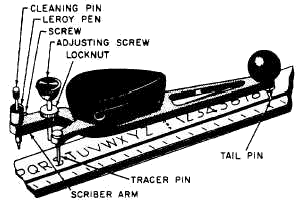
Leroy lettering requires a collection of templates and a small handheld instrument, the scriber. An inked letter is produced by the penholder on one side of the scriber as the metal stylus on the other side follows the grooves in the template positioned an inch below.
While scripting directly on the boards used for the finished art, Feldstein penciled in the copy in a system advantageous for Wroten, as Gaines explained: “He would take his six, seven or eight sheets of paper, because we had a formula—it was either an eight, seven or six-page story. He’d take a ruler, rule out the panels, he’d letter right into the panels, he’d hold his lettering three lines down so the letterer could read what he was lettering, because he used Leroy lettering with templates, and he had to leave room for the template.”
Since all Feldstein-edited books, over a period of years, featured Leroy lettering, readers assumed Feldstein chose to use Leroy lettering as the ideal adjunct to his clean, crisp art technique, but in 1975, he told interviewer Ed Spiegel (Fanfare #1, Spring 1977) that this choice was not his preference: “I inherited that. When I joined Bill, they were already using it. I think it was a mistake. Harvey didn’t want any part of Leroy. But the fellow who did it for us, Jim Wroten, had this whole family arrangement, and we didn’t have the heart to take it away from them. Jim and his wife did it. We published all those years with it, and I think it made the books appear a bit static. But there’s another angle to examine, and that’s whether the heavy captions I did would have been harder to read without it. It’s not easy to sustain good lettering over a whole paragraph.”
M.D. #1: Joe Orlando art with Wroten lettering.

He continued as a Keuffel & Esser salesman during World War II, exempt from military service because of his “confidential work for the government,” as she put it. Wroten Lettering began at the end of WWII when the couple, in 1945, joined William Moulton Marston (1893-1947) and others on the Wonder Woman team at 331 Madison Avenue.
“Jim quit Keuffel & Esser when we got our studio; he thought it would be a nice little business for the two of us to do together. Our studio was Doc Marston’s office. We were on the 12th floor. The art studio where Harry G. Peter worked was upstairs, right over us on the 13th floor. They had another artist, a girl named Arlene, who did backgrounds for him. Harry G. Peter was a nice old gentleman; he was just a nice person. We went out to Doc’s home several times, but after Doc died we never kept in touch with the rest of the family. He had an assistant who helped him write stories; her name was Joye Hummel. She married, and I think she’s down in Florida someplace.
Incredible Science Fiction #31: Wally Wood

Wroten Lettering’s list of clients boomed in the post-WWII years. “We worked on EC Comics. We worked on Hillman Comics. And Victor Fox—we worked on some of his too. We did charts, and we did lettering on some romance magazines at 500 Fifth. At one time we had some help, but mostly it was just my husband and myself. I liked working with him, and I happened to like Leroy lettering. I think it’s a very fine kind of lettering."
In addition to the comic books, the Wrotens also lettered for comic strips—Bert Whitman’s syndicated Debbie Dean (1942-48) and Stan MacGovern’s antic angle on human behavior, Silly Milly (1939-50), which had little syndication but appeared in the featured slot at the top of the New York Post’s comics page. In Sinclair Lewis’ novel Bethel Merriday (1940) a character leaving New York remarks that they won’t miss the city except for Silly Milly. Once toasted in a “Stan MacGovern Night” at Leon & Eddie’s nightclub, the talented MacGovern became one of the more curiously neglected cartoonists of the 20th Century because his popular Silly Milly was never seen nationally. He abandoned cartooning in the 1950s, opened an unsuccessful East Rockaway, Long Island gift shop, and then worked at a Long Island furniture store. He was 72 when he committed suicide in 1975.
With the advent of EC’s New Trend, the Wrotens often worked evenings and weekends to keep pace with the ever-increasing number of words per page. “When we went into the horror comics, heck, the lettering on the horror comics practically took up half the panels. All you were getting was heads, a lot of heads. When we first got into the business, a survey was taken that said the concentration span of a child was very limited—and they said 35 to 40 words a page. Those you could turn out in 15 or 20 minutes. Bill Gaines was paying $2.50 a page. I’d count the words sometimes and find 400 to 500 words on a page. That’s a lot of words. The average way it used to be when comics were first done was with 35, 40 or 50 words a page, and you could do a page in 15 to 25 minutes or half an hour, depending on the words.; 400 to 500 words a page would take an hour or so. When it got so terribly heavy, I think we just reduced the size of the template. We had to go down to a #140 template, I think, because you couldn’t use a #175 with all those words on a page.
“We got it done. We always got it done. We worked night and day on those things. Many nights we stayed until nine o’clock to get something out that they needed the next day. We delivered and picked up our own work. This way we knew it got there; I don’t believe in that messenger stuff. Whenever they would finish the stories, they would give us a call; we would come down, pick up the work, do the lettering and take it back to them when it was done. We tried to proof everything before we sent it down. If Bill found a mistake or made a change, he would mark it off in blue in the margin, and then we would just correct it. Sometimes when there would be changes or he would want to do something else, we would put them on little strips, cut them to fit and put them on with rubber cement.” (This created a problem for reprints many years later when the rubber cement dried, and the tiny strips fell off.)
This exchange of pick-ups and deliveries kept the Wrotens actively involved with EC, since the procedure often necessitated traveling downtown to EC’s office three or four times a week. The Wrotens saw the EC artists not only at the annual EC Christmas parties but also in the course of their work, since the deadline pace occasionally required the artists to go to 331 Madison. “We just had one big room. It was a small office, but it was large enough for three boards. If they didn’t finish something, or if they wanted to make a last-minute correction, they could do that. Once in a while they would stop in and pick up work from us. If they needed to make a correction, we had pens and ink they could use. This didn’t go on all the time. This was just if they wanted to to do something quick or change something. Lots of time they would even bring up the work. Jack Davis used to come in, and Wood came in. We always had an extra drawing board, and they could sit down and do whatever they wanted to do.
“Bill had very good artists. We always got comic books. I had loads and loads of them. I gave them away. I shouldn’t have, should I? The last comic books we did were for EC, and then Jimmy just got out of it. He went into doing charts, badge cards, formulas for chemical houses and floor plans for trade shows all over the country. We sublet part of the studio during the 1960s. I gave up the studio after he passed on six years ago.”
Labels: ec, feldstein, gaines, joe orlando, wroten
¶ 10:49 AM 3 comments
Tuesday, September 21, 2010

My design concept was to revive the inverted L of white space as seen on Galaxy Science Fiction and EC's Weird Science-Fantasy (see below) and Piracy. The splash of "Mars Is Heaven" not only had no balloons and captions, it had precisely the perfect proportions to fit into that cover layout. It also had strong storytelling with a psychological aspect of anticipation, as if the spacemen are waiting for the reader to turn to the first page. The panel was unusual in that almost all EC splash panels contained balloons and captions.
Truncated to become a Comics Journal cover, the image never made it onto the book. Instead, the cover that was used on Against the Grain was created by Roger Hill and John Morrow without my knowledge and never seen by me in advance. If they had shown it to me, I would have argued against it, because it may be one of the weakest covers Wood ever did in terms of action and storytelling. There is no anticipation. Spacemen have landed. So what?


Labels: against the grain, ec, wood
¶ 10:25 PM 7 comments
Sunday, August 29, 2010
Three versions of Wood's Weird Science 14 cover: the original art, the EC printed version and Wood's 1978 painted version as it appeared on the cover of Against the Grain (2003). Plus a bonus of the Grain back cover.


Labels: ec, weird science, wood
¶ 1:17 PM 0 comments
Thursday, July 29, 2010
The EC gang


Mad #8 (December 1953)


EC staffers as drawn by Jack Davis


Note how Special USA rearranged elements in the "Bat Boy and Rubin!" splash
Mad #8 (December 1953)

EC staffers as drawn by Joe Orlando (Panic #1, February 1954)

Wally Wood, Bernard Krigstein, Harvey Kurtzman in photo by E.B. Boatner from Squa Tront

Labels: ec, joe orlando, wood
¶ 9:53 AM 2 comments