Potrzebie
Wednesday, March 21, 2012


When I published The EC Fan Bulletin in 1953, Bill Gaines probably expected something a bit more classy. He realized it could be done better, so he did a slight upgrade on my title and began planning his EC Fan-Addict Bulletin. Perhaps anticipating my reaction to seeing my publication and title co-opted, overwhelmed and subsumed, he appointed me Contributing Editor. His ploy worked, and I congratulated myself on this amazing turn of events. I was no longer just EC Fan-Addict #503.


Labels: bill gaines, ec, wood
¶ 6:14 PM 1 comments
Sunday, March 11, 2012


The Mad staff in 1963 (clockwise): publisher Bill Gaines, contributing editor Nick Meglin, art director John Putnam, editor Al Feldstein, Leonard Brenner (production), Nelson Tirado (subscriptions) and associate editor Jerry DeFuccio.


When I edited the Mad Style Guide in 1994, I gave George Woodbridge the assignment of illustrating the Mad Zeppelin. The notion was to facilitate any company that might choose to manufacture a model kit. Previous depictions in the magazine were too sketchy or lacking in smaller features. Woodbridge delivered these drawings showing the Zeppelin from four different angles, so detailed that it even includes the nearby curious bird from two angles. The page also includes Harvey Kurtzman's hand with six fingers. As I recall, Kurtzman was disappointed that no letters arrived from readers who noticed the extra finger.
Labels: bill gaines, jack davis, mad, mad style guide, woodbridge
¶ 10:31 AM 1 comments
Thursday, August 11, 2011
Bill Gaines in the Statue of Liberty's arm
.
Annie Gaines took this photo of Bill Gaines stuck inside the arm of the Statue of Liberty. Only DeBartolo and Annie Gaines made it all the way to the torch balcony. However, being atop the torch platform, rocking gently in the wind, was so terrifying that they stayed less than a minute.
In his book Good Days and Mad, DeBartolo described how all three traveled one night to Liberty Island in DeBartolo's boat and then made the climb. This photo is part of a Life.com slide show on Mad which you can see here. Since the arm was closed to tourists, how did DeBartolo pull this off? He explains how he made the connection here.

Mad editor John Ficarra recalled: "This is Bill stuck in the Statue of Liberty. He was a huge Statue of Liberty fan. In fact, he owned the world's premiere collection of Statue of Liberty paraphernalia. He owned the original molds by Bartholdi. Dick DeBartolo talked to the guy who was the night watchmen at the statue and arranged for a group to have a private night tour. Bill had some trouble on those narrow stairs. The weird thing? I think that jacket he's wearing in the picture is the jacket he wore the day he died. He was not noted for his haberdashery."
Between 1876 and 1882, the Statue of Liberty arm was in Madison Square Park for fund-raising to complete the Statue. Anyone could pay 50 cents to climb to the torch balcony.


Labels: bill gaines, debartolo, mad
¶ 9:15 AM 1 comments
Friday, March 06, 2009
Topps #1: Dick Tracy wallpaper
 .
Dick Tracy wallpaper? Yes, this was marketed in 1950 by the Niagara Wallpaper Company. It was intended for a children's room, which explains why none of the strip's famed villains are evident.
During the time I was doing product development at Topps Chewing Gum in the late 1960s, I was also working on the Nostalgia Press book collection of EC Comics, prompting visits to the Mad offices for several meetings with publisher Bill Gaines. The more conspicuous item among the oddities in his office was a fake window. It contained a life-size head of King Kong (sculpted by Sergio Aragones) looking through the window frame at Gaines.
Back at Topps in Brooklyn, I thought about the Kong window and wondered how something similar could be done as a Topps product. For its humorous posters, Topps used a newsprint paper stock that folded several times down to their standard small trading card package size. The visual concept I pitched was King Kong Wallpaper, a product which would use such newsprint posters to make giant-size b/w jigsaw puzzle pieces that could be collected and assembled to fill one entire wall of a kid's room. A single image of Kong could then loom in an immense fashion to give nightmares. Kids would love it; it would be the mothers who had the nightmares of Elmer's Glue all over the wall.
At Topps, puzzle pieces were considered the "B" side on a trading card, on the theory that no one wants to purchase individual jigsaw puzzle pieces. So my idea was shot down with the somewhat illogical question, "What's on the other side?" In retrospect, the solution would have been to simply package the folded newsprint puzzle posters with some colorful trading card item.
Maybe something similar happened at the Niagara Wallpaper Company. Someone thought how cool it would be to see a roomful of weird and outrageous Dick Tracy villains. Then some executive stepped in to get rid of the villains, making the final wallpaper bland and banal.
Labels: aragones, bill gaines, brooklyn, chester gould, dick tracy, king kong, mad, topps
¶ 6:27 AM 0 comments
Monday, March 02, 2009
Patrissy's #2


Patrissy's opened in 1906, and eight decades later Danny Patrissy sold his restaurant to Arnold Magliaccio in 1995. It became NoLita's (a portmanteau since 1994 from "North of Little Italy") when it was taken over by Nicholas Barnes in 2000.


Patrissy's restaurant with "authentic Neapolitan cuisine" is gone, but Marie Severin's 2004 drawing (for Grant Geissman's Foul Play) recreates the high-spirited atmosphere over a half-century ago when the EC Comics staff went around the corner to 98 Kenmare for lunch at Patrissy's. The old-style telephone exchange, CAnal 6, appears beneath the logo design depicting the restaurant exterior with an overhead awning at the entrance. Below is the ultimate EC collectible, a Patrissy's ashtray.


In this early 1950s photo, Bill Gaines and Al Feldstein lunch at Patrissy's after spending the morning at 225 Lafayette Street creating EC stories. Patrissy's is mentioned in Frank Jacobs' The Mad World of William M. Gaines (1972) and Digby Diehl's Tales from the Crypt: The Official Archives (1996). "We'd plot in the morning, then go to Patrissy's, the local Italian restaurant," remembered Feldstein. "We'd gorge ourselves on spaghetti and manicotti and bread. I got fat. In a very short time I ballooned from 150 to 180." Feldstein soon chose to have melba toast and cottage cheese at the office instead of scanning the Patrissy's menu daily.


In this early 1950s photo, Bill Gaines and Al Feldstein lunch at Patrissy's after spending the morning at 225 Lafayette Street creating EC stories. Patrissy's is mentioned in Frank Jacobs' The Mad World of William M. Gaines (1972) and Digby Diehl's Tales from the Crypt: The Official Archives (1996). "We'd plot in the morning, then go to Patrissy's, the local Italian restaurant," remembered Feldstein. "We'd gorge ourselves on spaghetti and manicotti and bread. I got fat. In a very short time I ballooned from 150 to 180." Feldstein soon chose to have melba toast and cottage cheese at the office instead of scanning the Patrissy's menu daily.

Patrissy's opened in 1906, and eight decades later Danny Patrissy sold his restaurant to Arnold Magliaccio in 1995. It became NoLita's (a portmanteau since 1994 from "North of Little Italy") when it was taken over by Nicholas Barnes in 2000.
Labels: bill gaines, ec, feldstein, grant geissman, nolita, patrissy's, severin
¶ 7:51 PM 3 comments
Thursday, June 26, 2008
Frank Jacobs' "Hooray for Wally Wood!" Remix
 Lyrics © Frank Jacobs. Art © EC Publications.
Johnny Mercer and Richard A. Whiting teamed in 1937 to compose "Hooray for Hollywood," sung by Johnnie "Scat" Davis (1910-1983) in Busby Berkeley's Hollywood Hotel (1938). The song became a familiar standard, receiving an ASCAP award in 1987 in the "Most Performed Feature Film Standards on TV" category.
Over four decades ago, Mad writer Frank Jacobs wrote the satirical song "Hooray for Wally Wood!" not long after Bill Gaines took the Mad artists and staff on a vacation trip to the Virgin Islands. To thank the publisher for the trip, two shows were created by Mad's writers (Jacobs, Nick Meglin, Stan Hart, Larry Siegel) and staged in Gaines' Manhattan apartment. "Hooray for Wally Wood!" was sung by Jacobs at the first of these two shows.
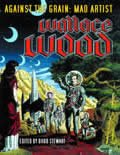
Meglin recalled, "Afterwards, any time Wally came in with a job, Bill would sing the first line." Grant Geissman transcribed Jacobs' lyrics from the original early 1960s tape recordings. The lyrics were published for the first time in Against the Grain (2003) when designer Greg Sadowski dropped them into the final panel of "The Mad 'Comic' Opera" by Jacobs and Wood from Mad 56 (July 1960).
Labels: bill gaines, busby berkeley, frank jacobs, grant geissman, greg sadowski, johnny mercer, mad, nick meglin, wood
¶ 10:39 PM 0 comments
Saturday, March 01, 2008
Ghoulishly Yours
 With the recent press release announcement about a forthcoming film biography of Bill Gaines, Ghoulishly Yours, William M. Gaines, one can speculate on the casting of EC staffers and how they will be depicted. In this Wally Wood drawing from "EC Confidential!" (Weird Science 21, September-October 1953), we see (l to r) most of the EC crew: Jack Kamen, Joe Orlando, Johnny Craig, Harvey Kurtzman, Graham Ingels, Al Feldstein, Bill Gaines, Wally Wood, Al Williamson, Jack Davis, Bill Elder, John Severin and George Evans. Missing from the line-up here are Bernard Krigstein, Reed Crandall, Frank Frazetta and Roy Krenkel. EC colorist Marie Severin (sister of John Severin) is seen at far left. The other women who worked in the EC offices were Gloria Orlando (married to Joe Orlando in 1951), Nancy Siegel (married to Gaines in 1955) and receptionist Shirley Norris. Tatjana Weintraub (married to Wally Wood in 1950) was an uncredited artist on some EC pages. Here's the 2/14 press release about the movie:
 Feldstein has signed on as the Creative Consultant of Ghoulishly Yours, William M. Gaines. In this photograph from the early 1950s, Gaines and Feldstein take a lunch break after spending the morning at 225 Lafayette Street writing and proofreading EC Comics. Cartoonist Vince Musacchia (see link at right) notes the photo was probably taken inside Patrissy's Restaurant, located in Little Italy at 98 Kenmare Street, just around the corner from 225 Lafayette Street, and indeed, Patrissy's is mentioned in both Frank Jacobs' The Mad World of William M. Gaines (Lyle Stuart, 1972) and Digby Diehl's Tales from the Crypt: The Official Archives (St. Martin's, 1996). "We'd plot in the morning, then go to Patrissy's, the local Italian restaurant," remembered Feldstein. "We'd gorge ourselves on spaghetti and manicotti and bread. I got fat. In a very short time I ballooned from 150 to 180." Feldstein soon chose to have melba toast and cottage cheese at the office instead of scanning the Patrissy's menu daily. Patrissy's opened in 1906, and eight decades later Danny Patrissy sold his restaurant to Arnold Magliaccio in 1995. It became NoLita's (a portmanteau since 1994 from "North of Little Italy") when it was taken over by Nicholas Barnes in 2000. So we are looking at a photo of the restaurant where EC stories were discussed and developed, leading to the question: Will Patrissy's be recreated for the movie?
Frank Jacobs' book was in the hopper for a film adaptation by HBO, as Jacobs recalled in 2006:


Where did people go for fantastic tales before EC Comics? Click heading above to hear five 1948-49 episodes of Wyllis Cooper's Quiet Please.
©WMG
 With the recent press release announcement about a forthcoming film biography of Bill Gaines, Ghoulishly Yours, William M. Gaines, one can speculate on the casting of EC staffers and how they will be depicted. In this Wally Wood drawing from "EC Confidential!" (Weird Science 21, September-October 1953), we see (l to r) most of the EC crew: Jack Kamen, Joe Orlando, Johnny Craig, Harvey Kurtzman, Graham Ingels, Al Feldstein, Bill Gaines, Wally Wood, Al Williamson, Jack Davis, Bill Elder, John Severin and George Evans. Missing from the line-up here are Bernard Krigstein, Reed Crandall, Frank Frazetta and Roy Krenkel. EC colorist Marie Severin (sister of John Severin) is seen at far left. The other women who worked in the EC offices were Gloria Orlando (married to Joe Orlando in 1951), Nancy Siegel (married to Gaines in 1955) and receptionist Shirley Norris. Tatjana Weintraub (married to Wally Wood in 1950) was an uncredited artist on some EC pages. Here's the 2/14 press release about the movie:
John Landis (National Lampoon's Animal House, The Blues Brothers, Masters of Horror) has been attached to direct the authorized feature biopic, Ghoulishly Yours, William M. Gaines. Landis will develop the project with Joel Eisenberg, who is penning the screenplay based on the life of the titular EC Comics' publisher (Tales from The Crypt, Mad). Pic will revolve around the banding together of an anti-establishment group of artists and writers, led by a reluctant Gaines and cohort Al Feldstein, as they produce their controversial yet hugely popular line of comic books. At the peak of his success Gaines becomes an unwitting First Amendment figurehead, defending his livelihood against the U.S. government amidst accusations of perpetuating juvenile delinquency. Landis most recently helmed Mr. Warmth: The Don Rickles Project for HBO. Eisenberg is a partner in production concern EMO Films, LLC with Tim Owens and Eugene Mandelcorn. Project is authorized by William M. Gaines Agent, Inc.
 Feldstein has signed on as the Creative Consultant of Ghoulishly Yours, William M. Gaines. In this photograph from the early 1950s, Gaines and Feldstein take a lunch break after spending the morning at 225 Lafayette Street writing and proofreading EC Comics. Cartoonist Vince Musacchia (see link at right) notes the photo was probably taken inside Patrissy's Restaurant, located in Little Italy at 98 Kenmare Street, just around the corner from 225 Lafayette Street, and indeed, Patrissy's is mentioned in both Frank Jacobs' The Mad World of William M. Gaines (Lyle Stuart, 1972) and Digby Diehl's Tales from the Crypt: The Official Archives (St. Martin's, 1996). "We'd plot in the morning, then go to Patrissy's, the local Italian restaurant," remembered Feldstein. "We'd gorge ourselves on spaghetti and manicotti and bread. I got fat. In a very short time I ballooned from 150 to 180." Feldstein soon chose to have melba toast and cottage cheese at the office instead of scanning the Patrissy's menu daily. Patrissy's opened in 1906, and eight decades later Danny Patrissy sold his restaurant to Arnold Magliaccio in 1995. It became NoLita's (a portmanteau since 1994 from "North of Little Italy") when it was taken over by Nicholas Barnes in 2000. So we are looking at a photo of the restaurant where EC stories were discussed and developed, leading to the question: Will Patrissy's be recreated for the movie?
Frank Jacobs' book was in the hopper for a film adaptation by HBO, as Jacobs recalled in 2006:

My book, The Mad World of William M. Gaines, was optioned six years ago by HBO. They held onto it for five years, then Fox/Searchlight productions, a division of Fox, took over, and now they’re finding that they don’t have enough in their budget for the film we want. So now it looks like Fox is selling the rights to another studio. I don’t know where it’s at right now, but I’m still waiting for the movie to be made. And it (the book) still has a good cult following, which pleases me. I get nice comments about it from time to time. So far as Oliver Platt goes, he seemed the choice early on. It had to be a young actor who was portly, who could pass for Bill Gaines because the script of the movie starts with Bill Gaines coming in knowing nothing, developing EC, and coming up with the horror comics. It covers the whole horror period, and the script ends with Mad becoming a success. It also covers the Harvey Kurtzman incident, you know, when Harvey demanded 51 percent, couldn’t get it, and Feldstein took over.

Patrissy's also figures into David Hajdu's new book, The Ten-Cent Plague: The Great Comic-Book Scare and How It Changed America, published this month (3/18) by Farrar, Straus and Giroux. With impeccable research, Hajdu covers reactions to comic books in the 1950s, the impact of Fredric Wertham, Gaines' confrontation with the Kefauver committee and other events we might expect to eventually see dramatized in Ghoulishly Yours. To write this detailed, authoritative overview, Hajdu spent six years interviewing over 150 comic book artists, writers, editors and publishers. The bibliographic notes alone fill 62 pages. An appendix includes the names of hundreds of artists, writers and others "who never again worked in comics after the purge of the 1950s." Surpassing past accounts, this is the definitive history of the comic book controversy and all levels of those involved, from censors to readers.
The clip below shows Bill Gaines and Mad writer Dick DeBartolo on To Tell the Truth in 1973. DeBartolo was a writer for Match Game and other game shows. During the early 1960s he invited Match Game guests to go on the roof where they performed in DeBartolo's 8mm films. He once had a showing of these films in a Manhattan hotel ballroom.
Labels: bill gaines, debartolo, ec, feldstein, frank jacobs, hajdu, patrissy's, wertham
¶ 4:06 AM 12 comments
Saturday, October 20, 2007
EC Comics: From Here to Nudity
 A native of India, Fershid Bharucha became a French citizen, notable as an artist, editor, translator and publisher in France, where he introduced Europeans to American artists in his USA Special magazine and also published hardcover French albums with comics by Will Eisner, Rand Holmes, Shary Flenniken, Mark Schultz, Bernie Wrightson and others. His own artwork was in early issues of the Hot Stuf ' and Bizarre Sex undergrounds. I came in contact with Fershid through a curious sequence of events.
When I learned that a graphic story I had scripted and packaged for Heavy Metal had been reprinted in Europe, I contacted Heavy Metal to get additional payment for myself and the artists involved. The rates at Heavy Metal were so high that I didn't expect any problem in getting a check for their resale. However, I was taken aback by the magazine's curious response, which came down to, "Prove it." Apparently this was because no records were kept when stacks of materials were shipped to France. It seemed pointless to get into an argument over such a matter, so playing by their rules, I wrote to Fershid who gladly sent me some copies of USA Special with the full-color story. I passed a copy along to Heavy Metal with a bill, and eventually we did get paid.
 When work on Against the Grain got underway in 1985, Fershid sent me some photocopies of Wally Wood art from his files. This included an odd, unlabeled inked drawing by Wood showing a man talking to a nude woman standing in front of his desk. Attached was a note from Fershid: "Woody rendered this panel on an EC page. Gaines didn't think it was funny. I don't know what story it's from. Do you?" It had a certain familiar feeling to it, and I began turning pages in Weird Science and Weird Science-Fantasy. It didn’t take more than a few minutes to spot it as identical to the layout and characters in panel six, page five of Wood's story "The Children" in Weird Science-Fantasy #23 (March, 1954), about the mutated children of space colonists.
 As discussed in past interviews, pranks at EC often involved hoax art never intended to be published. On several occasions, Wood brought in finished art with fake pasteovers on top of panels, calculated to surprise someone in the office and trigger a laugh. Interviewed in Bill Spicer's Graphic Story Magazine, Harry Harrison recalled, "We did two or three stories which gave us some laughs monkeying around with the artwork, mainly to relieve us from the boredom of having to illustrate lousy scripts. One was on a story called “Playtime Cowgirl” for an EC Western romance (Saddle Romances 11, March-April 1950). We brought the thing in originally with a big dong in the horse’s crotch, about four feet long, circumcised with crabs, real crabs and lobsters hanging from it, spider webs, Band-Aids all over it. Turned it in to Gaines, who loved it and kept it to show to his advertising man, Lyle Stuart. They showed it around; then forgot about it. Finally, it went to the engraver where they took black plates of it, then proofs, which got as far as the colorist, who was the one who caught it. ‘Mr. Gaines, isn’t this kind of a funny-looking horse?’ Gaines screamed to think it could get so close to going through. We just painted it out. They reshot the black plate, but it almost got by. Another one was also in the romance comics. They always had some title like ‘She Married a Man Who Gave Her No Love,’ which we changed to ‘She Married a Man With No Balls At All’ and pasted it over the real title. Stuck a lot of baseballs and footballs around the artwork, which could be peeled off. We’d sit around in the studio and think of ways to liven up the stories this way.”
 I stared at the page and the pasteover and realized this was a rare opportunity to see one of the long lost EC prank pages from decades earlier. With minimal effort I could reconstruct the way the panel looked in 1954. I went to a copy shop and sized the two elements to match. When I pasted them together, it was a perfect fit, requiring virtually no retouching, even though the background was different and the foreground figure was a silhouette in the original. So there it was: a restoration of the page as it appeared on the day Wood, anticipating hilarity, walked into the EC offices and pulled the finished inked story from his portfolio. I viewed this as a significant discovery, so the recreation page was included in the stack of artwork I wanted to include in Against the Grain.
 As designer Greg Sadowski and I worked on the book, we became aware of the full extent of censorship executed on both language and images by prudish publisher John Morrow. To his credit, Morrow far outstrips many publishers in accurate accountings and immediate payments to creators. But in terms of censorship, it was as though decades had never passed, leaving Morrow with a retro view akin to the attitudes of mid-century Midwestern small towns. I had agreed to the censorship because I wanted to see the book published after years of waiting. (Fantagraphics had originally commissioned the book but did not move to print it. When ten years passed, I asked them to return it to me.)
Greg was so surprised by the censorship that he did not even really believe it was true. Once he got past his initial disbelief, he was forced to go through the book, yank certain pictures and insert replacements. It seemed important, however, to retain the page from "The Children," but that would require masking parts from the panel. Should we use black bars? White bars? Greg's solution was simply to white out three spots on the figure.
In retrospect, I should have just deleted the entire page from the book, because the imposed restraints sabotaged the situation. The caption explained it was a restoration, but the alteration to remove body parts from a previous alteration left some readers scratching their heads in complete confusion. They read the caption, looked at the panel but were baffled by the image of a nude turned into a non-nude, a riddle wrapped in a paler shade of enigmatic whiteness.
So this Potrzebie presentation is aimed at banishing bewilderment with a comparison of the various elements: the original EC panel, the EC prank panel and the page from the past.
©2007 WMG and Wallace Wood Estate
 A native of India, Fershid Bharucha became a French citizen, notable as an artist, editor, translator and publisher in France, where he introduced Europeans to American artists in his USA Special magazine and also published hardcover French albums with comics by Will Eisner, Rand Holmes, Shary Flenniken, Mark Schultz, Bernie Wrightson and others. His own artwork was in early issues of the Hot Stuf ' and Bizarre Sex undergrounds. I came in contact with Fershid through a curious sequence of events.
When I learned that a graphic story I had scripted and packaged for Heavy Metal had been reprinted in Europe, I contacted Heavy Metal to get additional payment for myself and the artists involved. The rates at Heavy Metal were so high that I didn't expect any problem in getting a check for their resale. However, I was taken aback by the magazine's curious response, which came down to, "Prove it." Apparently this was because no records were kept when stacks of materials were shipped to France. It seemed pointless to get into an argument over such a matter, so playing by their rules, I wrote to Fershid who gladly sent me some copies of USA Special with the full-color story. I passed a copy along to Heavy Metal with a bill, and eventually we did get paid.
 When work on Against the Grain got underway in 1985, Fershid sent me some photocopies of Wally Wood art from his files. This included an odd, unlabeled inked drawing by Wood showing a man talking to a nude woman standing in front of his desk. Attached was a note from Fershid: "Woody rendered this panel on an EC page. Gaines didn't think it was funny. I don't know what story it's from. Do you?" It had a certain familiar feeling to it, and I began turning pages in Weird Science and Weird Science-Fantasy. It didn’t take more than a few minutes to spot it as identical to the layout and characters in panel six, page five of Wood's story "The Children" in Weird Science-Fantasy #23 (March, 1954), about the mutated children of space colonists.
 As discussed in past interviews, pranks at EC often involved hoax art never intended to be published. On several occasions, Wood brought in finished art with fake pasteovers on top of panels, calculated to surprise someone in the office and trigger a laugh. Interviewed in Bill Spicer's Graphic Story Magazine, Harry Harrison recalled, "We did two or three stories which gave us some laughs monkeying around with the artwork, mainly to relieve us from the boredom of having to illustrate lousy scripts. One was on a story called “Playtime Cowgirl” for an EC Western romance (Saddle Romances 11, March-April 1950). We brought the thing in originally with a big dong in the horse’s crotch, about four feet long, circumcised with crabs, real crabs and lobsters hanging from it, spider webs, Band-Aids all over it. Turned it in to Gaines, who loved it and kept it to show to his advertising man, Lyle Stuart. They showed it around; then forgot about it. Finally, it went to the engraver where they took black plates of it, then proofs, which got as far as the colorist, who was the one who caught it. ‘Mr. Gaines, isn’t this kind of a funny-looking horse?’ Gaines screamed to think it could get so close to going through. We just painted it out. They reshot the black plate, but it almost got by. Another one was also in the romance comics. They always had some title like ‘She Married a Man Who Gave Her No Love,’ which we changed to ‘She Married a Man With No Balls At All’ and pasted it over the real title. Stuck a lot of baseballs and footballs around the artwork, which could be peeled off. We’d sit around in the studio and think of ways to liven up the stories this way.”
 I stared at the page and the pasteover and realized this was a rare opportunity to see one of the long lost EC prank pages from decades earlier. With minimal effort I could reconstruct the way the panel looked in 1954. I went to a copy shop and sized the two elements to match. When I pasted them together, it was a perfect fit, requiring virtually no retouching, even though the background was different and the foreground figure was a silhouette in the original. So there it was: a restoration of the page as it appeared on the day Wood, anticipating hilarity, walked into the EC offices and pulled the finished inked story from his portfolio. I viewed this as a significant discovery, so the recreation page was included in the stack of artwork I wanted to include in Against the Grain.
 As designer Greg Sadowski and I worked on the book, we became aware of the full extent of censorship executed on both language and images by prudish publisher John Morrow. To his credit, Morrow far outstrips many publishers in accurate accountings and immediate payments to creators. But in terms of censorship, it was as though decades had never passed, leaving Morrow with a retro view akin to the attitudes of mid-century Midwestern small towns. I had agreed to the censorship because I wanted to see the book published after years of waiting. (Fantagraphics had originally commissioned the book but did not move to print it. When ten years passed, I asked them to return it to me.)
Greg was so surprised by the censorship that he did not even really believe it was true. Once he got past his initial disbelief, he was forced to go through the book, yank certain pictures and insert replacements. It seemed important, however, to retain the page from "The Children," but that would require masking parts from the panel. Should we use black bars? White bars? Greg's solution was simply to white out three spots on the figure.
In retrospect, I should have just deleted the entire page from the book, because the imposed restraints sabotaged the situation. The caption explained it was a restoration, but the alteration to remove body parts from a previous alteration left some readers scratching their heads in complete confusion. They read the caption, looked at the panel but were baffled by the image of a nude turned into a non-nude, a riddle wrapped in a paler shade of enigmatic whiteness.
So this Potrzebie presentation is aimed at banishing bewilderment with a comparison of the various elements: the original EC panel, the EC prank panel and the page from the past.
Labels: against the grain, bill gaines, ec, fershid, greg sadowski, harry harrison, heavy metal, lyle stuart, memoir, nudity, prank, severin, spicer, wood, wood chips
¶ 12:29 PM 0 comments