Potrzebie
Friday, May 18, 2012
Cartoon summit webcast begins tonight at 6pm. Go here.
Click here for participants and schedule.


Click here for participants and schedule.
Labels: comics
¶ 9:12 AM 0 comments
Sunday, May 16, 2010
Manga in Moscow
 Russia's Winzavod, the Moscow Centre for Contemporary Art, is a 215,000-square-foot exhibition area in an industrial section behind the Kursk Railroad Station. It opened in 2007. For the history of Winzavod, going back to its 1889 origin as a winery, go here.
In May, Winzavod staged one of Europe's largest comics festivals, including an exhibit of comics from America, Argentina, Germany, Italy, Japan, South Korea, Poland and Russia.
Festival coordinator Anastasia Grabakh appears in this video of the exhibition by Anton Murad, who has a genuine flair for skillfully editing his footage.


In May, Winzavod staged one of Europe's largest comics festivals, including an exhibit of comics from America, Argentina, Germany, Italy, Japan, South Korea, Poland and Russia.
Festival coordinator Anastasia Grabakh appears in this video of the exhibition by Anton Murad, who has a genuine flair for skillfully editing his footage.

Labels: comics, grabakh, kursk, moscow, murad, russia, winzavod
¶ 6:09 PM 0 comments
Saturday, July 11, 2009
Hero Initiative

The Hero Initiative is the first-ever federally chartered not-for-profit corporation dedicated strictly to helping comic book creators in need. It creates a financial safety net for comic creators who may need emergency medical aid, financial support for essentials of life and a path back into the comics field. Since it launched in 2000, the Hero Initiative has benefited 40+ creators and their families with more than $400,000 worth of aid and assists.
Here's an excerpt from John Horn's article on the Hero Initiative in today's Los Angeles Times:

A recent Ralph Reese page for DC's revived House of Mystery (May 2009).

The Hero Initiative is the first-ever federally chartered not-for-profit corporation dedicated strictly to helping comic book creators in need. It creates a financial safety net for comic creators who may need emergency medical aid, financial support for essentials of life and a path back into the comics field. Since it launched in 2000, the Hero Initiative has benefited 40+ creators and their families with more than $400,000 worth of aid and assists.
Here's an excerpt from John Horn's article on the Hero Initiative in today's Los Angeles Times:
Gene Colan, a renowned artist best known for his work on Batman, Daredevil and The Tomb of Dracula, said that like many freelancers in comics he usually worked without insurance and retirement coverage. "There was very little support -- there was nothing in terms of benefits," Colan said from Brooklyn. "Artists have always been oblivious to this kind of stuff -- all we needed was enough to support our families." That changed, however, when Colan's health began failing 10 years ago. In addition to suffering a heart attack, the 83-year-old artist had glaucoma and then liver disease.
"I looked like a prisoner of war," he said of losing 40 pounds to his illnesses. He had some insurance, he said, "but it couldn't possibly cover what I needed." Gifts of several thousand dollars from Hero Initiative to Colan and his wife, Colan said, "helped pull the two of us out of a big mess."
Bill Messner-Loebs was in an even deeper hole. A writer and illustrator whose credits include The Flash and Wonder Woman, Messner-Loebs and his wife lost their home to foreclosure in 2001, and after another housing setback were moving from cheap motel room to cheap motel room. Soon thereafter, essentially homeless, the couple was living in various Michigan church shelters for weeks at a time.
"In the midst of all of this, I was contacted by the Hero Initiative, and they gave us money a couple of times to pay for some hotel stays and build up our savings," the 60-year-old Messner-Loebs said from Brighton, Mich. The organization was also able to drum up some work for Messner-Loebs, who said he is now working on a "secret project" for DC Comics. "We are doing much better than we were before," he said. "But I really can't imagine where I'd be without their help."
Ralph Reese, an illustrator for National Lampoon and Mad magazine and the Flash Gordon and Magnus, Robot Fighter comics, worked steadily until the comic book business consolidated in the 1990s. "I had nothing -- there was no retirement plan, no pension, no healthcare benefits. That's the life of a freelancer," the 60-year-old Reese said from Staten Island, N.Y. "After 30 years in the business, I couldn't get any work. I had a wife, a six-year-old daughter, and I eventually had to go out and drive trucks to make ends meet."
By 2005, Reese could no longer work because of a back injury, and his unemployment benefits didn't cover his medical bills. On welfare, Reese said he couldn't afford his prescription drugs or doctor visits. A $3,600 gift from Hero Initiative has allowed Reese to enroll in Medicaid. "I dedicated my life to something that ultimately didn't pay off and left me high and dry," Reese said. To supplement (and pay for) its grants to artists in need (Hero Initiative handed out some $40,000 in June alone, president McLauchlin said), the nonprofit conducts regular live and online auctions of donated artwork, some from the strapped artists needing help (there are works from Reese now for sale).
The organization also helps curate tribute books, for which active illustrators contribute artwork to honor a specific artist in financial distress. The next such book, focused on Green Arrow and Batman writer and artist Ed Hannigan, is due in December and its proceeds will go to the 58-year-old Hannigan, who has multiple sclerosis.

Labels: bill messner-loebs, comic books, comics, dc comics, ed hannigan, gene colan, hero initiative, ralph reese
¶ 3:11 PM 4 comments
Sunday, October 05, 2008
Wood Chips 5

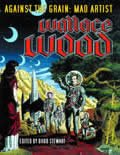
Here are panels and sketches of Wood's Weegie and Dimentius, odd fantasy characters he created in the mid-1940s. He later drew them into a six-page story titled "Weegie". (See full story in Against the Grain.) The two panels at bottom were redrawn into the last page of that story. Click to enlarge the similar panels extracted from the end of the story.
Should the wild "Weegie" be considered a precursor to underground comics? The freeform, free associative dialogue and captions raise a question: If Wood had not been forced to work within the conventions and restraints of the commercial comic book industry, where would his imagination have taken him during the 1950s?


Here are panels and sketches of Wood's Weegie and Dimentius, odd fantasy characters he created in the mid-1940s. He later drew them into a six-page story titled "Weegie". (See full story in Against the Grain.) The two panels at bottom were redrawn into the last page of that story. Click to enlarge the similar panels extracted from the end of the story.
Exactly why Wood drew and inked these panels twice remains a mystery. Judging by his newfound lettering skills and professional polish, the "Weegie" story could have been done for a class assignment at Burne Hogarth's Cartoonists & Illustrators School or possibly created as a sample shortly after he left Hogarth's School. A classroom situation might explain why the panels were redrawn.
Should the wild "Weegie" be considered a precursor to underground comics? The freeform, free associative dialogue and captions raise a question: If Wood had not been forced to work within the conventions and restraints of the commercial comic book industry, where would his imagination have taken him during the 1950s?


Labels: against the grain, burne hogarth, comics, dimentius, weegie, wood, wood chips
¶ 8:07 AM 0 comments
Friday, May 09, 2008
Ripley Redux
Control click heading to hear excerpt from the audiobook of Patricia Highsmith's The Talented Mr. Ripley (1955) read by Michael Hayden.
This is a scene from Purple Noon (1960), adapted from Patricia Highsmith's The Talented Mr. Ripley. Below is the scene recreated for an advertising campaign by the South Korean firm Polham.


From 1942 to 1948, Highsmith scripted for comic books. She talks about her work for comic book publishers in this 1987 interview. Having left the field, she got in a nice jab at the comics world in The Talented Mr. Ripley when Ripley phones comic book artist Frederick Reddington (pages 14-16): "Tom had a hunch about Reddington. He was a comic-book artist. He probably didn't know whether he was coming or going."


From 1942 to 1948, Highsmith scripted for comic books. She talks about her work for comic book publishers in this 1987 interview. Having left the field, she got in a nice jab at the comics world in The Talented Mr. Ripley when Ripley phones comic book artist Frederick Reddington (pages 14-16): "Tom had a hunch about Reddington. He was a comic-book artist. He probably didn't know whether he was coming or going."
Labels: comics, highsmith, melvyn bragg, novel, reddington, ripley
¶ 6:21 AM 0 comments